The career center is usually where a student goes to find somebody willing to hire them. Susan Amat helped turn one into a place where students could consider hiring themselves. At the University of Miami, The Launch Pad offered a practical invitation: bring the business idea, find some help, and see whether it could survive contact with the world outside campus. Failure could be part of the education. For a university, that was an interesting addition to the prospectus.
Amat had already spent years on the other side of that invitation. She started her first business at 15 and worked in entertainment before returning to university. She knew that wanting to make something and knowing how to run a business were separate problems. Much of her subsequent career has occupied the space between them.
That space now includes Venture Hive, the company she founded in Miami, and software for the people who organize entrepreneurship programs. It reaches into international startup education, too. Yet the story is easiest to understand at human scale: a person has an idea, encounters something they cannot do, and needs more than a round of applause.
The business side of being in a band
Her early customers were close at hand. Friends had bands. The practical requirements of performing and releasing music needed attention. Amat stepped into the business side. The teenager’s work grew into a media career that included a record label, a CD-ROM magazine, and a television show. Before entrepreneurship became her subject, it was her occupation.
There is a pleasing lack of ceremony about that beginning. A band can have talent and still need someone to arrange the less musical parts of its existence. Business enters through the side door, carrying a list of things somebody has to organize. Amat’s later work would return repeatedly to that gap between creative intention and practical capability.
She also remembers an earlier introduction to selling: fruit and lemonade outside her house. Making signs and engaging customers were part of the pleasure. She described herself as “being a ham.” The enjoyment was in the encounter, as well as the sale. A customer was someone to interest, persuade, and understand.
University eventually gave this practical experience a formal structure. Amat earned a Bachelor of Liberal Arts at Miami in 2001, an MBA in 2004, and a doctorate in 2008. Her field was strategic entrepreneurship. Industrial engineering, business, and education all figured in her doctoral training, a combination suited to someone interested in how people and organizations actually work.
A career center with another answer
In 2008, Amat co-founded The Launch Pad with William Scott Green. Its home was the university’s Toppel Career Center. That placement carried an argument of its own: creating a business belonged among the career possibilities available to students, including those who had never considered themselves likely entrepreneurs.
The project had a local ambition as well. Students who started companies could build them in the surrounding community. Education and economic development would meet in the same activity. The student gained a possible livelihood; the community gained a possible employer. Neither result was guaranteed. Both were worth giving people a way to attempt.
“We help start businesses,” Amat wrote in 2012. The simplicity mattered. A student needed access to resources and people, plus an opportunity to put an idea to work. The program’s early record included more than 2,000 student and young-alumni members and over 900 concepts receiving mentoring in its first three years.
Historical figures for the program’s first three years.
The approach traveled. The Blackstone Charitable Foundation supported replication at other institutions, extending a Miami experiment into a wider campus network. By March 2012, Amat could point to six additional schools in Michigan and Ohio. What had begun in one university’s career center was becoming something other universities could use.
That year, she was recognized at the White House as a Champion of Change for mentoring entrepreneurs. Her ambitions extended beyond individual businesses. She imagined students finding partners, providers, and customers across state and national borders. The network was meant to give a student’s idea somewhere further to go.
Miami asks for a bigger classroom
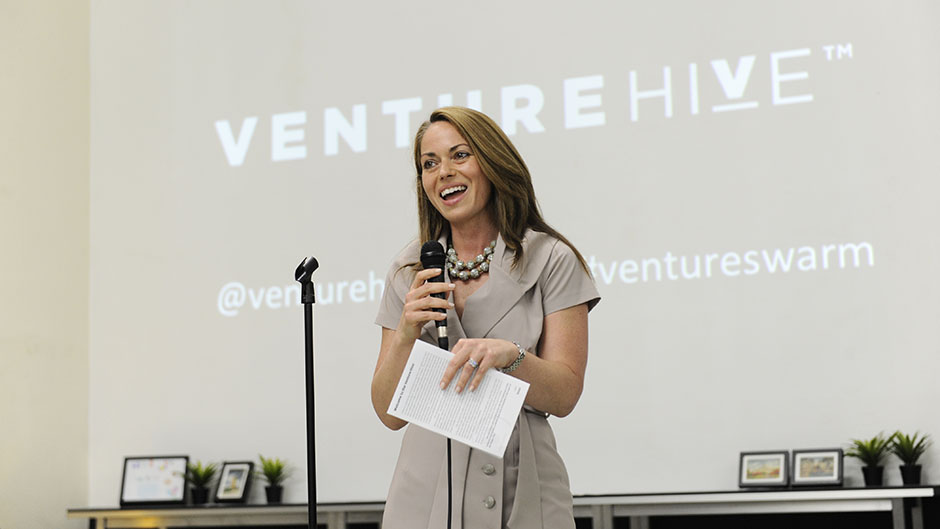
Venture Hive launched in 2013. It moved the work beyond a university population and into the development of Miami’s business community. Local and international entrepreneurs were part of the picture. For a founder arriving from abroad, establishing a company in the United States involved questions that a promising product alone could not answer.
Amat’s program offered structure around those questions. Training, guidance, and connections could help founders navigate a market while learning to operate a company. The city was more than a backdrop. The accelerator’s purpose included attracting businesses that could establish themselves there and contribute to its economy.
By 2016, companies from more than 40 nations had applied to its accelerator. That international interest helps explain the dual character of Amat’s work. It could be rooted in Miami and useful to people whose entrepreneurial lives began somewhere else. A local network could become an entry point into a new market.
The early model also gave founders a particular financial arrangement. A 2016 account described Venture Hive’s programs as taking neither equity nor a participation fee from companies. That was a meaningful feature for an entrepreneur considering what support might cost. Guidance did not require giving away a share of the company under that model.
It is tempting to tell an accelerator’s story through the excitement of selection. Amat’s work invites attention to what follows: the repeated meetings, the business decisions, and the ability to act on advice. Being admitted gets a founder into the room. The room still needs to be useful.
The unglamorous work after the pitch
Venture Hive’s other business makes that concern visible. Flitepath, its cloud-based program-management software, helps organize content, deliverables, mentoring sessions, and the records of what participants have done. It addresses the operational work that sits behind the public face of an entrepreneurship program.
A workshop can be photographed. Progress requires a little more documentation. Which commitment was completed? What did a mentor and founder discuss? Where is the information needed for the next meeting? These are ordinary administrative questions. Without answers, a program can become remarkably good at remembering that everyone attended.
- 01 Schedule sessions
- 02 Document work
- 03 Track deliverables
- 04 Evaluate progress
Activities supported by Flitepath; a process illustration, not an outcome forecast.
The software brings those activities into a shared system. Venture Hive describes an approach that replaces scattered calendars, spreadsheets, and repositories while making program information available in real time. The clients include people managing corporate innovation, accelerators, and entrepreneurship centers. Teaching founders and equipping their teachers become connected businesses.
There is a recognizable philosophy behind that combination. Support should help someone become capable of running a company. Records and feedback make the work visible; they also make it harder to substitute enthusiasm for completion. Amat’s short formulation of a career lesson is suitably direct: “execution is everything.”
Her educational work has also extended through the Global Entrepreneurship Network. In 2018, she became its first vice president for education and executive director of GEN Accelerates. Her team designed and ran programming for Entrepreneurship World Cup. The 2020 edition drew more than 175,000 applicants from over 195 countries, taking the educational challenge to a different scale.
How big a life does a big company leave?
For someone whose work concerns growth, Amat has offered founders a notably personal test of ambition. “Be very honest with yourself around the kind of life you want to live,” she advises. A large technology company creates demands on its founder and on the partners expected to help build it. Those demands deserve consideration before the ambition hardens into a promise.
She has suggested that a smaller, profitable business may be a better fit for some people. The question includes skills, partners, and family. It makes room for a version of success in which the company works financially and the founder recognizes the life it produces. A business plan can accommodate a person, even if the spreadsheet has neglected to provide a column.
“Execution is everything.”
Susan Amat
Her own account gives family considerable weight. She names her mother and daughter as women who changed her life, and raising two children willing to solve problems and work hard as her proudest achievement. The vocabulary overlaps with her business advice: responsibility, effort, and the ability to work things out.
At 19, she read Sam Walton’s Made in America and Akio Morita’s Made in Japan. What stayed with her was their emphasis on humility, trust, and creating value. These are useful companions to her practical concern with execution. Finishing the work matters; so does the way people come to trust the person responsible for it.
The route leads back to campus
In 2021, Amat returned to Miami Herbert as an associate professor of practice and director of entrepreneurship initiatives. The university was familiar territory in more ways than one. Her father, Frank Wills, had taught English there for 34 years. Her own career had repeatedly carried her away from campus and back toward its educational possibilities.
The connections beyond it continued. Florida announced her appointment to the Florida Opportunity Fund board in December 2023. In April 2026, she and two colleagues were running Miami Herbert’s annual Business Plan Competition, with $67,500 at stake. The founder who had once been a student participant was helping organize the opportunity for another generation.
There is continuity in that return. Teenage musicians needed practical help. Students needed somewhere to try an idea. Founders needed structure; program managers needed tools. Amat kept finding work in the distance between an intention and the ability to carry it out.
The career center’s familiar question remains useful: who will hire you? Amat’s contribution was to make room for another answer. A student could begin building something, gather evidence, ask for help, and try again. The first attempt might fail. There would still be something to learn on Wednesday.