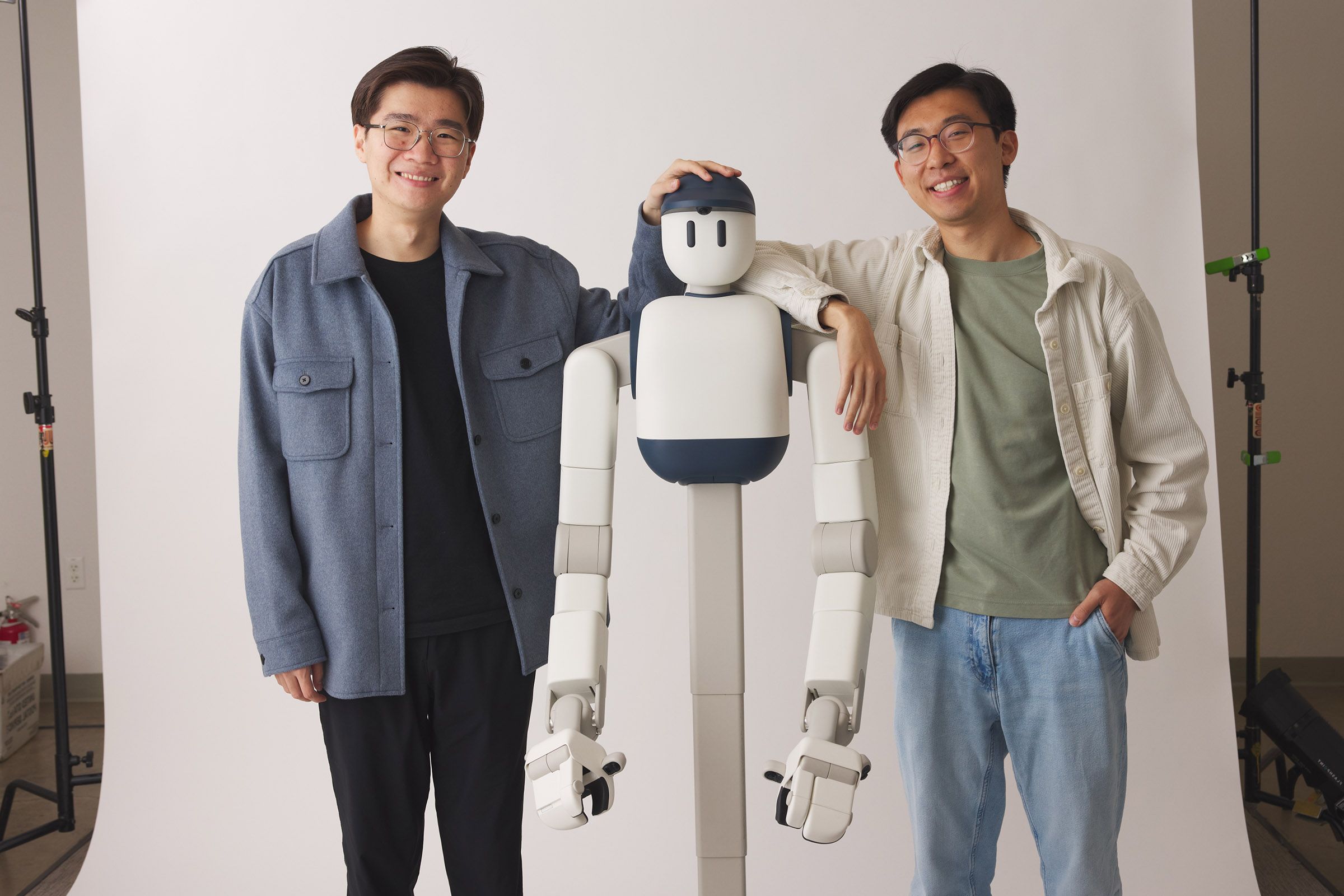
In a fluorescent-lit warehouse off Highway 101, a four-foot machine wearing a soft silicone shell rolls up to a kitchen counter, picks up a dirty plate with two gripper hands, and places it in the dishwasher. Nobody is driving it. Nobody is even watching it. The machine has a hat.
I.Who They Are, Right Now
Sunday is what happens when two Stanford PhD roboticists decide that the most ambitious thing in AI is not building a chatbot. It is building a machine that can reliably fold a fitted sheet. The company - based in Mountain View, run by 130 engineers, designers and former academics - is racing toward a launch window it has publicly committed to. The first autonomous Memo robots roll out by Thanksgiving 2026.
It is the kind of deadline you only set when you genuinely believe you can hit it. Or when you have just raised $165 million from Coatue, Tiger Global, Benchmark and Bain Capital Ventures, which Sunday did on March 12, 2026, at a $1.15 billion valuation. Both are true.
II.The Problem They Saw
Home robotics has been the running joke of futurism for sixty years. The Jetsons gave us Rosie in 1962. The 21st century gave us a vacuum cleaner that gets stuck on cords. Between those two milestones lies a long graveyard of seven-figure prototypes that could not, in any reliable sense, pick up a sock.
The reason is unglamorous - and Sunday's founders had spent their academic careers staring directly at it. Manipulation is hard. Not in a vibes way, in a measurable way. Robots are catastrophically bad at handling objects of differing weights, textures and fragility. Training them in simulation does not transfer. Training them in the real world requires data, and data requires demonstrations, and demonstrations require teleoperation rigs that cost around $20,000 per workstation, plus a human willing to wear them and load thousands of dishwashers on camera.
It is not that nobody had tried. It is that the cost curve made trying pointless.
III.The Founders' Bet
Tony Zhao and Cheng Chi met inside the Stanford robotics ecosystem, where Zhao built ALOHA - a low-cost open-source teleoperation platform developed with Google DeepMind that became one of the most-cited reference designs in modern imitation learning. Chi, meanwhile, was the lead on UMI, a project that pushed the same idea further. Strip the cost out of data collection. Let the model do the heavy lifting.
In 2024, both dropped out of their respective PhD tracks and rented a garage. They bought 3D printers. They ran the printers around the clock. They argued about the right number of fingers for a household gripper, and the right curvature of a face plate that would not scare a toddler, and whether a robot needed legs at all if it was going to live indoors.
Their answers were: two grippers, gentle, and absolutely not. Memo - the product they emerged from stealth with in November 2025, alongside a quiet $35 million round - has wheels. The wheelbase is wide. The center of gravity is low. The machine, by deliberate design, would rather lose a battle with a doorframe than fall on a child.
IV.The Product
Memo stands about four feet tall at rest and reaches up to seven feet when it needs to. It wears a soft silicone shell in colors you might find in a Scandinavian preschool. Its arms terminate in dexterous grippers. Its face is two straight black lines and a small hat. The hat is removable. Customers will be able to swap it.
Inside, Memo is running on-device models trained on demonstration data captured by Sunday's signature piece of hardware - the Skill Capture Glove. The glove costs roughly $200 to produce. A user wears it, performs a household task once or twice, and the recorded motion stream becomes training data for Memo. Sunday has shipped more than 2,000 of these gloves to a community of households the company calls "Memory Developers."
It is, charitably, a clever pun. It is also a real economic shift. The teleoperation rig the rest of the industry is forced to use costs 100 times more than what Sunday is using to train the same kinds of skills.
The Cost of Teaching a Robot to Fold a Towel
V.A Quick Timeline, Because You Asked
Sunday · The Garage-to-Unicorn Compression
VI.The Proof
A pitch is cheap. Demonstrations are not. Sunday has been quietly showing Memo doing the things that historically defeat home robots - clearing a table without scratching it, loading a dishwasher in a kitchen the robot has never seen before, folding socks into matching pairs, pulling a shot of espresso from a real machine.
The list is deliberately mundane. The hardest thing in robotics is not the demo that looks impressive. It is the demo that looks boring. Boring is what gets you into someone's kitchen and keeps you there.
The investor list is the second proof point. Coatue, Tiger Global, Benchmark and Bain Capital Ventures do not co-invest in robotics speculatively. They invest when the engineering risk has dropped enough that the remaining question is manufacturing scale.
VII.The Mission
Sunday's stated mission is small in scope and large in implication - give people back their time. Not by adding another app. Not by another productivity framework. By removing the dishes, the laundry, the wiping-down of counters, and the small endless inventory of household labor that consumes hours per week per household and is invisible in every GDP calculation.
It is a mission with an unusual moral weight, because the labor in question is overwhelmingly done by women and is overwhelmingly unpaid. If Memo works - and that is still an if - the social arithmetic shifts in a way that is not trivial.
Sunday talks about privacy more than most robotics companies, which is also a clue. Memo is trained by glove, not by remote teleoperators piping video out of strangers' homes. Skills run on-device. The company's bet is that the household is precisely the environment where the trust gradient is steepest, and that earning trust will matter more than any feature list.
VIII.Why It Matters Tomorrow
The first wave of household robots will not feel like robots. They will feel like appliances with social presence - somewhere between a dishwasher and a golden retriever. If Sunday lands the launch, it sets a precedent that will pull the rest of the field along. Cheap data collection beats expensive teleoperation. On-device training beats cloud surveillance. Wheels beat legs - for now.
And the harder, more interesting question opens up. Once the chore robot is normal, what else becomes possible in the home that nobody is currently building for? Sunday is not going to answer that question alone. But they are likely to be the company that forces everyone else to ask it.
IX.Back in the Warehouse
The four-foot machine has finished loading the dishwasher. It rolls back, lowers its arms, and stands quietly next to the counter, waiting. From across the room you can hear someone laugh. It is the laugh of a person watching something they were told was twenty years away happen on a Tuesday afternoon in March.
Sunday is still a startup. Memo is still a prototype. Thanksgiving is still eight months away. But the warehouse is loud with 3D printers and quiet with finished robots, and the gap between those two sounds is closing fast.