Subir Chatterjee has a conference to account for. Standing beside a sign for Fi-Tek’s 2025 Wealth Technology Conference, he works through what made the gathering successful: the turnout, the products, the people. More than 300 participants came, he says. His staff answered questions, helped clients and talked about what should come next. The setting is modest: wood paneling, a conference placard, a founder speaking directly to the camera. The subject is the ongoing work of keeping customers close.
It is an appropriate scene for someone whose business lives behind the financial statement. Chatterjee founded Fi-Tek after nearly eighteen years in banking. His company supplies technology for wealth management, hedge funds and family offices, places where the pleasant word “wealth” soon acquires a substantial entourage of accounts, records and obligations. Somebody has to make those agree. A beautiful balance is considerably less beautiful when it belongs in the wrong account.
Over the years, his work has connected a banker's operating experience with software development, the purchase of a Rockefeller-built technology business, and a question about how artificial intelligence might help advisers understand the next generation of clients. The recurring concern is how separate pieces become something a person can use. To follow Chatterjee’s career is to follow that concern through several different rooms.
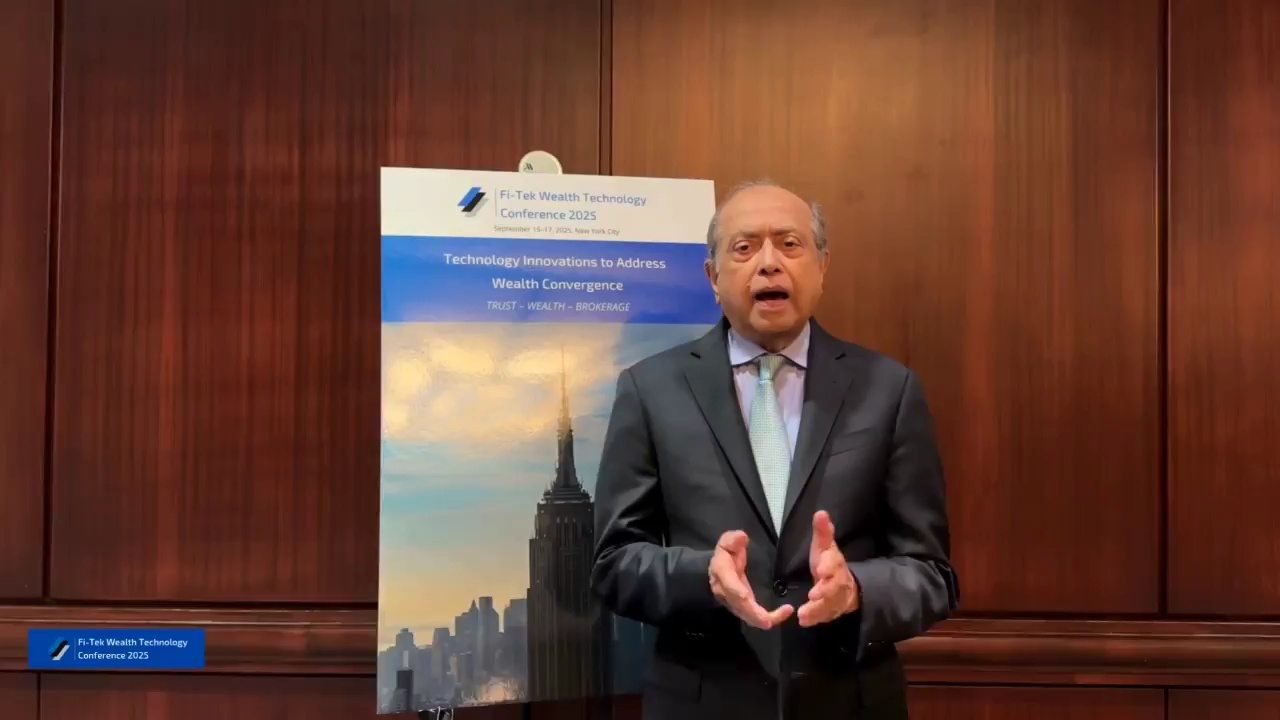 ▶ Watch the recap
Eighteen years before the starting line
Chatterjee’s route to entrepreneurship ran through Chase Manhattan Bank and Bankers Trust, where he held leadership positions. The chronology matters. By the time he founded Fi-Tek in 1998, he had spent nearly eighteen years in banking. Financial institutions were the environment in which he had already worked, with all their existing systems and practical demands. Starting a technology company meant approaching a familiar industry from another position.
His education crossed three disciplines: mechanical engineering at IIT Kharagpur, then a master’s in operations research and an MBA in finance at Syracuse University. Taken together, they provide an interesting way to read the subsequent career. Engineering concerns itself with how a system works. Operations research asks how decisions can be improved under constraints. Finance supplies a particularly exacting setting in which to try both. The combination offers a useful lens on his subsequent work.
Fi-Tek’s early work was concrete. In 1998, it began modernizing trust systems for a wealth organization, moving operations into a Windows-based environment. HedgeTek followed in 2001, addressing hedge-fund allocation and partnership accounting. Global WealthES arrived in 2013, combining accounting, reporting and portfolio workflows. Each milestone added another part of the work financial institutions needed to finish.
The sequence gives his entrepreneurship a distinctive tempo. Years separate the platform milestones. The business grows around specialized financial tasks that persist through changes in software. A trust account still needs its accounting; a fund still needs to allocate results among investors. The interface can change considerably while the obligation underneath remains stubbornly recognizable.
- 1998Chatterjee founds Fi-Tek after a banking career.
- 2016Fi-Tek announces the Rockit Solutions acquisition.
- 2023He brings the next generation of wealth owners into his AI discussion at Columbia.
- 2025Fi-Tek and BetaNXT introduce TrustWealthX.
The Rockefeller connection came with work attached
In January 2016, Chatterjee’s company agreed to acquire Rockit Solutions from Rockefeller & Co. There was an arresting name in the announcement, but the operating arrangement was just as revealing. Rockefeller & Co. would enter a long-term relationship with Fi-Tek for information management services for itself and its clients. The transaction brought a continuing job along with a technology business.
Rockit Command had launched in January 2000 to support middle- and back-office services within Rockefeller & Co.’s wealth and asset management business. In 2005, Rockit Solutions became a wholly owned subsidiary and started serving outside clients. By the time Fi-Tek came to buy it, the business already had a history of handling the records behind complicated financial affairs.
Chatterjee spoke of his admiration for the organization and its business. His proposed next step was to extend the platform’s capabilities while continuing to serve Rockefeller & Co. That combination is a useful clue to the transaction: development and continuity were being discussed together. The acquisition expanded his company’s family-office work, an area where accounting and reporting have to make sense across more than a single account.
“We have long admired the Rockefeller & Co. organization and the Rockit Solutions business.”
Subir Chatterjee · January 2016
There is a quieter sort of entrepreneurial responsibility in that arrangement. An announcement can be finished in a morning. A servicing relationship continues through the next reporting period, and the one after that. Chatterjee’s company was taking on work whose success would be judged repeatedly, after the public attention around the deal had moved elsewhere.
He also sat on the other side of the technology
His professional history includes First State Trust Company as well as Fi-Tek. He served as the trust company’s chairman, and by December 2023 his roles included chairman and CEO of both First State Trust Company and Rockit Solutions, alongside his Fi-Tek role. Those positions put financial services and financial technology alongside each other in his working life.
The connection had a practical expression. When First State Trust Company became independent of Citigroup, Chatterjee welcomed the experienced staff and discussed the opportunity to develop products and services with Smith Barney. His comments tied a technology affiliation to the work of an operating trust business. The relationship offered a setting in which software and service requirements could meet.
It is tempting to tell any founder’s story as a succession of ideas. Here the organizations themselves carry much of the plot: banks, a trust company, a family-office service provider, a financial-software business. Each has people responsible for completing tasks on behalf of someone else. Chatterjee’s career moves among those responsibilities, giving the product story an institutional setting.
Three platforms, and people to operate them
In June 2024, Rockit Solutions was presented under the Fi-Tek Wealth Solutions name with an expanded service offering. The business combined Rockit Command, Global WealthES and HedgeTek with teams in the United States and India. Operations, administration, accounting and reporting were part of the proposition. The three platforms addressed different wealth segments, while the service offering brought people into the delivery of that work.
This is a significant development in a founder’s story because it changes what a customer can ask the company to do. Providing a system and helping deliver an operation involve related but distinct commitments. The software needs capabilities; the service needs people who understand the client’s requirements and can carry the work through. Chatterjee’s company was putting those commitments together.
His conference recap makes more sense in that context. Product demonstrations were one of the things he chose to celebrate. So were staff members and subject-matter experts helping clients talk about support and future needs. The video offers a small, specific glimpse of his public manner as a founder: he gives the event’s success several contributors and spends time acknowledging the team.
The 2025 conference agenda supplied a detailed picture of those conversations. Chatterjee was scheduled to deliver the welcome remarks. Sessions covered a combined view of trust, advisory and brokerage business, a redesigned Global WealthES interface, customizable reports, an adviser dashboard and mobile access. For a founder, a programme like that puts years of product work in front of the people expected to use it. Each demonstration invites a practical response from the room.
The heir has a different question
At Columbia’s digital-finance summit in December 2023, Chatterjee’s presentation concerned AI, financial advisers and the next generation of wealth owners. His premise was that inheriting assets need not mean retaining a parent’s adviser. Technology could help advisers understand individual clients and offer more customized service at scale. The business question came before the technical one: how would an adviser remain useful to a new client?
That concern extends beyond processing records correctly. It asks what an institution can learn from information once it has it, and how that understanding might improve a relationship. Chatterjee’s presentation described AI as a way to connect data with individual needs. The aspiration was personal service delivered across a larger client base, a challenge familiar to any institution that wants scale without making every customer feel interchangeable.
In March 2025, Fi-Tek and BetaNXT introduced TrustWealthX, addressing another obstacle to a coherent client experience. Trust, advisory and brokerage accounts can occupy separate systems. Trust accounting also has to distinguish principal from income. The partnership set out to bring positions and balances across those accounts into a shared family view, with connected operations and reporting.
The partners brought different capabilities to that effort. BetaNXT supplied brokerage accounting and operations; Fi-Tek brought its multi-currency trust and wealth platform, along with capabilities such as performance measurement and data aggregation. The design recognized that a shared view still rests on specialized work. Putting balances together requires the underlying records to retain their meaning. For the family looking across its accounts, that coordination is part of what makes the picture useful.
For Chatterjee, the sequence suggests a continuing interest in what happens between systems and people. A family’s financial life crosses account types; an heir may bring different expectations; an adviser needs information that helps answer the next question. These are distinct problems, but they share a demand for useful connections. The founder who began by modernizing trust operations is still working where financial detail meets the person waiting for an answer.
His company’s geography gives the story another dimension. Fi-Tek is headquartered in Edison, New Jersey, where Chatterjee is based, and has a development and support centre in Kolkata. The 2024 service expansion explicitly combined professionals in the United States and India. A client sees an institution’s reports and responses; behind those sit teams coordinating across offices and time zones. Maintaining that coordination is another continuing task in the business he founded.
Return to the conference video, and his choice of measures feels apt. People came. Products were shown. Staff helped customers discuss what followed. For a business built around keeping complex affairs in order, the next conversation is part of the work.