Who they are now
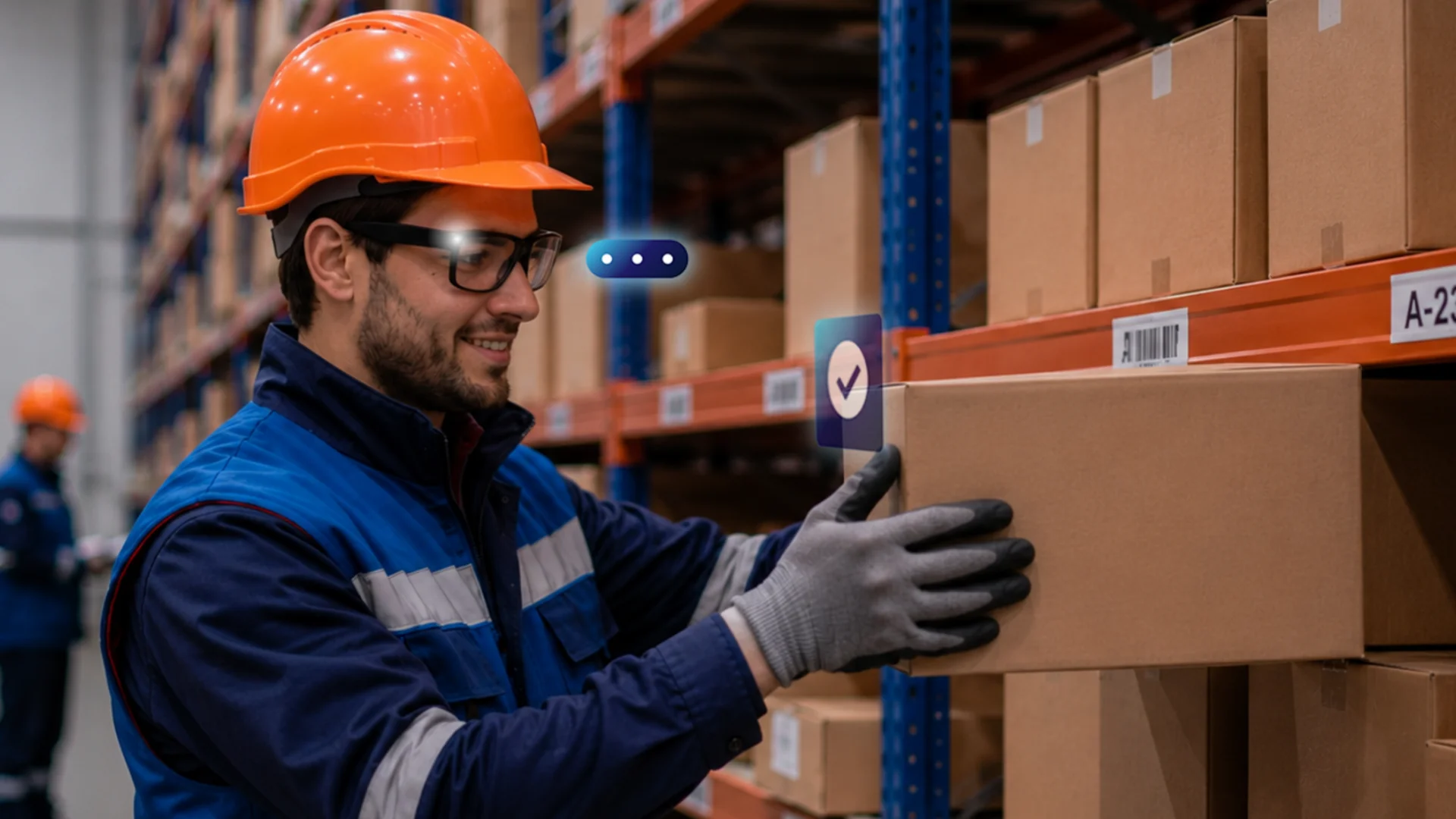
A worker reaches for a part. The glasses already know if it's the wrong one.
Somewhere on a warehouse floor this morning, someone is doing a job they've done a thousand times. On the thousand-and-first, they grab the wrong cable. In the old world, nobody notices until the unit fails inspection three stations later. In STRIVR's world, a pair of smart glasses catches it in the half-second before the mistake becomes a defect.
That is what STRIVR sells in 2026: hands-free AI that watches frontline work through a camera, recognizes when a step goes sideways, and quietly guides the worker back on track. The company calls it Frontline Intelligence. The pitch is blunt - "the first hands-free AI solution for mistake-free work." It is a long way from where this story began, which was, of all places, a football field.
"They didn't pivot from training to AI. They followed the same question into a new room: how do you get a person to do the right thing, in the moment that counts?"
— The throughline, 2015 to today
The problem they saw
You forget the slide deck. You remember the fire.
Corporate training has a dirty secret: most of it doesn't stick. A worker sits through a video, clicks "I agree," passes a quiz, and forgets nearly all of it by the following week. The frontline - the people stocking shelves, de-escalating angry customers, working machines that can take a finger - learns the hard way, on the job, where the stakes are real and the do-overs are expensive.
STRIVR's founders came at this from an unusual angle. They had watched athletes drill the same play until it became muscle memory, and they suspected the brain doesn't much care whether the "experience" happened on a real field or a convincing simulation of one. If you could make practice feel real, the learning would behave like it was real too.
"People remember what they do. They forget what they're told. Everything STRIVR built is a bet on that one sentence."
— The thesis, more or less
The founders' bet
A coach quit his dream job over a hunch.
In 2014, Derek Belch was a graduate-assistant football coach at Stanford - close to the kind of job people spend careers chasing. He left it. His master's thesis had tested whether virtual-reality reps could improve real-game performance, and the early answer was promising enough to walk away from the sideline. He built STRIVR in 2015, with Stanford professor Jeremy Bailenson - founding director of the university's Virtual Human Interaction Lab - as co-founder and resident skeptic-in-chief, and Michael Manuccia as co-founding COO.
Bailenson mattered for an unglamorous reason: receipts. His lab had spent years publishing peer-reviewed research on how immersion changes behavior. So when STRIVR claimed VR training worked, it could point to science rather than vibes - a rare thing in a category that has never been short on hype.
Derek Belch
Founder & CEO. Left a Stanford coaching job to chase a thesis. Four Stanford degrees and a USC MBA later, still running it.
Jeremy Bailenson
Co-Founder & Chief Visionary. Founding director of Stanford's VHIL - the reason the science holds up.
Michael Manuccia
Co-Founder & COO. The operator who helped turn a campus experiment into a Fortune 1000 vendor.
The product
First the headset. Then the platform. Then the glasses.
STRIVR has changed what it sells twice without ever changing why. Version one strapped athletes and then employees into VR headsets to rehearse high-stakes moments - a tense customer, a spill, a safety hazard - until the right response felt automatic. Around that it built a full platform: a Content Studio to create simulations, delivery and device management to run them at scale, and a patented way to measure what learners actually did inside the experience.
That measurement turned out to be the real asset. Watching how someone behaves in a simulation - where they look, how they hesitate, what they get wrong - is a far richer signal than a quiz score. It is also, conveniently, exactly the kind of data a modern AI model loves.
Frontline Intelligence
Smart-glasses AI using custom visual language models to spot procedural errors and guide corrections, hands-free.
WorkWise
Captures an expert's video and turns it into step-by-step visual instructions and searchable SOPs - updated automatically as work changes.
Immersive Platform
The original VR/XR engine and Content Studio that trained hundreds of thousands of frontline employees.
Behavioral Analytics
Patented measurement of what people actually do inside a simulation - tying practice to real-world performance.
"The headset was never the point. The signal was. STRIVR spent a decade learning to read how people work - AI just gave it a faster way to use what it learned."
— On the quiet pivot
The proof
The client list reads like a stock index.
It is easy to dismiss enterprise VR as a gadget looking for a job. STRIVR's answer is its customers. Walmart, Verizon, Bank of America, BMW, MGM Resorts, Sprouts, Fidelity and FieldCore - a GE company - have all run training on the platform. Walmart's commitment was the loudest: it didn't pilot, it bought 17,000-plus headsets and pushed STRIVR into thousands of stores.
Funding, round by round
USD raised, approximate // Series A through Series B extension
"Walmart didn't run a pilot. It bought seventeen thousand headsets. That is not curiosity - that is conviction."
— On enterprise adoption
Why it matters tomorrow
Back to the warehouse floor.
Return to that worker reaching for the wrong cable. The mistake never reaches inspection. The glasses flagged it, suggested the right part, and the line kept moving - no scrap, no rework, no supervisor pulled off the floor to explain a process for the hundredth time. Multiply that by every shift, every site, every job that used to be learned by failing at it.
Whether smart glasses become as ordinary as hard hats is still an open bet, and STRIVR is not the only company chasing it - Augmentir, Tulip and Microsoft's Dynamics 365 Guides want the same factory floor. But STRIVR is walking in with something rare: a decade of data on how people actually work, and a list of Fortune 1000 customers who already trust it with their training. The question that started on a football field hasn't changed. The tools just finally caught up to it.
"The future of work isn't a worker replaced by a machine. It's a worker who never has to make the same mistake twice."
— The closing bet