Founder & CEO // STRIVR
Derek Belch
He asked whether a quarterback could get better without throwing a single pass. The answer became a company that trains a million people.
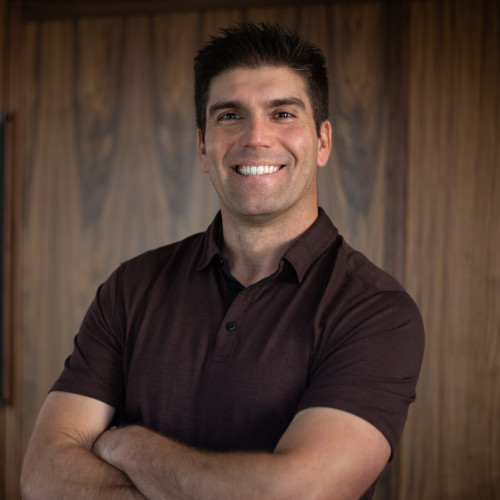
Belch, headset adjacent, hype-free.
He asked whether a quarterback could get better without throwing a single pass. The answer became a company that trains a million people.
Walk into a Walmart back room before Black Friday and a cashier might be staring down a virtual stampede of holiday shoppers, learning to keep calm before a single real customer arrives. A new Verizon rep might be defusing an angry caller who exists only in a headset. A BMW technician might be rehearsing a procedure that, done wrong on a real car, would cost a fortune. The thread connecting all of it runs back to Derek Belch and the company he built, STRIVR.
Belch is the founder and CEO of STRIVR, an enterprise virtual reality training company headquartered in Santa Clara, California. Its pitch is unglamorous and exact: put employees inside the moments that matter most, before those moments arrive for real. STRIVR says it has now trained more than a million people in VR, and counts Walmart, Verizon, Bank of America, MGM Resorts, BMW, JetBlue, Fidelity, Tyson Foods and the NFL among the names it has worked with.
What is strange about the person at the top is that he claims no love of gadgets. "I'm not really a tech enthusiast in my day-to-day life," Belch has said, an admission that sits oddly on the desk of a man selling immersive computing to the Fortune 1000. He frames himself as a tech optimist and a realist in the same breath, more interested in whether a tool changes behavior than in whether it is impressive.
That instinct hardened into a rule he repeats often. STRIVR does not, in his words, "do VR for VR's sake." The company's job is to build experiences that "actually have an impact on your employees," not demos that wow a procurement committee and then gather dust on a shelf of forgotten headsets.
More recently, the work has shifted from pure simulation toward measurement. STRIVR has folded in cognitive science, data science and artificial intelligence, including generative AI, to read the data that immersive training throws off and hand HR and learning leaders something they rarely get from a classroom: evidence. In 2024 the company introduced WorkWise, an AI-powered standard-operating-procedure platform built to capture what expert workers know and deliver it at the exact point a task gets done.
The throughline, twenty-some years from his first job on a football field, is the same: reps. Get them where the stakes are low so you are ready where the stakes are high.
"If VR is done well, the brain can't tell the difference between a virtual simulation and real life."- Derek Belch
Belch's relationship with Stanford is hard to overstate. He kicked for the Cardinal as an undergraduate, then stacked degrees on top of the experience: a BA in communication, a master's in journalism, and a master's in media studies, all from Stanford, with an MBA from the University of Southern California added later. By the early 2010s he had circled back to the football program as a graduate assistant coach.
He was also chasing a master's in virtual reality, and he needed a thesis. So he aimed his question at the team in front of him. Could a quarterback improve by taking mental reps in VR, reviewing plays and reads off the field, without the wear of live practice? To find out, he teamed up with Jeremy Bailenson, the Stanford professor who runs the university's Virtual Human Interaction Lab and is one of the most cited voices in VR research. Together, inside that lab, they built a prototype.
Stanford's quarterbacks started using it late in the 2014 season. It worked well enough that head coach David Shaw did something unusual: he told his graduate assistant to quit coaching and go build a company, and offered roughly $30,000 to help him start. Belch took the advice and the check.
The early traction was fast. Within its first six months, STRIVR had signed five NFL teams to multiyear contracts and roughly a dozen college programs. Then, in 2016, Belch made the call that defined the company: he turned it away from athletes and toward employees, betting that the Fortune 1000 needed mental reps even more than quarterbacks did.
Belch resists the urge to put everything in a headset. His shorthand for deciding what deserves immersive training is an acronym - and a filter against gimmickry.
Events that almost never happen, like a Black Friday surge, so staff can't learn them on the job.
Scenarios you simply cannot recreate safely or practically in the real world.
High-risk situations where a mistake in real life carries a real cost.
Training that would be cost-prohibitive to stage physically, again and again.
"We do not do VR for VR's sake."- Derek Belch, on building things that change behavior
"This technology that used to be very cumbersome, very expensive, very heavy ... that's all gone." The hardware finally caught up to the idea.
Done well, VR convinces the brain it is somewhere it is not. That is what turns a drill into a memory the body can act on later.
STRIVR pairs immersive training with cognitive science, data science and AI - turning headset hours into measurable performance insight.