A roof is a stubbornly local product. It is measured on site, installed by a crew that knows the weather, and recommended over fences and in neighborhood groups. The customer may choose between national shingle manufacturers, but the contractor usually wins on a familiar name, a nearby office and somebody willing to answer when the next storm arrives. Stonegrove Roofing Partners has built its young company around that contradiction. It wants the scale of a national platform without asking a trusted roofer to start behaving like a distant chain.
Founded in 2024 by Pierre Abousleiman and Jonathan Shifke, the New York-based company acquires or invests in established residential roofing businesses. The seller can receive cash, retain meaningful equity and keep leading. The trucks, crews and local brand remain. Behind them, Stonegrove adds capital and a central bench for finance, accounting, marketing, recruiting, technology, operations and vendor negotiations. It is less a single roofing company than a federation with one back office.
Those are Stonegrove's current reported figures, assembled in roughly two years. The public roster stretches from Golden Group Roofing in Massachusetts and The Exterior Company in Pennsylvania to A-R Roofing in the central Plains, Lifetime Roofing on the Gulf Coast, Bigfoot Roofing in northeast Florida, Integrity Roofing near Seattle and Arrowhead Roofing in Dallas-Fort Worth. The common thread is not a uniform sign. It is a company with a defensible local reputation and an owner still interested in building.
The product is the layer nobody sees
Homeowners buy repairs, replacements, inspections and storm restoration from the operating brands. Depending on the market, those companies also sell siding, gutters, skylights, insulation, solar and other exterior work. Property managers and referral partners can approach Stonegrove for coordination across several markets. Yet the platform's more revealing customer is the roofing-company owner - often a founder who has created a valuable business but has reached the limits of personal capital, personal bandwidth or an improvised back office.
That owner has a familiar set of problems. Materials and software cost more when bought alone. Recruiting a finance chief, a performance marketer or a technology team is hard to justify at regional scale. Reporting systems built for a ten-person shop strain when the company adds branches. Succession creates another dilemma: selling outright may provide security but separate the founder from the people, name and community that made the business worth buying.
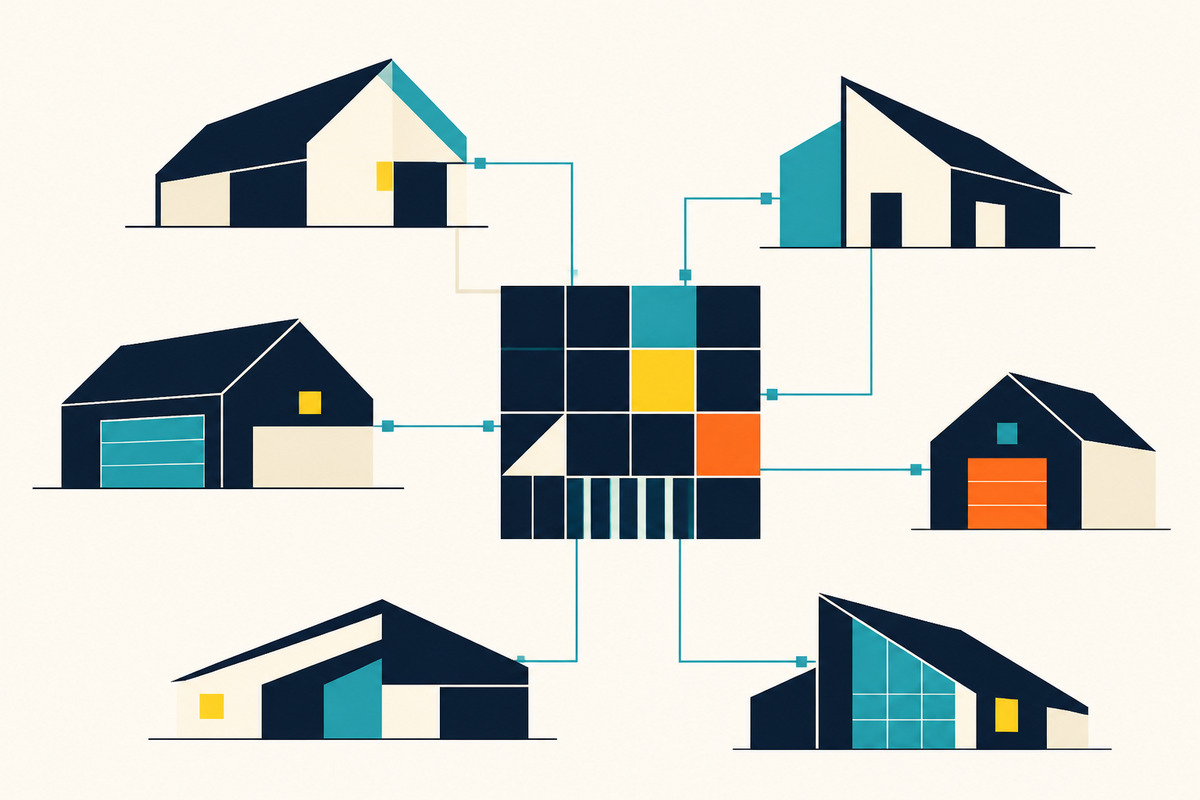
Stonegrove's proposal is to separate identity from infrastructure. Centralize the work that improves with repetition and volume; keep local the judgments that depend on market knowledge and earned trust. One partner executive has pointed to software contracts as a mundane but telling example: the larger group helped renegotiate agreements and produced measurable savings. It is not a cinematic synergy. It is exactly the kind that can improve a contractor's margin without confusing a homeowner.
Shared at platform level
- Finance and forecasting
- Recruiting and benefits
- Technology and integration
- Marketing playbooks
- Vendor negotiations
Kept close to the market
- Brand and reputation
- Local leadership
- Crews and customer care
- Community relationships
- Day-to-day accountability
A succession plan with a second act
Stonegrove says it looks for stable or growing residential roofers with loyal customers, strong local brands, people-first leadership and cultures worth preserving. Retail businesses, insurance-driven storm businesses and hybrids can all fit. The important filter is intent: leadership should want to keep growing, not merely hand over the keys.
Its published process begins with confidential conversations, followed by an evaluation of operations, financials and market position. A tailored proposal sets out the structure and growth plan. Closing and integration follow, then the central team supplies ongoing operational and financial support. Stonegrove says the trip from signed letter of intent to closing typically takes 60 to 90 days. The cash at closing solves one founder problem; retained equity is meant to keep the founder invested in what happens next.
“We started Stonegrove with the vision of working hand in hand with owners and entrepreneurs to build something special.”Jonathan Shifke, co-founder
The line sounds friendly, but the incentives underneath it matter. A founder who keeps ownership has a reason to pursue growth across both the original business and the wider platform. Stonegrove gets continuity with employees and customers. The local company gets a balance sheet and specialized colleagues it could not easily hire alone. If the model works, the founder's second payday reflects value created after the transaction, not only the company that existed before it.
The map grew deal by deal
The expansion is easiest to understand as a sequence of local stories. A-R Roofing brought a Wichita base and operations across Kansas, Nebraska and Oklahoma in early 2025. The investment in family-owned Bigfoot Roofing & Construction, which had served northeast Florida since 2011, closed that March. Golden Group added a woman- and minority-owned operator built around Greater Boston and Central Massachusetts. Lifetime Roofing extended the network through Louisiana and into Texas. None arrived as a blank branch office waiting for a corporate identity; each brought years of customer reviews, supplier relationships and crews who understood a particular market.
Moss Roofing made the preservation thesis especially visible. When Stonegrove announced the partnership in September 2025, the Indiana company had more than three decades of history. Its leadership and brand remained, while finance, marketing, human resources and technology support moved behind it. Later additions pushed the public roster toward Michigan, Pittsburgh, the Southeast and Dallas-Fort Worth. Arrowhead Roofing, founded by longtime friends Brad Allen and Judson Pedigo, joined with the same stated promise around leadership and culture.
Strand Equity appears on the capital side of the story. The consumer growth investor lists Stonegrove in its portfolio, and transaction reporting has identified it as a financial sponsor. The amount invested, Stonegrove's valuation and consolidated revenue are not public. That absence makes the operating evidence more useful than speculative arithmetic. The visible questions are whether branches are added, whether founders stay, whether shared services create savings and whether the network can serve customers across more than one market without weakening local accountability.
Why roofing keeps attracting platforms
Roofing sits inside a large, fragmented home-services market. Demand is recurrent but irregular: roofs age predictably, while hail, wind and hurricanes create sharp regional surges. Execution remains labor-intensive. Reputation is highly local. Thousands of independent operators still handle sales, installation and insurance-related restoration. For an acquirer, that fragmentation creates a long list of possible partners. For an operator, it creates opportunities to spread fixed costs, negotiate with suppliers and move proven practices between markets.
Preserve the customer-facing asset - the local name - while standardizing the systems that govern cash, leads, talent, purchasing and performance.
Stonegrove is not alone. Sponsor-backed groups including Legacy Service Partners, Omnia Exterior Solutions, Allstar Services, Skyline Roofing Partners, Aligned Exteriors, Alloy Roofing and First Ridge compete for many of the same owner-led contractors. Some emphasize a broader set of home services. Others concentrate on particular regions or exterior categories. Capital, therefore, is not the only differentiator. Sellers compare valuation, rollover equity, autonomy, cultural fit and whether a buyer's promised help survives contact with Monday morning.
Stonegrove's answer is its decentralized stance and an operator-heavy central team. The leadership roster covers finance, operations, growth, marketing and technology, people, acquisitions, integration, accounting, business development and regional management. The expertise is practical: reporting, system implementation, reputation management, lead generation, recruiting, training, benefits and cost control. The pitch is not that every roofer should operate identically. It is that each should have access to a better toolbox.
Two customers, one network
The next stage broadens the logic beyond acquisitions. Stonegrove now markets a multi-market program to clients and referral partners who need roofing support across properties or regions. The network offers repairs and replacements, storm response, inspections, due diligence, preventive maintenance and related exterior services. A property operator gets one relationship and escalation path; the job is still performed by a local company with local crews and accountability.
That creates a useful bridge between the two halves of the model. Buying more roofing companies expands geographic coverage. Broader coverage makes the platform more useful to portfolio customers. Those relationships can send work to local brands, increasing the value of joining the network. The cycle is attractive on paper, though coordination quality will decide whether it becomes a flywheel or merely a map covered in pins.
The difficult parts deserve attention. Decentralization can preserve speed and culture, but it can also produce uneven processes and customer experiences. Centralization can deliver clean reporting and better buying terms, but too much of it can slow operators or make founders feel that autonomy was a brochure promise. Storm-driven work brings capacity and quality-control pressure. Acquisitions can outpace integration. Stonegrove's result will be measured less by the number of logos collected than by retention, repeat customers, employee opportunity and whether partner margins improve without service slipping.
Still, the company's organizing idea is clear and observant. In local services, a national brand is not automatically more valuable than a familiar one. Scale may belong in the accounting system, the benefits plan and the vendor contract rather than on the side of the truck. Stonegrove is placing capital behind that distinction, one roofline at a time.