An outsourcing company usually arrives with a promise to do the work. Sreedhar Veeramachaneni added a less obvious promise: the customer ought to be able to take it back. In January 2020, while discussing application development, the founder of System Soft Technologies made knowledge transfer part of the bargain. Expertise would come through the door. Understanding should stay behind when the experts left.
There is something pleasantly inconvenient about that proposition. A supplier has every commercial reason to remain useful. Teaching a customer to manage without you requires a longer view of the relationship. It puts confidence in the work, and in the relationship, ahead of the comfort of being indispensable. For Veeramachaneni, the handover belonged in the discussion before the project had properly begun.
“The best vendors actively design an exit strategy into their project approach from day one.”
Sreedhar Veeramachaneni · January 2020
That thought offers a way through a career that now runs from an IT services company founded in 1999 to an enterprise AI venture called Accelyst. The software vocabulary changes. The underlying question keeps its shape: can the organization understand and control the technology it has invited inside? A purchase order can settle who pays. The harder matter is who knows enough to take responsibility afterward.
Twenty years before the AI conversation
System Soft Technologies began in 1999. By October 2019, the company was describing itself as a $125 million business and expanding its leadership, services and technology platforms. Veeramachaneni was its CEO. Twenty years separated the founding date from that announcement, a stretch long enough for enterprise software to acquire several new wardrobes and a rather larger luggage allowance.
The expansion had names attached. Bethany Plaza joined as vice president of professional services. Eric Thacker joined as vice president of marketing. The company was adding capabilities around data, cybersecurity and application development, while building a design studio at its Tampa headquarters. Those details matter because they show the work spreading beyond a founder’s own desk. Services businesses grow through other people’s judgment as well as their technical skill.
A consulting business sits in an interesting position. It sees the distance between what a customer hopes technology will accomplish and what the customer can currently build, run or staff. The sale begins in that distance. Delivery has to close it. Veeramachaneni’s public comments from this period are most revealing when they stay close to that practical problem, where a broad ambition meets the available people and the existing systems.
The customer should understand the machinery
By early 2020, he was describing application development as a more complicated assignment than it had once been. Software had to work across different devices and interfaces, connect with evolving data and accommodate AI. Building an application also meant anticipating how it would behave under changing demand. The work reached beyond writing code into architecture and operations. A tidy specification had acquired a crowd of moving parts.
Outsourcing, in his account, answered a skills problem. It also created an obligation. Customers needed to receive the knowledge accumulated during the engagement, with documentation and communication built into delivery. They should retain options over who would eventually operate the result. His position gave the buyer homework, too: a customer had to ask for that visibility and insist on arrangements that made a transfer possible.
Read as a business philosophy, this is a preference for relationships that can survive scrutiny. A useful supplier ought to be able to explain the work. A useful client ought to be able to ask informed questions. There is a modest kind of respect in that exchange. It assumes the customer can become more capable, and that the supplier’s value will survive the customer knowing more.
What should remain when the project team leaves?
An editorial illustration of the customer ownership principles in his 2020 interview.
A little “Botalytics” with your morning meeting
Later that January, Veeramachaneni published predictions under a title containing “Botalytics,” a combination of bots and analytics. It was a cheerful word for a serious workplace question: what happens when automation takes on more of the process work inside financial businesses? He also expected software customers to want easier ways to configure their tools, with less dependence on expensive custom programming.
Another prediction concerned the employee’s patience. People accustomed to convenient consumer technology would bring those expectations to work. An organization could hardly expect its staff to forget the ease of the rest of their digital lives at the office door. The observation sounds ordinary until one remembers how often workplace software appears to have been designed with the employee’s lunch break as an available resource.
These were forecasts, with all the uncertainty that accompanies forecasts. Their interest here lies in what caught his attention: time spent on process, the cost of changing software, the friction felt by the person using it. That is a recognizable set of concerns for a services founder. It begins with the working day and asks which parts technology might make less laborious.
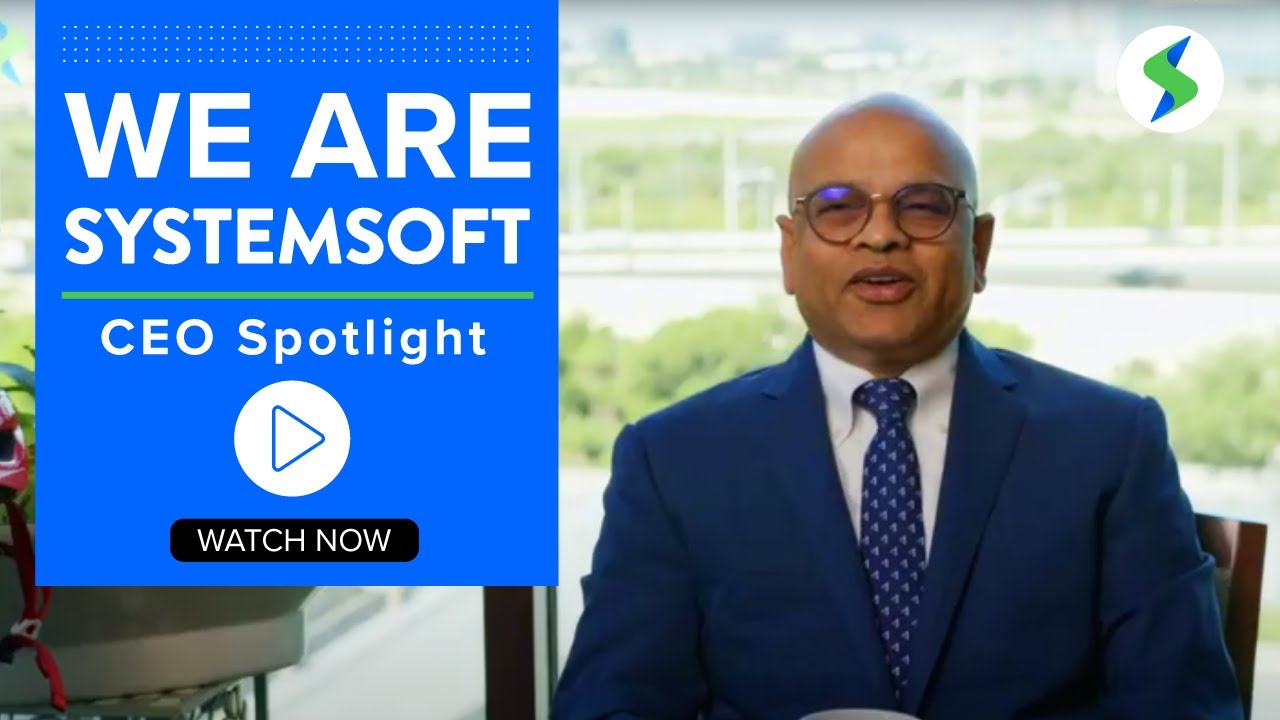
The company around the founder
A May 2021 CEO spotlight presented a more personal account of business building. Its description emphasized the friends and colleagues around Veeramachaneni, along with persistence, adaptability and diligence. Those are unglamorous qualities, which is part of their appeal. They have the advantage of still being needed on a Thursday afternoon, when the presentation is over and somebody must solve the remaining problem.
That September, System Soft received the Florida State Minority Supplier Development Council’s Class IV MBE Supplier of the Year award. Veeramachaneni’s response spread the credit across senior leaders, department stakeholders and team members. He also spoke about developing opportunities with minority business partners. The recognition attached to the company, and his response treated it as work shared across the organization.
Supplier diversity was part of a continuing institutional story. A council letter had recognized System Soft’s minority business enterprise certification for the September 2020 to September 2021 period. In 2023, USPAACC’s Fast 100 Asian American Business Award winner poster listed System Soft and named Veeramachaneni as CEO. These milestones place the business within networks concerned with access to customers and opportunities, alongside the technical work itself.
They also widen the picture of what a founder builds. A company needs a place in other organizations’ purchasing decisions. It needs relationships that make an introduction possible and enough credibility to turn an introduction into work. The engineering problem and the commercial problem share a calendar. Neither is especially impressed by the other’s excuses.
There is a useful distinction between being introduced to a buyer and being trusted with the work. An introduction opens a conversation. The work brings deadlines, questions and the possibility of disappointment. A services company has to keep earning the next conversation through the way it handles the current assignment. The awards belong beside that everyday effort, giving a date and a name to recognition that individual project teams experience in smaller increments.
A new venture, a familiar question
Veeramachaneni now leads Accelyst. In describing why he built the business, he pointed to the obstacles between enterprise interest in AI and confident deployment: infrastructure, security and visibility. His proposed approach included private systems, configuration around the organization’s needs, human participation and workflows people could inspect. The ambition was to make AI usable inside the business rather than leave it at the exploratory stage.
“Our clients don’t want experiments. They want outcomes.”
Sreedhar Veeramachaneni · On building Accelyst
The current company gives those concerns a concrete setting. Accelyst offers work in areas including legacy modernization, knowledge retrieval, AI agents and governance. Its public materials emphasize working with existing systems and maintaining control over enterprise data. These are descriptions of its approach, rather than a reason to assume every promised result. What they establish is the kind of problem the venture has chosen to pursue.
There is continuity with the earlier handover argument. In both settings, a customer is being asked to trust expertise it may not possess internally. That trust becomes easier to assess when the work is visible and responsibilities are explicit. AI adds new questions, but the organization still needs to know what it is buying, how the system fits and who will answer when a decision needs explaining.
Accelyst’s stated values include respect for investments customers have already made: their people, their data and their technology. That is a useful detail in a field fond of announcing the next beginning. Most organizations arrive carrying earlier decisions. The systems already in place have users, costs and reasons for existing. Any new tool must negotiate with that history before it earns a place in the working day.
The same test can be applied to the word innovation. What does it ask of the person who inherits the result? A manager needs enough information to make decisions. A team needs a way to raise questions. A customer needs room to change direction. Veeramachaneni’s interest in handovers makes those ordinary requirements worth keeping in the frame, even as the conversation turns toward newer technology.
Seen across these chapters, Veeramachaneni’s story is about the obligations that travel with a technical promise. Build the thing. Help people use it. Leave them able to understand it. The open door is an apt image for this career: expertise comes in, knowledge moves around, and the customer keeps a route toward taking charge. It is a demanding standard for a supplier. It gives the customer something sensible to ask for.
Continue the conversation
- Accelyst · current company ↗
- Sreedhar on LinkedIn ↗
- System Soft Technologies · company profile ↗
- The 2020 application development interview ↗
- His 2020 technology predictions ↗
- System Soft’s 2019 expansion ↗
- The 2021 supplier diversity award ↗
- The 2020–2021 MBE certification letter ↗
- USPAACC’s 2023 Fast 100 award poster ↗
- Accelyst · values and vision ↗
- His explanation of building Accelyst ↗
- Watch · CEO Spotlight, May 2021 ↗
- Accelyst · videos and demonstrations ↗