01The Orchard, Right Now
A field in central Wyoming, late winter. The wind off the High Plains is steady - the kind of wind that lifts your hat without asking. In a few years, that wind will be doing real work. It will pass through stacked trays of small white pellets, and on the other side it will be measurably lighter in carbon dioxide. The pellets don't move. The fans don't spin. There are no fans.
This is the bet that Spiritus is making. Carbon removal, the company argues, has been doing it wrong. Direct Air Capture has been treated like a chemical plant - hot, mechanical, expensive. Spiritus would like to treat it more like an orchard.
02The Problem They Saw
The dirty secret of climate finance is that everybody agrees we need to suck CO2 out of the sky, and almost nobody agrees on how to pay for it. Conventional DAC plants - the Iceland-style steel-and-fan cathedrals - run somewhere around $600 to $1,000 per ton captured. At that price, removing a gigaton costs more than the GDP of Sweden.
Which is, to put it gently, a problem.
Most of the cost lives in two places: the energy to peel CO2 off the sorbent (huge, hot, hungry) and the mechanical work of forcing air across that sorbent (fans, motors, electricity). Spiritus's founders looked at this and asked a slightly impertinent question: what if you just didn't?
Field Note
Industry baseline cost for DAC, circa 2023: ~$600-$1,000 per ton. Spiritus's stated target: under $100/ton. That is not an improvement. That is a different category of object.
03The Founders' Bet
Spiritus was founded in 2022 by Charles Cadieu and Matt Lee. Cadieu had two prior exits - IQ Engines, sold to Yahoo, and Caption Health, sold to GE HealthCare after winning a TIME 100 Best Invention nod. Lee came out of Los Alamos National Laboratory, where he was a Group Leader. One of them knew how to build a company. The other knew how to build a sorbent. They moved to northern New Mexico and got to work.
Their wager has two prongs. First: design a sorbent that releases its captured CO2 at very low temperatures - around 70 to 100 degrees Celsius, hot bathwater rather than blast furnace. Second: skip the industrial fans entirely. Stack the sorbent on trays, on tree-like rigs, in open-air "groves," and let the natural breeze do the contacting.
Two founders, one lab town, an awful lot of pellets to make.
04The Product, In English
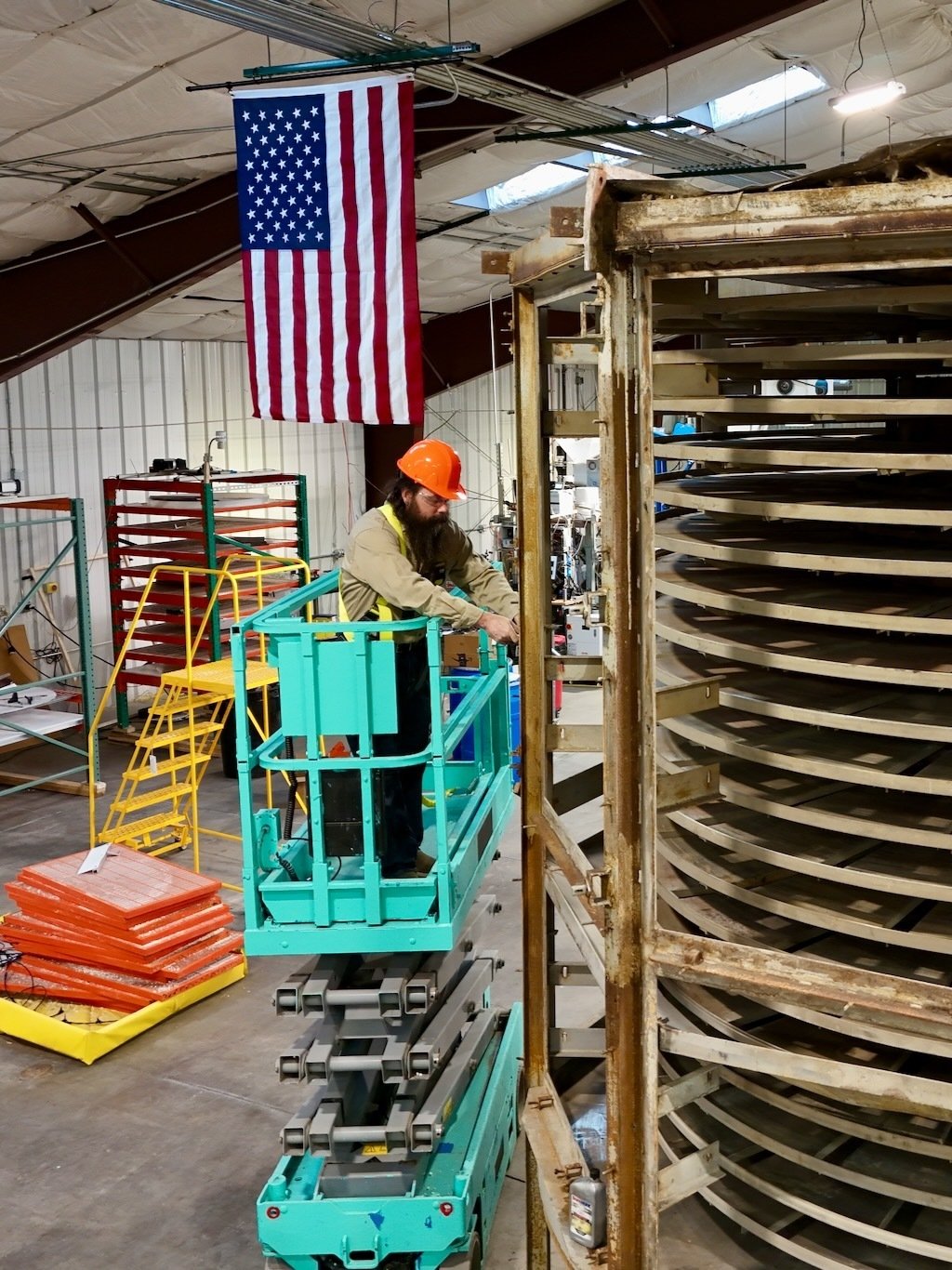
Spiritus's vocabulary is borrowed from agriculture, which is either charming or marketing genius depending on your temperament. A tree is a silo-shaped column packed with trays of sorbent pellets. A grove is a cluster of trees that together remove around 50,000 tons of CO2 per year. An orchard is the whole farm. Orchard One, the flagship facility planned for Wyoming, is being sized to sequester two megatons annually.
The pellets themselves are the company's crown jewels. They are a solid amine sorbent - a porous material with a chemistry tuned to grab CO2 molecules out of passing air and let them go again when a low-temperature steam treatment arrives. The released CO2 is then piped underground for permanent geological sequestration. The cycle repeats. The orchard breathes.
What They Sell
Spiritus Sorbent - the chemistry. Carbon Orchard - the facility. Orchard Power - a newer offering pairing firm electricity with integrated carbon capture, aimed squarely at data centers that would rather not be the villain of the AI energy story.
The whole system is modular. Add trays. Add trees. Add groves. Cost scales linearly because the unit of expansion is a pellet on a rack, not a bespoke pressure vessel. This is the part venture capitalists actually liked.
A Short, Useful Timeline
Three years from incorporation to a megaton-scale roadmap. The orchard grows fast.
05The Proof
It is easy to promise things in a slide deck. The harder thing is getting strategic investors with operational chemistry expertise to write a check. Spiritus has done that. Aramco - which knows a thing or two about moving large volumes of carbon - led the Series A. Mitsubishi Heavy Industries America, which builds power plants, joined. TDK Ventures, whose parent company manufactures industrial materials at planetary scale, also bought in. Khosla, the resident climate-tech believer, doubled down.
What "Cheap DAC" Actually Means
Approximate per-ton cost of carbon removal across approaches. Lower is better. Spiritus is the right-most number a venture investor wants to hear.
Sources: industry estimates; Spiritus stated target. Chart is illustrative.
Customers, too, are showing up. Watershed, the corporate climate platform, picked Spiritus as a marketplace supplier and made its first purchase. Frontier, the advance-market commitment fund backed by Stripe, Alphabet, and Shopify, has been an early signal-buyer. Prometheus Hyperscale signed on to anchor a carbon-negative AI data-center campus in Wyoming - an early, telling indicator of where this whole industry is heading.
06The Mission, Stripped of Decoration
You can read Spiritus's mission in two ways. The official version says something like: "accelerate sustainable stewardship of the climate through scalable, low-cost carbon removal." Perfectly fine. Approved by counsel.
The unofficial version is shorter. Make pulling CO2 out of the air cheap enough that someone will pay for it. Not as a gesture. As a line item.
Why It Matters
Most credible decarbonization scenarios require gigatons of CO2 removal per year by mid-century. At $1,000 a ton, that is fantasy. At $100, it is procurement.
The orchard metaphor is more than cute. It signals a posture - that climate technology should be patient, agricultural, low-drama. Plant the trays. Let the wind do the work. Pull the carbon. Repeat. The hard work is in the chemistry and the manufacturing, not the heroics.
07Why It Matters Tomorrow
Spiritus is not the only company chasing cheap DAC. It is, however, one of the few combining a passive air-contacting architecture with a low-temperature desorption process, in an industry where almost everyone else has chosen one or the other. The bet is that doing both attacks the cost curve from both directions.
There is a reasonable case that they will pull it off. There is also a reasonable case that scaling pellet manufacturing, sequestering CO2 underground at regulatory speed, and operating in a still-fragile carbon market will take longer and cost more than the slides suggest. Both things are true. Hard tech is hard.
What is clear is that the company has assembled the rare combination that climate hardware actually requires: lab-grade chemistry, operating partners with industrial muscle, a host community on the ground, and customers willing to pre-buy tons of removal they cannot yet see. That is not nothing. That is, in fact, most of the job.
Back to the field in central Wyoming. The wind is still steady. Soon it will pass through trays of small white pellets that look, at a distance, a little like fruit on a rack. On the other side, the air will be measurably lighter in carbon dioxide. Nothing dramatic. No flame, no fan, no roar. Just an orchard, doing what orchards do - quietly, on schedule, year after year.