Right now
I.The 4:17 a.m. file that disappeared
Aregional hospital in the American Midwest. Tuesday. A research coordinator opens her Google Drive and finds a folder she has worked on for eleven months replaced by a single document she has never seen. The filename is in a language she does not read. By 4:21 a.m. - four minutes later - a Spin.AI agent has frozen the encryption, flagged the offending OAuth grant, restored the folder from a clean snapshot taken at 3:00 a.m., and pinged the on-call admin in Slack. The coordinator finishes her shift without ever knowing what happened.
This is what Spin.AI does on an average weeknight. It is also the entire point of the company.
The problem they saw
II.SaaS swallowed the enterprise. Security stayed at the door.
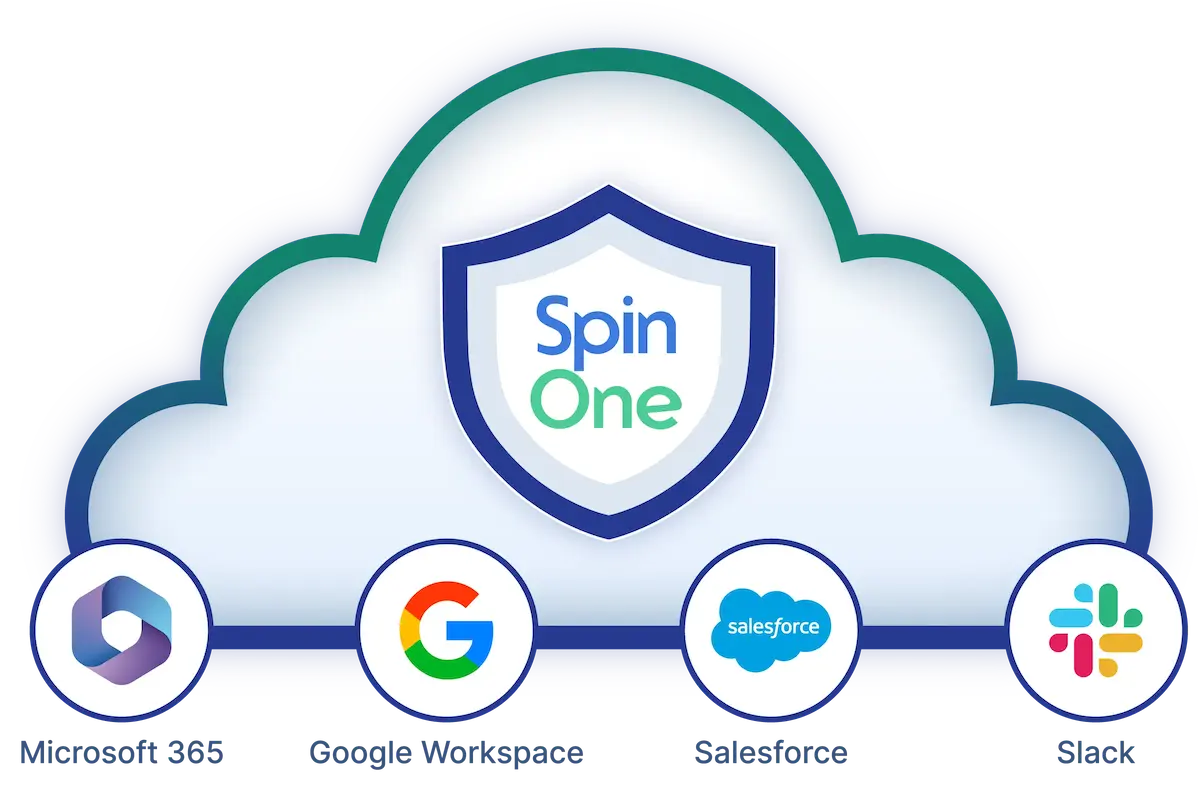
For roughly fifteen years, the cybersecurity industry pointed its budget at endpoints, networks, and identity. Reasonable - that's where the data lived. Then between 2015 and 2020, the data quietly left. It migrated into Google Workspace, Microsoft 365, Salesforce, Slack, and a long tail of SaaS apps nobody in IT had explicitly approved.
The vendors will tell you their platforms are secure. They are - mostly. What they don't cover is the customer side: misconfigurations, over-permissioned third-party apps, malicious browser extensions, rogue OAuth tokens, ex-employee accounts that nobody got around to deprovisioning, and ransomware that encrypts cloud files just as cheerfully as local ones. The shared responsibility model is a polite way of saying "the rest is your problem."
This is the gap Spin.AI noticed before most people had a name for it.
The founders' bet
III.One founder, one wager, two pivots.
Dmitry Dontov founded the company in 2017 under a less ambitious name: Spinbackup. The original product did exactly what it sounded like: backed up Google Workspace data so a careless click couldn't take a small business down with it. Useful. Unsexy. A category in waiting.
Dontov - twenty-plus years in cybersecurity, an engineer by temperament - made two bets that turned out to matter. First, that SaaS-to-SaaS attacks would become the dominant vector. Second, that the same machine-learning models being used to generate phishing emails could be trained, with sufficient stubbornness, to spot them. The company added ransomware detection, then posture management, then browser extension risk scoring. In 2022 Spinbackup became Spin.AI. The rename was accurate. The pivot, in hindsight, looks obvious - which is the only kind of pivot worth making.
The product
IV.Five products, one console, no fuss.
SpinOne is the umbrella. Underneath it are four working dogs, each with a specific job.
SpinSPM
SaaS Security Posture Management. Finds the misconfigurations, the over-permissioned OAuth grants, and the third-party app a marketing intern installed last Tuesday.
SpinBackup
Automated, version-controlled backup for Google Workspace, Microsoft 365, Salesforce, and Slack. Restores at the file, folder, mailbox, or org level.
SpinRDR
Ransomware Detection & Response. Spots in-progress encryption and rolls SaaS data back to clean snapshots before the ransom note loads.
SpinCRX
Enterprise browser security. AI scores every Chrome extension your workforce installs and quarantines the ones that fail.
The combined effect is mundane in a way most security tools are not. The dashboards are calm. The alerts are few. When something genuinely interesting happens, the platform tends to have handled it before the admin reads the email.
AuditedSOC 2 Type IIGDPR-aligned
- 2017Spinbackup founded in Palo Alto by Dmitry Dontov. First product: backup for Google Workspace.
- 2019Adds ransomware detection - among the first SaaS-native tools to do so.
- 2020Seed funding from Blueprint Equity. Microsoft 365 coverage ships.
- 2022$16M Series A. Spinbackup becomes Spin.AI. SSPM module launches.
- 2023SpinCRX (browser security) released. Three Global InfoSec Awards.
- 2024Salesforce and Slack coverage. Crosses 1,000 organizations.
- 2025Forbes' America's Best Startup Employers list. SSPM extends to 25+ apps.
- 2026K1 Investment Management announces a growth investment in March.
The proof
V.1,500 customers and counting (the numbers tell on themselves).
The skeptic's question for any security startup is: who actually trusts you with the keys? Spin.AI's answer is roughly 1,500 organizations in more than 100 countries, sold through about 400 channel partners, with a customer base that tilts toward education, healthcare, finance, and legal - the regulated industries that catch a lot of the world's worst headlines and would prefer not to.
Translation: more than half of Spin.AI's defended surface area is the place your team actually opens at 9 a.m. Google built the building - Spin watches the locks.
The mission
VI.What they are actually building.
The official mission - protect SaaS data against ransomware, human error, and insider threats - is true but flat. The interesting version is this: Spin.AI is making a bet that the next generation of cybersecurity teams will be smaller, not larger, and that AI will close the gap between what a tired admin can keep up with and what an attacker can throw at them. The product is built around the assumption that nobody has time to read a 200-page audit log. The console is built around the assumption that they shouldn't have to.
It is a quietly counter-cultural position in an industry that often confuses dashboard density with security maturity.
What it means tomorrow
VII.The next twelve months.
K1 Investment Management's March 2026 backing is not a small thing. K1 tends to write checks to companies it expects to consolidate categories, not just inhabit them. Spin.AI's roadmap suggests two directions: deeper coverage of the long tail of SaaS apps (the SSPM expansion to 25+ applications is already in flight) and more aggressive use of AI for incident response, where the lag between detection and action is still measured in human minutes rather than machine seconds.
If they execute, the next research coordinator at the next regional hospital may never have to think about whether her files are still hers. The work, as Spin.AI sees it, is to make the question stop being interesting.
VIII.Back to 4:17 a.m.
The hospital admin gets the alert and reads it twice. The folder is back. The OAuth token is revoked. The user is flagged for password reset. Nothing burns down. By 8 a.m., the only person who knows there was an incident is the admin, and even she has to scroll the log to find the timestamp.
This is the version of cybersecurity Spin.AI is selling: not heroic, not loud, not the kind of thing that ends up in a Netflix documentary. Just a folder that came back, on a Tuesday, before anyone had time to notice it was gone.
The company would consider that, on balance, a good night's work.