The expensive part of a subscription is often the month you forget it exists. A direct debit slips through, a broadband deal expires, a bill inches upward. None requires a financial catastrophe. Just a busy person with better things to do than interrogate a bank statement. Snoop has built a company around that moment of inattention.
The British personal finance app connects existing accounts and turns their transactions into a running commentary on spending. It flags bills, sorts purchases and suggests ways to cut costs. The ambition is concrete: catch something a customer can do something about. The branding is cheerfully peculiar. The financial lookout is a small, wide-eyed robot.
Behind it sits a less cuddly business question. How much is helping people spend less actually worth? Snoop attracted venture money, pursued a sale and became part of Vanquis Banking Group. Its story runs from a kitchen-table workshop to the balance sheet of an established lender, with useful lessons about both household budgets and startup economics.
01 / THE PRODUCTThe bill that slipped past you
Snoop’s natural customer is a UK adult whose financial life is scattered across bank accounts, cards and recurring payments. Its free app brings supported accounts into one view, categorises spending and builds budgets. It can flag a higher bill or a possible shortfall before upcoming payments. Personalised tips, called “Snoops”, connect that spending history to offers and ideas.
Take a household juggling a current account and two credit cards. Seeing grocery spending across all three is more revealing than looking at each balance separately. A recurring payment then becomes something to question: is the service still useful, has its price changed, and when can the contract be reviewed? This is an illustrative use case, but the chores are familiar.
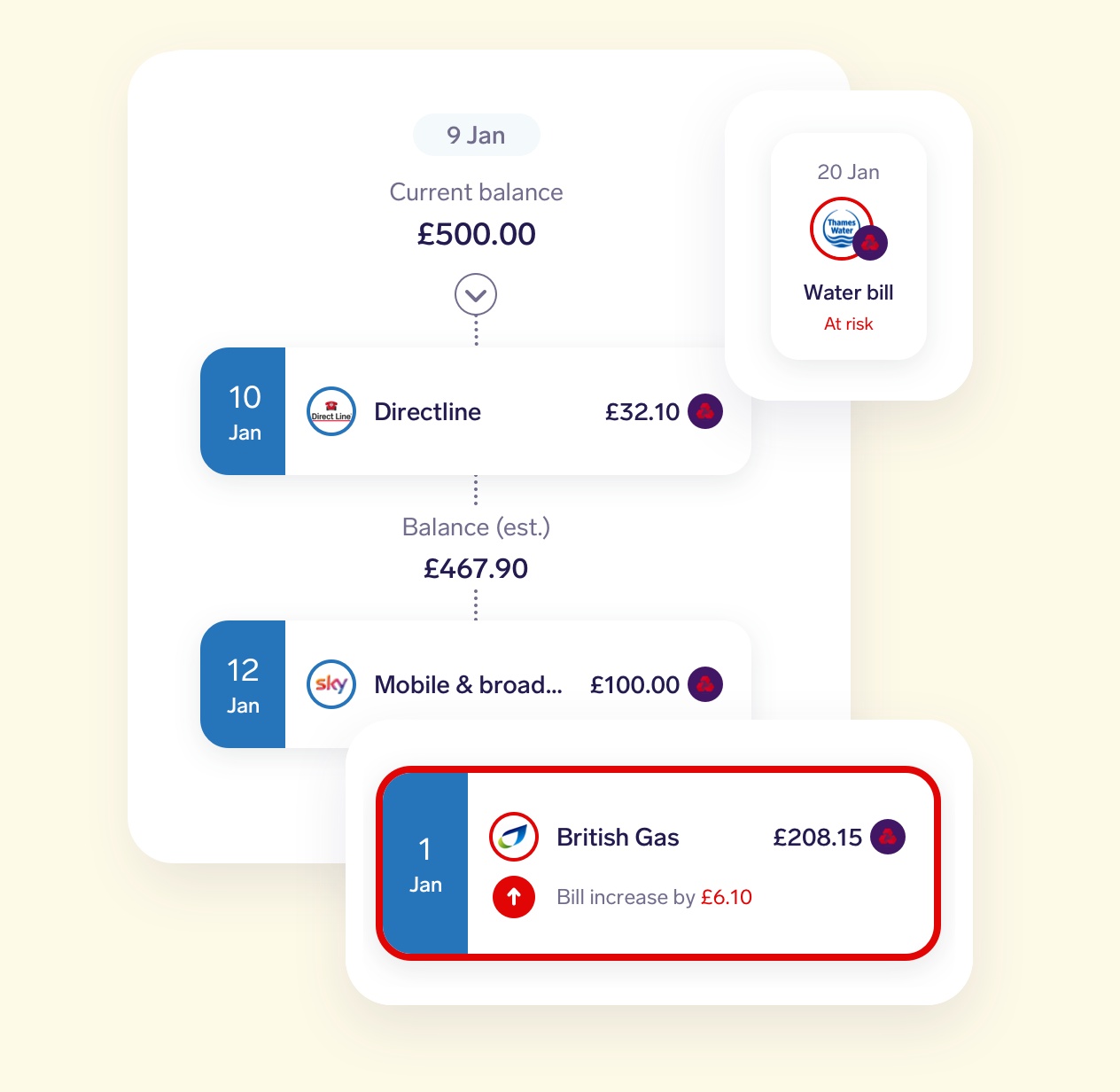
Account aggregation alone is hardly exclusive. Emma also combines accounts, budgets and subscription tracking. Snoop’s pitch puts particular emphasis on finding a saving at the moment the data makes it relevant. It occupies the space between a bank statement, a budgeting tool and a comparison website. The user can keep their bank and add a second pair of eyes.
That extra observer needs permission. Snoop uses open banking and says it never sees a customer’s bank password. Its security arrangements include encryption, two-factor authentication, monitoring and external audits. Usnoop Limited is FCA-registered for payment services. Those credentials concern how the service operates; the app’s terms explicitly distinguish its tips from advice on an individual’s financial circumstances.
02 / THE BEGINNINGA workshop, a lockdown, a robot
Snoop began in 2019 with a team that included former Virgin Money chief Jayne-Anne Gadhia, chief executive John Natalizia and technologist Jem Walters. Its own photo diary records a workshop at John’s house on March 6. By June there were offices in Waterloo and Norwich. An April photograph captured product work happening on the floor before office furniture had caught up.

The public app arrived on April 16, 2020, during the first UK lockdown. Early beta users supplied suggestions extending beyond tariffs to home-schooling and community help, according to contemporary reporting. That detail helps explain the character: a friendly messenger carrying practical ideas, with banking technology operating underneath.
The public mission remains to make people better off. Its team roster pairs engineers with customer-support staff and finance writers. There is substance to that combination. Detecting a transaction is one job; explaining why it matters without making someone feel foolish is another. The promise depends on both.
“Snoop was created to make everyone better off.”
Snoop’s stated mission
03 / WHO PAYS?Free has a business model
Snoop names three revenue streams: supplier payments when people switch, anonymised spending insights for businesses and a premium subscription. The same app can therefore serve a household looking for cheaper bills and a business studying consumer trends. Aggregated reporting is distinct from sending another company a named customer’s bank statement.
The optional Snoop Plus plan is advertised at £5.99 a month or £47.99 a year. It adds payday-based analysis, unlimited custom categories, refund alerts, manual accounts, net-worth tracking and transaction exports. A budget that follows payday may be more useful than one resetting on the first. An expected-refund alert can turn a vague mental note into a checkable task.
Accounts, budgets
and bill tracking
Or £47.99 billed annually.
Extra controls and reports.
There is an obvious commercial tension in recommending products while collecting referral payments. Snoop says the size of those payments does not drive its tailored suggestions. Customers can still compare an offer’s total cost, contract and usefulness. A recommendation becomes valuable when it improves the household’s position, not simply when someone taps through.
The often-cited £1,500 annual saving also needs its arithmetic attached. Snoop’s explanation combines example switching savings with changes such as cancelling an £8.99 monthly subscription. Some tariff comparisons use 2023 prices. The total is an illustration shaped by circumstances and action, not a measured result every user receives. A household already buying carefully has fewer easy wins.
04 / THE DEALThe price of building a money-saving app
For investors, the bill arrived in stages. An early £3.2 million round in April 2020 was followed by approximately £10 million through crowdfunding and government match funding. A £15 million Series A backed by Paulson & Co. in 2021 put the reported post-money valuation at £47 million. The ambitions then included international expansion.
By March 2023, Sky News reported that Snoop was working with Rothschild on raising capital or selling, following unsolicited approaches. Vanquis announced the acquisition in July; its accounts record completion on August 7. The buyer offered an existing customer base and support to develop the proposition. Distribution was part of the attraction, alongside money.
post-money valuation
acquisition consideration
Different dates and transaction structures. These figures are not a calculation of any individual investor’s return.
The acquisition accounting recorded £8.7 million of consideration: £3.1 million in cash, £3.3 million in shares and £2.3 million in contingent consideration. Vanquis separately reported £3 million of deal-related costs. For the acquisition-to-year-end period, Snoop generated £0.4 million in revenue and £2.5 million in losses. Those are partial-year figures.
The contrast with the earlier valuation is stark, although financing rounds and acquisition accounting measure different things. The defensible conclusion is narrower than a dramatic startup obituary: user appeal had not removed the expense of running the company. A free product could attract attention while still needing financial support and a route to more customers.
05 / THE EDITSA savings account, and a shorter product list
The product history contains an unambiguous retreat. Snoop removed its web app from service by November 2024. Desktop access was a feature it stopped offering. The mobile app continued, and the website still offers switching services. For someone who wants to do their budgeting in a browser, that is a meaningful limitation.
At roughly the same stage, savings entered the proposition. The easy-access account now starts at £1, with money held at Vanquis Bank and administration handled by Bondsmith. Issue 4 advertised 4.00% AER, variable, on September 7, 2026. Withdrawals requested before 11am are normally processed the same working day. Interest gives saved money a visible destination inside the app.
Users soon asked for more. In February 2025, a SnoopSpace discussion questioned the absence of separate savings pots. A staff reply said the priority had been getting the account out to customers, with development to follow. It is a small example of a public feedback loop: launch something usable, hear what people cannot organise, and consider the next version.
Credit monitoring adds another reason to return. Snoop’s free score uses Equifax information and updates monthly. It is a guide to credit standing, not a promise that a lender will approve an application. Spending visibility, savings and credit information now share a screen, though each solves a different problem.
06 / THE SECOND ACTA bank buys more than an app
Vanquis reported 328,000 active Snoop users at the end of 2025. That reached 335,000 by June 2026, including 44,000 Vanquis customers. The latter report also highlighted a new savings dashboard. These are active-user figures, a more useful measure of an ongoing habit than the accumulated download count.
The acquisition’s influence also reaches the parent’s working habits. Walters became Vanquis CTO in September 2023. In a March 2026 interview, he described initially being unsure about the role before conversations with senior management changed his mind. He wanted a more entrepreneurial technology operation and discussed plans to bring Snoop-style money management into the bank’s app.
That suggests a second way to value the purchase: as a source of software, experience and customer engagement inside a larger bank. It is an interpretation of the strategy, not proof of its eventual returns. The ownership change gives Snoop a different setting in which to justify its running costs.
07 / THE TAKEAWAYStart with the payment you keep ignoring
The practical lesson is easy to copy. Gather the accounts, inspect recurring payments, compare the next renewal and check that an expected refund arrived. Snoop packages those actions and reduces the remembering. A spreadsheet and calendar can reproduce parts of the routine, but the connected feed makes it easier to keep the picture current.
A useful first pass is deliberately modest: review one month’s recurring payments before setting ambitious spending targets. Mark the ones worth keeping, the ones needing a comparison and the ones to cancel through the provider. Then check the following statement. Finding a payment and actually stopping it are separate tasks; the second check establishes whether the decision reached the bank account.
The conditions matter. Unsupported accounts leave gaps; at least one supported account must be linked to use Snoop. A prompt cannot make a poor switching offer worthwhile, and a budget cannot create income. The app earns its place when information changes a decision. Its robot has an undignified but useful assignment: keep asking about the payment everyone else has stopped noticing.