The most expensive number in a hospital may be the one nobody sees. A payer sends a remittance. The accounting system records it. The month closes. Somewhere between a negotiated contract and that final deposit, a few dollars disappear from one claim, a few thousand from another. The payment looks official, which is not the same as being correct.
SlicedHealth, an Atlanta-area healthcare software company founded in 2019, is built around that unglamorous gap. Its platform reads and models payer contracts, calculates what a provider should receive, compares that expectation with what arrived, and hands the revenue team a list of discrepancies worth investigating. In a market stuffed with dashboards, the useful unit is not the chart. It is the appeal that can be filed, the contract that can be renegotiated, or the money that can be recovered.
The receipt is the product
The cleanest illustration comes from Goodall-Witcher Healthcare, a 25-bed critical-access hospital northwest of Waco, Texas. Its leaders suspected larger payers were underpaying, but suspicion is a weak instrument in a reimbursement dispute. Small hospitals rarely keep large contract-modeling teams. Staff members already juggling billing and denials cannot manually reconstruct every carve-out, fee schedule and priority rule.
Goodall-Witcher had considered other contract-management and business-intelligence systems. Some were too expensive. Some vendors were not interested in a smaller facility. An anticipated EHR solution had not solved the immediate problem. SlicedHealth offered a pre-purchase review, a way to upload payer contracts without a capital-intensive interface project, and service that the hospital felt matched its budget and staffing reality.
In the first month, the software identified $280,000 in underpayments across only a handful of accounts. One Medicare Advantage payment was $50,000 below the modeled contract amount. The hospital reported collecting $55,000 while further items moved through adjudication and scrubbing. Its president and CEO, Adam Willmann, said the product had paid for itself in that month.
“With SlicedHealth, we can do more without hiring additional staff.”Adam Willmann, Goodall-Witcher Healthcare
That story answers two questions buyers usually care about more than feature lists: what did it cost, and when did the risk fall? SlicedHealth sells modular enterprise contracts shaped around the organization, products and service involved. Goodall-Witcher's decision changed when a test produced evidence, implementation did not require a heavy interface, and the expected recovery could be compared with the product cost. The buying argument became arithmetic.
From contract to work queue
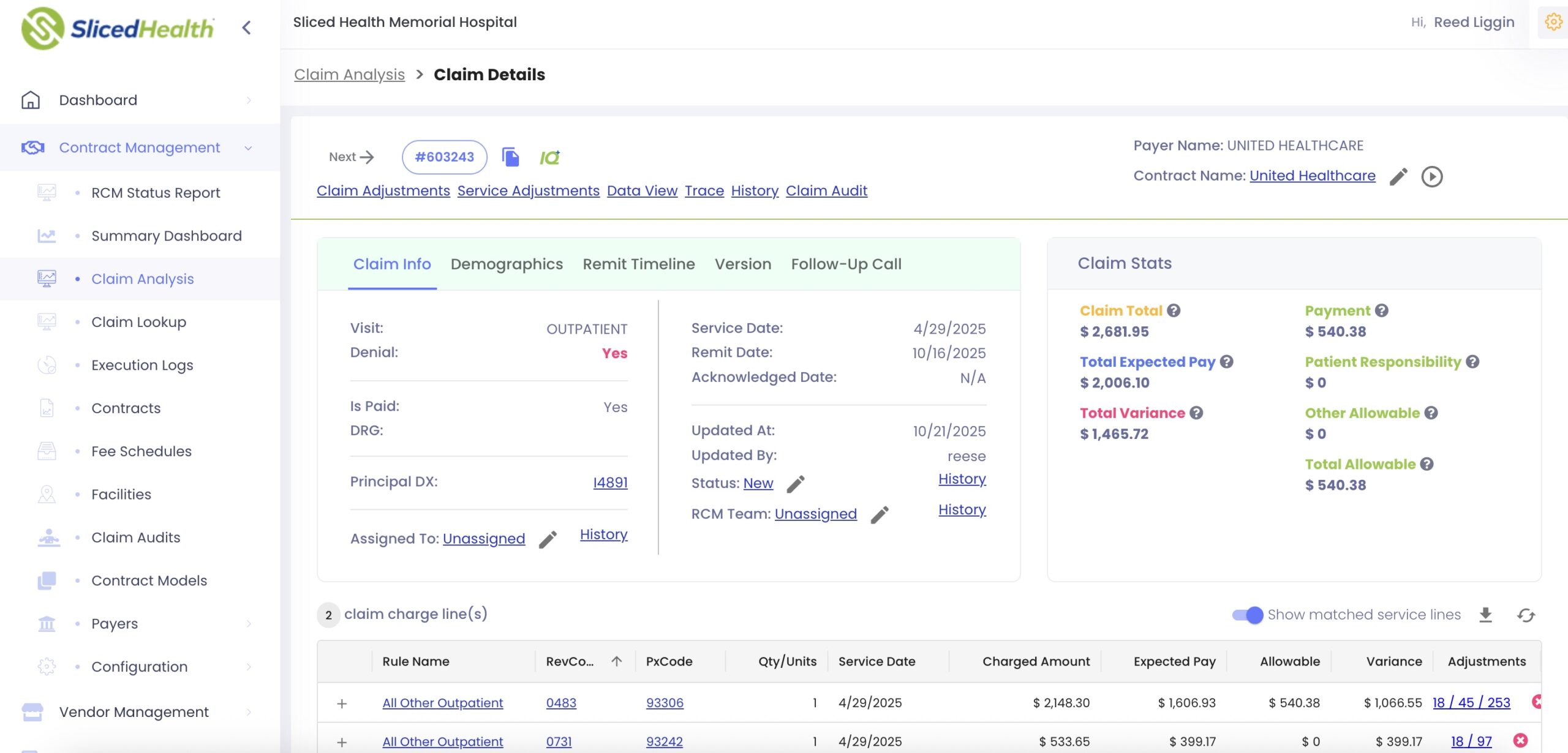
A payer contract is not simply a price list. It may contain case rates, exclusions, stop-loss provisions, special fee schedules and rules that apply in a particular order. SlicedHealth converts those terms into structured reimbursement logic. Its Variance Analysis product then applies the logic to claims and payments, looking for underpayments, denials and patterns in payer behavior. Instead of asking an analyst to inspect everything, it emphasizes higher-value exceptions.
SlicedIQ is the intelligence engine underneath the suite. The company describes it as a set of specialized AI agents working in a HIPAA-compliant environment, built for contract interpretation and reimbursement analysis rather than open-ended conversation. Business Intelligence tracks financial and operating performance. Claim Estimation uses contract terms and real reimbursement patterns to set expectations before care and improve upfront collection. Price Transparency supports the public files and pricing data hospitals must maintain under federal rules.
The newest expansion is GROW - short for Govern Revenue, Operations and Workflows. Its studios centralize contracts, supply-chain agreements, credentialing and compliance work, and projects. This is a larger claim than finding an underpaid claim: that the same agreement-centric intelligence can become an operating layer for a hospital. It also creates the classic vertical-software opportunity to land with one acute problem and expand across adjacent workflows.
Who is it really for?
The customer set includes health systems, hospitals, specialty practices and ambulatory surgery centers. The sharper wedge is the community or rural provider: sophisticated enough to have complicated managed-care contracts, too lean to maintain a large reimbursement-analysis department, and under enough margin pressure that missed revenue matters immediately. Heart of Texas Healthcare System is another named user, and partnerships with organizations serving rural providers reinforce the focus.
The company reported in 2023 that it had analyzed more than $3 billion in claims and uncovered hundreds of millions in denials and underpayments. Those are company-reported aggregate figures, not audited financial results, but they explain the scale of the hunting ground. A tiny percentage error across billions of dollars becomes a very large market.
Its business model is enterprise SaaS wrapped in expert service. Buyers can start with a module and expand, while implementation and ongoing contract expertise reduce the burden on the customer's team. The service layer is important. Contract software is only as credible as the models inside it, and an incorrect model can create a beautiful list of false alarms. SlicedHealth's “elevated service model” is partly customer experience and partly quality control.
Different from another dashboard
SlicedHealth competes with revenue-cycle platforms, contract-management vendors, specialist consultants, EHR analytics and the most persistent incumbent in enterprise software: a spreadsheet maintained by somebody indispensable. Larger alternatives include FinThrive, Waystar, Experian Health, Craneware, Infinx and AKASA, though their products and target customers overlap in different ways.
The distinction SlicedHealth wants buyers to notice is the link from contract language to payment accuracy. A general analytics tool can show that revenue fell. A contract model can argue that a specific payer owed a specific amount under a specific rule. The first is observability. The second is leverage.
Partnerships widen the system without forcing SlicedHealth to build every part. PatientPay adds a digital patient-payment layer. Quadax connects clearinghouse and claims execution with contract expectations and payment outcomes. Athenahealth provides an integration route. ScribeEMR ties clinical documentation support to downstream revenue-cycle performance. The Cottano Group offers reach and service in community and rural hospitals.
Where the model breaks
No contract-intelligence tool creates revenue by merely finding a discrepancy. The hospital still needs usable contracts, clean enough claim and remittance data, and people or services capable of appealing, rebilling and following through. If payer terms are missing, amendments are scattered, or source data is unreliable, the expected-payment model will inherit the mess. If the organization has very low claim volume or little negotiated payer exposure, the recoverable pool may not justify the software.
The first thing likely to fail is not the algorithm but operational trust. Too many low-value alerts will be ignored. A modeled variance that finance cannot explain will not survive a payer conversation. And a promising recovery list without staff capacity becomes a more sophisticated backlog. This is why SlicedHealth's emphasis on hands-on support and prioritization is more than packaging: it is a response to the point where revenue-integrity projects commonly stall.
There is also expansion risk. The further GROW moves from reimbursement into supply chain, credentialing and project management, the more crowded and varied the competition becomes. The product must preserve the specificity that made the original pitch credible. “We found the claim that was paid $50,000 short” is a sharper sentence than “we govern operations.”
A company built in the mismatch
CEO and co-founder Reed Liggin has spent decades where healthcare and software meet. A pharmacist by training, he previously co-founded rural-hospital EHR company RazorInsights, which athenahealth acquired in 2015. At SlicedHealth, he works with co-founders Mike McKenzie, the chief operating officer, and Reese Walker, the chief product officer. The company has roughly 42 employees according to supplied company data.
Arthur Ventures invested $5 million in Series A funding in July 2024, with the company saying the money would accelerate AI, machine learning, automation and product expansion. A debt-financing event followed in 2025.
What makes SlicedHealth interesting is not that hospitals have data. Everyone in healthcare has data. It is that a relatively small provider can use contract logic to create an evidence-backed claim against a much larger payer - without first building an analytics department. The software's best moment is when a quiet discrepancy becomes a number somebody can collect.
For founders, the copyable lesson is compact: find the promise a powerful institution made, find the transaction that tests it, and give the smaller party a receipt. For hospital leaders, the practical test is equally plain. Pick a payer, a contract and a recent batch of payments. Run a limited review. Measure identified variance, collectible dollars, time to action and false positives. If the recovered cash exceeds the cost and the team can work the queue, expand. If it cannot, no amount of AI vocabulary improves the math.