Theodore Search had a question about chemotherapy. An infusion pharmacist preparing to care for a discharged patient, he wanted another pharmacist’s advice about dosing a new product. Ordinary social networks offered plenty of people and very little reassurance about this particular conversation. According to Skipta’s account of its origins, the clinical nature of the question made him reluctant to use them. The missing feature was a room whose occupants belonged there.
- Verified professionals gather in communities organised by specialty and disease.
- Pharma and life science teams pay for targeted content and engagement.
- A shared technical foundation lets distinct communities operate together.
In 2009, Search established Pharmacist Society. Skipta now describes a network of more than 50 medical communities. Its current membership claim exceeds one million verified healthcare professionals. Those figures describe the company’s reported reach, rather than how many people arrive each morning. The smaller unit, the specialist community, remains the more interesting invention.
A nation of very particular people
Consider the names: Cardiologist Connect, Urology Nation, Neurologist Connect. They sound like countries established by people who got tired of explaining what they do. Their purpose is practical. A professional can find clinical discussion, research and peers within a setting already organised around the work. Expertise becomes a condition of entry and a reason to return.
Skipta’s published member testimonials describe that usefulness in modest terms. Cardiologist Lynn Cronin recalls losing easy access to colleagues after moving from an academic hospital to a smaller community practice. Neurologist Huma Sheikh points to relevant reading. The appeal is familiar to anyone who has changed jobs: the useful colleague once down the corridor has suddenly become harder to reach.
“It’s helpful to have journal articles curated based on my specialty and subspecialty.”Dr. Huma Sheikh · Skipta member testimonial
The network also gives commercial customers a defined audience. Pharmaceutical and biotech teams need to reach professionals who influence treatment choices. A specialist forum supplies context alongside identity. An oncology message arrives among oncology material, rather than hoping to catch a relevant person somewhere in the general online crowd.
The guest who pays for the room
Skipta’s economics have long depended on two constituencies. In 2015 reporting, membership was free; advertising and custom networks for organisations, schools and societies generated revenue. That February, Mansa Capital led a $2.5 million funding round. Skipta operated 28 networks and planned to spend the money on new communities, membership growth and its executive team.
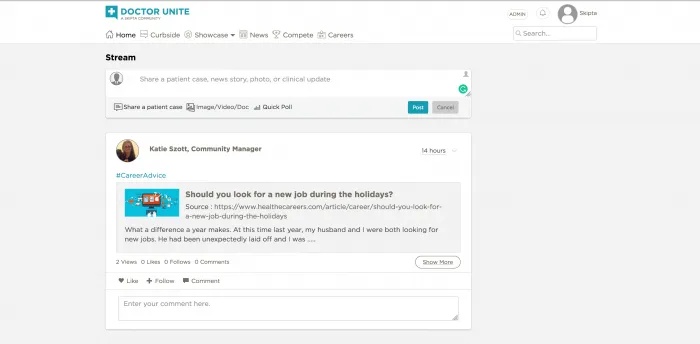
Today’s commercial catalogue offers several ways into the conversation. InStream Post places brand text, images, files and video in the community feed, including safety, efficacy and study updates that can be read without clicking through. Showcase embeds a brand’s website within a community. Skoop Email brings sponsored information to the inbox. Each reduces a different distance between the advertiser’s material and its intended reader.
The expertise here combines community management, medical content, campaign delivery and audience segmentation. Skipta also sells expert Q&As, lectures, discussions and roundtables. For a clinician, these formats can offer relevant information and peer exchange. For a sponsor, they create identifiable places to present material. The arrangement works only while the professional has sufficient reason to keep visiting.
Thirty-two doors, one set of plumbing
There was a less glamorous problem behind those rooms. In a 2018 case study, development partner Asentech described communities built in core PHP and other frameworks without common code standards. Sites behaved differently even when they were meant to behave alike. Maintenance consumed time and money. Administrators had limited access, so routine work kept landing with the technical team.
Asentech rebuilt the solution with Drupal 8 multisite. Its account describes common code and tools across 32 community sites, with room for different designs. Administrators gained more control over content and users, reducing requests to developers. The published account supplies the operational explanation without assigning a dollar saving. Separate audiences could have distinct identities while sharing the machinery behind them.
That is the piece another business can copy: preserve the differences customers value, then standardise the repeated work underneath. A professional community needs its own conversations. It need not require its own version of every technical fix.
The message gets a clock
Skipta’s current position inside Norstella adds data to that community model. SkiptaNXT uses engagement and real-world-data signals to guide subsequent messages; its product description includes weekly updates to physician segments. Lab Alerts can trigger outreach when testing occurs or particular results arrive. A marketer can coordinate email, feed posts and banners around an event rather than relying entirely on a calendar.
Market Access Messaging brings another kind of relevance: insurance coverage. It uses sibling company MMIT’s information to customise messages for plans in a professional’s area. MMIT also offers bundled promotion with Skipta. Knowing a medicine exists and understanding whether local patients can obtain it are different information needs. The product catalogue addresses both.
- 01 Identify a relevant professional
- 02 Match specialty, activity or a data trigger
- 03 Deliver approved content in feed or inbox
Who actually moves the decision?
An April 2026 case study offers a revealing audience choice. An unnamed oncology brand used Skipta and NorstellaLinQ to identify specialty pharmacists involved in access and treatment decisions. Skipta advertises “3X higher performance” on the landing page. The more transferable lesson is the targeting choice: a campaign concerned with access has reason to include the professionals who help navigate it.
Skipta competes for professional attention and commercial budgets alongside Sermo, Doximity and medical media. Its recognisable proposition is the combination of specialist communities, verified audiences and data-informed promotion. It suits campaigns with a defined professional audience and relevant material to deliver. Poor audience matching, weak content or unreliable triggers would undermine that logic. A large membership total cannot repair any of those problems.
The original question was narrow. That narrowness became a design choice, then a commercial asset. Skipta’s story gives community builders a useful test: can you name the conversation your members came to have? Search could. It involved a pharmacist, another pharmacist and a patient whose treatment required an answer.