Before Hyland could teach people to use its software at a conference, it had to get the computers there. The company’s old arrangement involved locally hosted servers and on-site lab infrastructure. A workshop was also a small construction project. More students meant more machinery, more coordination and more opportunities for the lesson to begin with an apology.
That is a useful place to meet Skillable. The company supplies virtual environments in which people can use software, practise technical tasks and take practical assessments. Its less glamorous accomplishment is making those environments available without asking the education team to moonlight as a travelling datacenter.
- The product: hosted practice labs, custom lab authoring and performance checks.
- The buyers: software companies, training providers, certification teams and enterprise educators.
- The attraction: repeatable environments that can serve a class, a customer demo or a scored assessment.
- The catch: someone still has to choose useful tasks, maintain the content and pay for the computing.
The classroom had a freight bill
Hyland’s homegrown lab system could not comfortably meet growing demand at user events. The constraint was operational: updating environments, handling late registrations and relying on IT staff to keep everything working. Its education team moved the lab ecosystem to Skillable, where participants could launch environments without the local server arrangement.
In the customer case study published by Skillable, Hyland reports an 80% reduction in the time needed to update and deploy event labs. Training rooms grew from 25 seats to more than 100. The company also repurposed the labs for a premium training subscription. An exercise built for a conference could earn its keep after everyone went home.
The lesson is pleasantly mundane. Sometimes a learning program needs a better exercise. Sometimes it needs the same exercise to stop requiring a heroic amount of preparation. Skillable sells tools for both problems, and the second is easy to overlook until your instructor is waiting for a virtual machine.
A rehearsal with something at stake
A virtual lab gives a learner an environment to manipulate. Skillable adds instructions, tasks and, where configured, checks on the state of that environment. A person can explore a product, follow a guided exercise or demonstrate that a requested change has been made correctly. Those are different experiences, even when they use similar infrastructure.
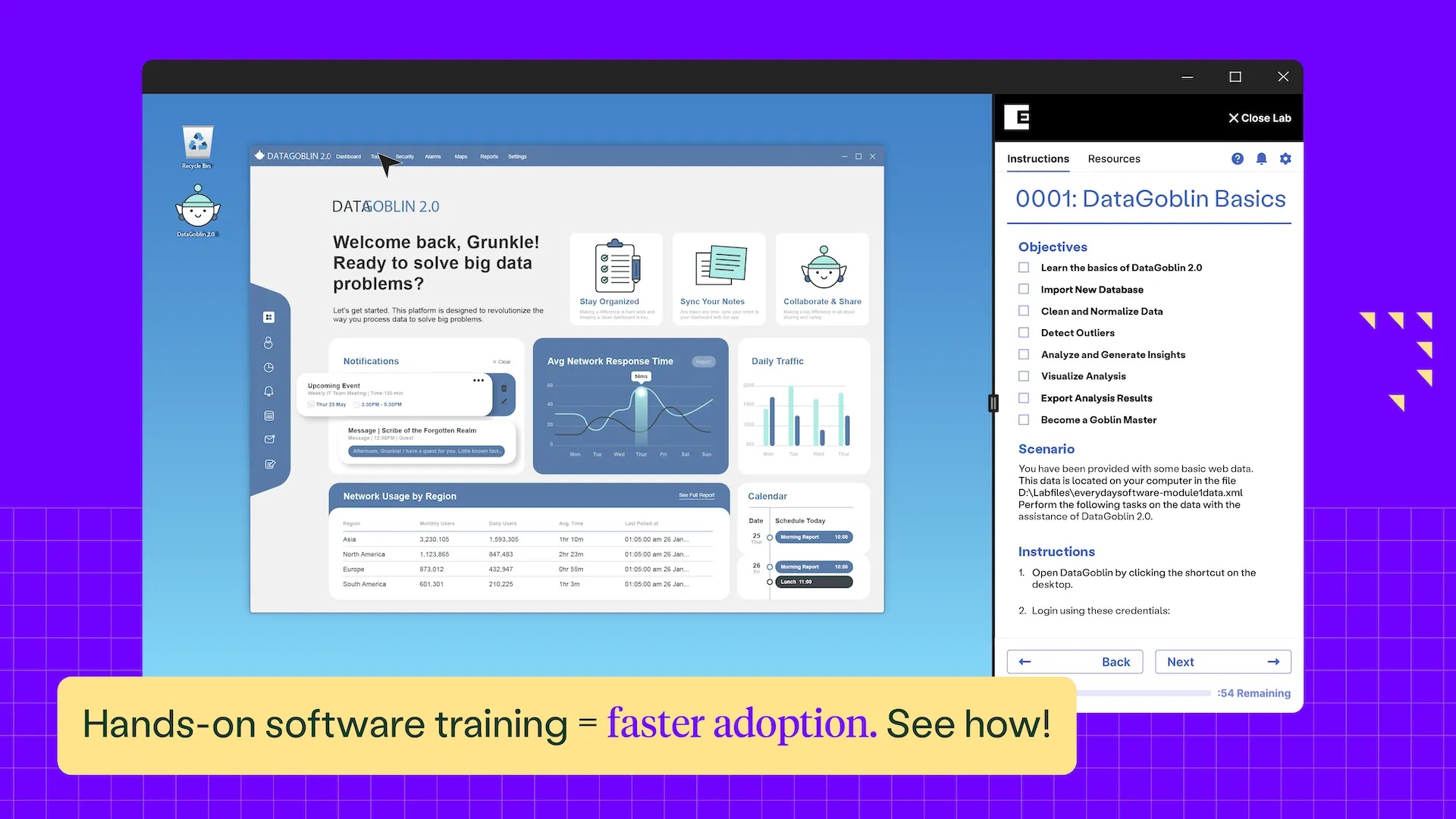
Skillable Studio is the workshop behind the workshop. Authors build and customise labs; developers configure networks and scripts; administrators control permissions; reporting tools expose activity and performance. Labs can connect to an existing learning management system, or use Skillable’s own training management system. Professional services help organisations that need lab development or courseware expertise.
For teams that want existing content, Skillable Challenges supplies more than 1,300 labs across areas including cybersecurity, cloud computing, programming and data science. Its scenarios can increase in difficulty, with hints or documentation available according to the level. The platform checks the live environment to see whether tasks were completed.
“work in a test environment to set up something real.”
Nicola Keskin, TD SYNNEX’s Academy, describing Skillable Challenges
The distinction matters. Following instructions demonstrates that you can follow instructions. An assessment has to decide what evidence would show independent competence. A lab supplies a place to collect that evidence; the quality of the judgment still depends on the task and its scoring.
The expensive part was waiting
Majesco, which makes insurance software, had already tried giving learners sandboxes. The first failure was that completed training did not reliably translate into basic job tasks. The next was the burden of the sandbox itself: downtime, configuration work, limited availability and repeated demands on experts.
What changed the calculation was counting the interruptions. Majesco included environment setup, troubleshooting and learner delays in its opportunity costs. Its Skillable case study reports $300,000 in annual opportunity cost savings after the redesign, a four-month launch and more than 30 labs. That number describes recovered capacity; it is not a receipt for the software.
The cost of waiting and fixing was part of the training budget, whether anyone had put it there or not.
Quest Software attacked a related problem in partner education. Its program used hands-on practice and performance testing, with automated work checks and results passed back through an integration. The published case study reports an 85% reduction in certification costs per candidate and a 183% increase in partner-led sales. It also describes fewer enrollment support tickets and shorter support workflows.
The sales result is a customer-program outcome, not proof that a lab platform alone caused growth. The more portable lesson is the workflow: remove repeated manual handling, put the exercise where partners already learn and return useful results without another round of administrative correspondence. A training program should not need its own pen pal.
The bill follows the environment
Skillable primarily uses consumption-based pricing. Annual lab hours and environment size influence the bill. A lab requiring 32GB of RAM costs more per hour than one requiring 8GB. That makes environment design a commercial decision as well as an instructional one: extra computing has to justify its place in the lesson.
There are public examples for particular offerings. Skillable’s Azure Lab Services page estimates a small instance at $1.163 per hour when using the customer’s subscription, or $1.196 with Skillable’s subscription. Its example of 50 students using 40 hours each comes to $2,326 or $2,392 respectively. The Skillable-subscription option also requires a one-time setup fee. These are that package’s estimates, not a universal price list.
Cloud Slice, introduced in 2018, provides isolated access for many learners within a cloud subscription. Customers can use their own accounts or Skillable-managed ones. The documentation makes the tradeoff concrete: using your own means taking on more account administration; using Skillable’s includes its cloud pricing plus a 25% management fee. Dedicated lab accounts are recommended when bringing your own.
That is also where a buyer should compare alternatives. CloudShare and Strigo offer hosted environments and hands-on training too. Skillable’s case rests on the combination of lab authoring, content, scoring, integrations and delivery experience. A browser-based lab alone is not an exclusive invention. Ask each provider to run the actual workload.
A lab can have a second career
Corey Hynes founded holSystems in 2004. It grew as a Microsoft lab delivery vendor; its 2014 merger with Terillian Technologies created Learn on Demand Systems. Shamrock Capital invested in March 2021, and the Skillable name arrived that November. The business has roots in the practical demands of technical education, rather than a recent discovery that people enjoy interactive screens.

The customer base includes software companies and training providers. Calix, for example, used professional services to develop reusable templates and learn to build scored labs for its broadband education program. The same platform can support customers learning a product, sellers rehearsing a demonstration and candidates attempting a certification task.
Distribution now extends to commerce. Skillable Storefront lets providers sell labs through a branded store; Marketplace lets buyers purchase lab packages by credit card. That gives content another route to an audience. The inventory is an experience someone can launch, rather than another document someone can promise to read.
In April 2026, Skillable announced an expansion into academic markets. In August, its AI capabilities became generally available across authoring, learner guidance and performance validation, with supported models and a bring-your-own-model option. These developments widen the ways labs can be built and used. They do not relieve an educator of deciding what deserves practice.
Even the company’s work arrangements have an operational flavour. Skillable describes itself as fully remote, with a monthly home-office stipend and Friday afternoon sign-off for employees who have met their commitments. Its stated culture puts accountability beside balance. Deliver the work, then close the laptop: a sensible instruction for a company selling evidence of performance.
Start with the task, not the catalog
The useful thing to copy is the sequence. Pick a task that matters to a customer or a job. Decide what successful execution looks like. Give people somewhere to practise it, then inspect the result. Reuse the environment only where the task and audience still fit.
That approach has conditions. A complex environment can be excessive for an introductory audience: Skillable’s unnamed Fortune 500 customer used simulations because its deeper technical labs were too involved for AI sellers. High-stakes tests need assessment expertise, not just functioning servers. Content still needs maintenance, and access still depends on a usable network and browser.
Skillable is most interesting when the question is specific: can this partner configure the product, can this employee perform the task, can this customer try the feature? A certificate can remain a pleasant souvenir. The lab gives the organisation something else to look at: the work.