The house is available. The buyer is available. The seller, regrettably, has a dog, a meeting and a rather different understanding of “available.” Before anyone admires the kitchen, somebody must make those facts agree. In residential real estate, the front door is often easier to open than the calendar.
ShowingTime made that small predicament its business. Founded in Chicago in 1999, it supplies the scheduling software, appointment coordination and feedback tools that sit behind a home tour. Its paying audience is largely professional: agents, teams, brokers, offices and multiple listing services, or MLSs. Buyers and sellers encounter the results as notifications, confirmations and a little less uncertainty.
- ShowingTime connects appointment requests with listing rules and seller responses.
- Its advertised individual-agent Appointment Center plan costs $15 a month and includes access to live appointment specialists.
- Zillow announced a $500 million purchase in 2021; final cash consideration was approximately $512 million.
- The useful lesson: make the next step easier inside the system customers already use.
The expensive space between two calendars
Consider a hypothetical Saturday with four houses on the itinerary. A buyer’s agent needs times that make geographic sense. Listing agents need to know who is coming. Occupants need notice. Each change can unsettle the rest of the route. A calendar invitation alone cannot settle who has permission to visit, which instructions apply or whether a request has actually been accepted.
ShowingTime for the MLS places a scheduling button alongside a listing. Agents can request appointments, configure unavailable times, use mobile tools and review activity reports. The older ShowingCart feature lets them group properties into a buyer’s tour with a map and driving directions. In the next-generation interface, single appointments and multi-stop tours share one scheduling experience.
The distinction between requested and confirmed is the important one. An appealing house on a screen remains an appealing house on a screen until somebody settles the visit. ShowingTime works on that transition. The product has to carry a decision through a network of people who have different responsibilities, rather than merely display an empty square on Tuesday.
- 01RequestBuyer’s agent picks a time
- 02CheckListing rules and availability
- 03ConfirmPeople receive the decision
- 04LearnFeedback follows the visit
There are people inside the software
Appointment Center adds a service component: live appointment specialists available around the clock. Agents can outsource scheduling while using desktop and mobile tools to track their listings. Front Desk serves offices and teams managing appointments internally; Live Connect adds live call answering. The choice is partly about where the administrative work should happen.
That combination is distinctive. A general-purpose booking tool can accept a time slot. Real estate coordination includes listing-specific instructions, seller availability, multiple agents and the consequences of a delayed response. ShowingTime sells software, but it also sells access to people who handle the calls. Anyone who has tried negotiating an occupied house’s timetable can appreciate the difference.

The human layer also helps explain its expansion. In 2019, ShowingTime acquired Centralized Showing Service, another showing-management business. Accel-KKR Credit Partners and Wells Fargo Capital Finance supplied acquisition financing. Founder Scott Woodard described debt as a way to accelerate growth without diluting the equity the company had built. The lenders did not disclose an amount.
Woodard’s background included engineering and automated voice notification technology. Michael Lane, a founding management team member who became president in 2013, had worked as a consultant and served aboard nuclear submarines. Scheduling a suburban viewing is less dramatic than submarine duty, but both careers give the phrase “coordination problem” a certain weight.
Fifteen dollars, with a local asterisk
The advertised individual-agent Appointment Center subscription is $15 a month. Team and office plans require a sales conversation. MLS arrangements vary too, and some members already receive particular tools through their subscriptions. Shopping sensibly therefore begins with checking what the local MLS supplies and what the agent’s own workflow needs.
Appointment Center individual-agent subscription. Team and office terms vary; Offer Manager is subject to market availability.
Offer Manager organizes offers by listing and retains buyer-agent contact information. Target Market Analysis and Pricing Benchmark reports help agents discuss pricing and showing activity with clients. Those tools extend the service beyond booking, though the advertised availability qualifications matter. A nationwide brand can still deliver different feature combinations in different markets.
For sellers, Home by ShowingTime provides an agent-connected view of upcoming appointments, listing activity and feedback the agent shares. Buyers can see appointment status and details. The seller guide distinguishes requests requiring approval from “Go & Show,” where no approval is required. Choosing an appointment type changes the amount of waiting built into the process.
A practical way to copy the workflow is to make those decisions before the first request arrives: establish showing windows, choose suitable approval rules, set notification preferences and invite the seller into the client app where available. Otherwise, automation can faithfully reproduce an unresolved decision at impressive speed.
The charts behind the appointments
ShowingTime also has a quieter business in market statistics. InfoSparks lets real estate professionals compare up to four geographies, filter housing data and share branded charts. An agent can narrow a conversation from “the market” to a particular location, price range or property type. That is a more useful starting point than treating every house in a city as interchangeable.
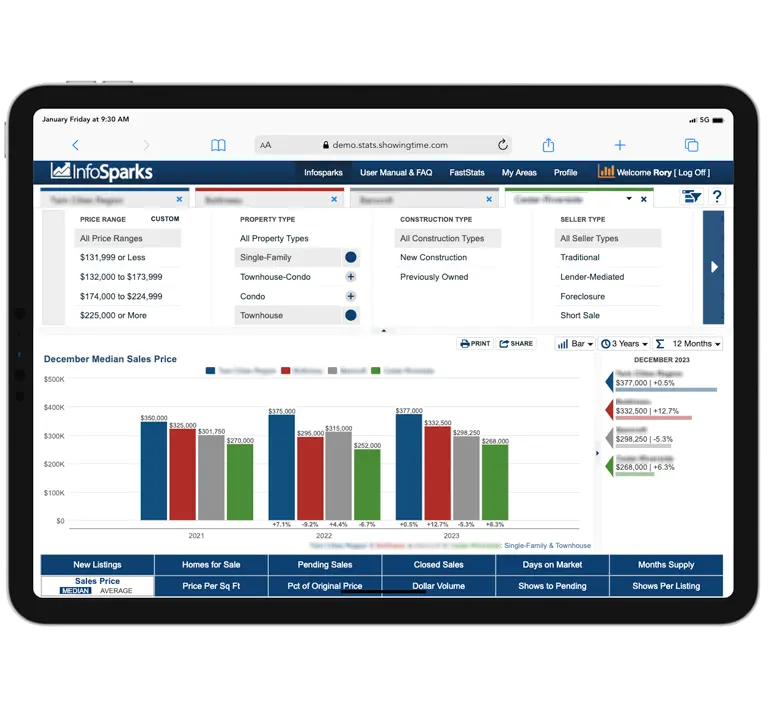
FastStats takes a different approach: prepared reports, selected through local geographies and interactive maps. The division of labor is sensible. Some conversations need custom investigation; others need a readable report immediately. OneKey MLS’s March 2026 resource update confirms both products are included with its subscription, illustrating how analytics can reach agents through their existing membership.
The Showing Index measures average buyer showings on active residential properties each month. For February 2026, it reported U.S. traffic down 5.2% year over year. Showing activity can help describe interest before a transaction closes, but a visit is not an offer. Treat the index as a view of demand, with its own coverage and timing, rather than a verdict on what any individual home will fetch.
The calendar Zillow wanted
On February 10, 2021, Zillow announced an agreement to acquire ShowingTime for $500 million. The purchase closed on September 30. Zillow’s subsequent annual filing reported approximately $512 million in cash consideration. The February announcement was the agreement, not the completed acquisition - a small date distinction with eight months inside it.
At announcement, ShowingTime described a reach of nearly one million real estate professionals. Zillow said the platform would stay open to existing and new partners and maintain its existing privacy policies. At an industry discussion that month, Lane said the commitment to openness and investment in scheduling research and development was a main reason for agreeing to the sale.
“Seeing a calendar that’s connected to something real breaks down a barrier between shoppers and agents.”
Greg Fischer, West + Main Homes managing broker
A brokerage example makes the logic tangible. In January 2023, West + Main announced real-time tour availability for supported Colorado listings on its website. Real Estate Webmasters built the API integration using ShowingTime information. Unsupported listings retained a standard contact form. The improvement had a clear boundary: it worked where the underlying listing and scheduling connection existed.
The purchase also changed the politics around the product. Some agents and MLS leaders raised concerns about Zillow ownership and showing data. In December 2023, Zillow and ShowingTime sued MLS organizations over alleged exclusion of ShowingTime integrations in the Phoenix and Milwaukee markets. Those were allegations in a legal dispute, not findings of wrongdoing. They reveal how much an appointment service depends on access to someone else’s network.
A plus sign does not book the house
In September 2022, Zillow introduced ShowingTime+, a broader brand grouping ShowingTime with dotloop, Bridge Interactive and listing-tour tools. ShowingTime’s scheduling service and that wider portfolio are worth distinguishing when comparing subscriptions. The company’s appointment expertise does not mean every product under the plus sign arrives in one agent plan.
The next-generation redesign offers multi-stop scheduling, calendar views, a notification center and offline appointment details. Some features, including MLS single sign-on, depend on the market. Its 2023 pilot let users try the redesign while retaining the classic version; May 2026 app-store updates show continued maintenance. The work of coordinating tours continues after the interface gets a new coat of paint.
Alternatives include BrokerBay, Aligned Showings, SentriKey Showing Service and Showingly. For an agent, the useful comparison begins with local integration, support, appointment handling and contract terms. A handsome app is less helpful if it adds another place to search for the listing. ShowingTime’s advantage is the combination of workflow connections, live coordination and reporting, where those services are available.
What fails first when coordination falters? The handoff. Incorrect availability, an unanswered approval request or an agent who supplies no feedback can leave the system waiting. Automated reminders cannot manufacture a response. ShowingTime’s lesson for other businesses is precise: find the repetitive handoff customers already struggle with, settle its rules and make the next action easy. The front door still needs a human being to walk through it.
Explore the appointment machinery
ShowingTime website ↗ Appointment Center ↗ Product resources & blog ↗ Next-generation features ↗
Product demos & webinars ↗ YouTube channel ↗ Next-generation walkthrough ↗ Michael Lane podcast interview ↗
The acquisition announcement ↗ West + Main’s integration story ↗