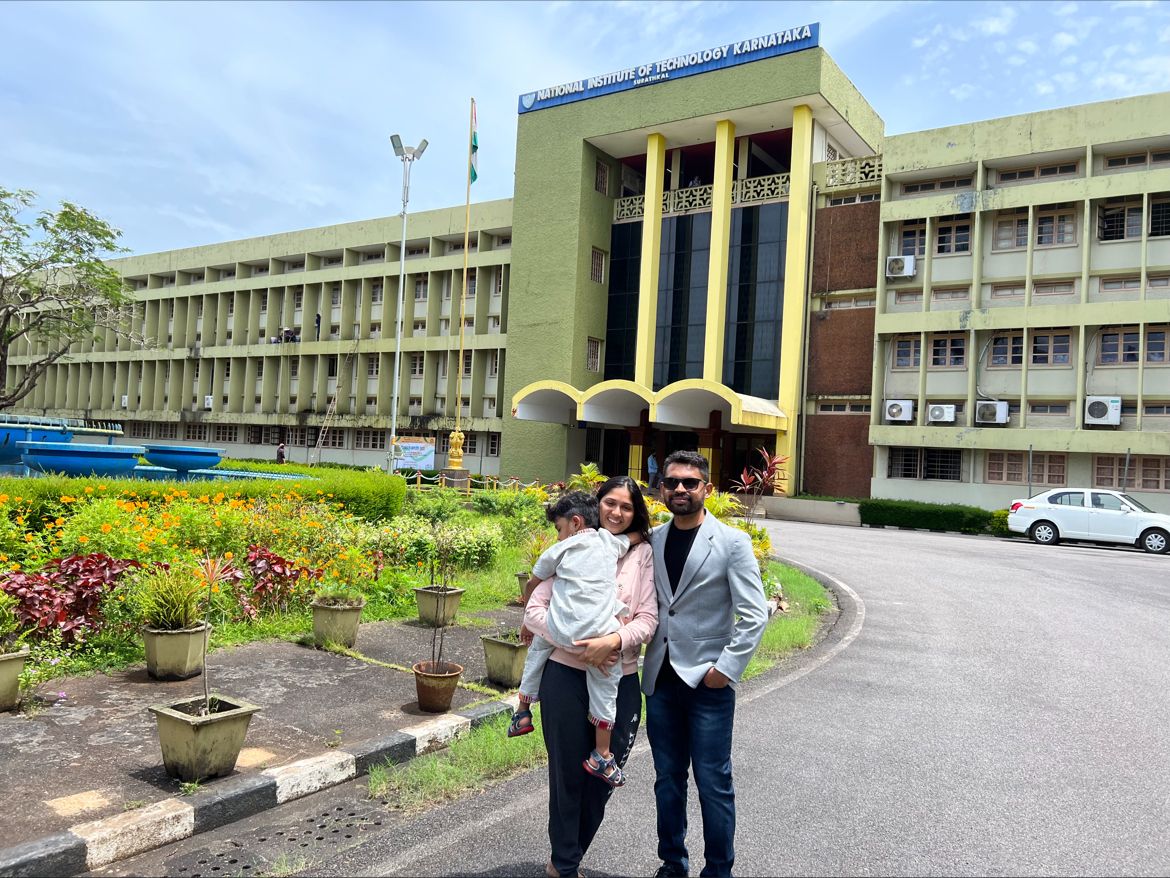
Twenty years after graduating from NITK Surathkal, Shivaprasad KT went back with a different assignment. He was there to recruit. His wife and son came along, turning a hiring visit into a family homecoming. In the photograph he shared, the institute’s name stretches across the building behind them. The engineering graduate had become an employer; the campus was now a place to find future colleagues.
“A perfect homecoming,” he called it. There is a useful clue in that small episode. For all the talk of artificial intelligence surrounding his work, Shivaprasad’s business depends on people making a connection: between a college and a career, a technical team and a client, a promising calculation and the person who must decide what happens next.
He co-founded Ganit in 2017 with Ashok Harwani and Hariharan R. Their shared subject was mathematics. Their shared business problem was rather less elegant: companies could buy sophisticated analysis and still carry on making decisions much as before. A dashboard might be admired, circulated and quietly abandoned. It was an expensive way to decorate a meeting.
Three classmates, one unfinished calculation
The three founders had been batchmates before their careers took them in different directions and across continents. By the time they reunited professionally, they had experience to bring alongside their enthusiasm for numbers. Today, their responsibilities divide among Shivaprasad as CEO, Harwani leading solutions and Hariharan leading strategic partnerships. A common interest became a working division of labour.
Shivaprasad’s education links engineering and management. He earned his engineering degree at NITK and an MBA at SP Jain in Mumbai. His public education history places his management studies between 2004 and 2006. Those two disciplines offer a helpful way to read his later work: understand how a system functions, then understand why an organisation would change it.
Before Ganit, he worked as a consultant at i2 Technologies, as a regional head at Mu Sigma and as managing director at Impact Analytics. His work at i2 included an enterprise project spanning China and India. The Mu Sigma chapter lasted eight years. The recurring setting was the large organisation, where a correct answer has to survive many handovers before it becomes an action.
His professional profile places him in New York. Ganit’s work has crossed markets in North America, Europe, the Middle East and Asia-Pacific. This international career matters to the story because the difficulty he describes is organisational rather than geographical. A manager in another country may face different customers and costs, but still needs an answer that fits the day’s work.
A former colleague, Raj Gopalaswamy, described him as a structured problem solver who could align a team around a goal. Another recommendation, from Vijaya Kumar V, emphasised people management and analytical solutions. These are colleagues’ assessments, but they put a human shape around the job titles: someone expected to organise the work as well as understand it.
There is a distinction between producing an answer yourself and building a team that can produce useful answers repeatedly. The recommendations point towards the second task. It also makes the return to campus easier to understand. Recruiting belongs to the same story as client delivery; the next difficult assignment will need someone capable of taking it on.
The dashboard that nobody opened
While consulting with senior executives in the US and Australia, Shivaprasad came to believe that roughly 90 percent of the analytical solutions being created were receiving little or no use. That was his assessment of the problem he encountered. It helps explain the irritation behind Ganit’s founding: substantial technical effort could end without changing a business decision.
“We will start with consumption of analytics,” he said in 2020. Consumption is a deliberately practical word. It directs attention to the recipient. Someone must understand the output, trust it enough to use it and have the authority to do something with it. Without those conditions, another model can simply become another item awaiting attention.
By August 2020, he said Ganit had expanded from three people to more than 100. He described a business serving Fortune 1000 customers across several regions and industries. These were early milestones, reached within about three years of starting. They also raised an obvious management challenge: a founding belief has to travel through a growing workforce, client by client and project by project.
“We will start with consumption of analytics.”
Shivaprasad KT · 2020
His technical description of the company combined hypothesis testing, AI that discovers patterns, and newer data from sensors and connected devices. The combination gives his pragmatism some substance. He is interested in the available techniques; he wants their selection to follow the problem. The client’s working routine gets a place in the conversation alongside the mathematics.
A forecast has to become an order
Retail gives that argument a physical setting. A fruit-and-vegetable department has limited time to get its quantities right. In a March 2021 account he co-authored with More Retail’s Supratim Banerjee and Ganit’s Gaurav H Kankaria, Shivaprasad described a project connecting demand forecasting to automated ordering. The work continued beyond predicting what shoppers might buy.
The team ran more than 200 experiments. The account reported forecast accuracy rising from 24 percent to 76 percent, with fresh-produce wastage reduced by up to 30 percent. These were results described for that deployment, with its particular data and operating conditions. They give the story something firmer than a general promise about AI: stock, orders and a perishable product.
Crucially, the account also described change management. Category owners accustomed to ordering through their own judgment had to adopt the system and keep stock information current. The human part belonged inside the implementation. A forecast earns its place when the surrounding process can carry it into purchasing. In this case, adoption was part of the engineering job.
A separate comment Shivaprasad made in November 2020 adds another detail to his thinking. For many customers, he said, a small group of products accounts for much of the business. Improving forecasts for those products can matter more than improving the overall average. The number on the scoreboard needs to reflect what the organisation actually cares about.
That observation is modest and consequential. An average can make an untidy operation look pleasantly orderly. Meanwhile, the item a customer most wants may still be missing. His attention goes to which errors carry the greatest business consequences, and to tools that let teams test models faster while spending less effort calculating their performance by hand.
What happens when the cheque arrives?
In July 2022, Ganit announced a pre-Series A funding round. Its backers included Addverb co-founder Sangeet Kumar, Kissht co-founder Krishnan Vishwanathan and EatClub Brands co-founders Anshul Gupta and Amit Raj. The amount was undisclosed. The company set out plans to expand its products and grow its team, giving the founding argument a larger commercial agenda.
The proposed product areas were specific: forecasting, promotion planning, route optimisation, pricing and voice of customer, alongside ESG. Each involves a repeated organisational choice. How much stock should move? Which offer should run? What price makes sense? The list shows how Shivaprasad’s concern with decisions can travel between departments without requiring every client to have the same problem.
The company also announced an ambition to reach 500 employees by the end of 2023. That was a hiring target stated in 2022. Read alongside the product plans, it reveals the scale of the task the founders were setting themselves: build a business capable of delivering the approach repeatedly, rather than relying on three experienced people to explain every answer personally.
Money introduces a further test of the original idea. New products need development; a larger team needs coordination. The usefulness promised to a customer has to survive those demands. The funding announcement describes expansion, while the founder’s earlier interviews supply the question against which to judge it: whether the resulting work reaches the people making decisions.
A name for the gap
By September 2023, Shivaprasad was discussing Consumption Quotient, or CQ: a way of drawing attention to whether analytics gets used. He called the resulting failure to act “Decision Debt.” His proposed remedy included a decision inventory, identifying what people would do differently because a project existed. He also distinguished financial returns from learning through experimentation.
The appeal of that vocabulary is its insistence on a next step. A team can list its decisions and assign responsibility. It can ask whether an experiment taught it anything useful. Read this way, his argument gives technical work a destination and gives the people commissioning it a share of the responsibility for its success.
- 01Name the decision
- 02Identify its owner
- 03Measure the change
His public calendar has carried that discussion into other rooms. The August 2025 Hyderabad Retail Summit agenda listed him for an AWS retail and generative AI roundtable. An October 2025 convention in Mumbai listed him as a lab expert for an ESG technology workshop. Retail and sustainability bring different constraints; both require technology to meet a working problem.
There is a nice symmetry in the campus photograph. The graduate returned to look for people who might help build his company. The company he had built asks its customers to do something equally concrete with the knowledge they possess. Shivaprasad’s own LinkedIn description puts the aspiration plainly: “make using data a habit for decision making.” Habits, unlike presentations, have to show up again tomorrow.