The Shutter Speed Problem
A protein sits on a screen. It looks like a knot of ribbons in three colors. Every drug company in the world starts here, with a snapshot of a protein pulled out of an x-ray crystallography beamline, and asks the same question. Where do we bind this thing.
Shengfang Jin's answer, more or less, is that they are looking at the wrong picture.
Proteins are not the knots on the screen. Proteins wobble. They flex. They breathe on nanosecond timescales, and every now and then, for a stretch of time about as long as it takes light to cross a room, they open a small pocket somewhere on their surface. Then the pocket closes again, and the crystallographers, who took a very slow photograph, never see it.
Ensem Therapeutics, the company Jin co-founded and now runs, is built around the pockets in between. Its platform is called Kinetic Ensemble. The name is also the thesis. Treat the protein as an ensemble of shapes. Find the shapes with the pockets. Design the drug for those.
This is not a rhetorical flourish. It is a stack. Ensem's platform braids together x-ray crystallography, cryo-electron microscopy, HDX mass spectrometry, NMR dynamics, molecular dynamics simulations, and an AI/ML layer that tries to predict which cryptic pockets are going to open, when, and for long enough to matter. The tools are not novel by themselves. Assembling them and pointing all of them at the same question is where the company lives.
Jin, who did her Ph.D. at Tufts and her postdoc at Harvard as an NIH Fellow, has been running biology teams for something like a quarter century. She is not a computational chemist by training. She is a molecular biologist who kept ending up at companies where the difficulty of the target was the point.
At Agios Pharmaceuticals, before it was famous, she was Senior Director of Biology. The Agios thesis was that cancer cells run their metabolism differently from healthy cells, and that if you could inhibit the mutant enzymes doing the running, you had a drug. Three FDA approvals came out of that thesis while Jin was there or shortly after: IDHIFA for acute myeloid leukemia in 2017, TIBSOVO for AML in 2018, PYRUKYND for pyruvate kinase deficiency in 2022. Jin's biology work sits somewhere in the origin of all three.
She then went to Editas Medicine and ran discovery biology. Editas is a CRISPR company. The problem set moved from cancer metabolism to gene editing in the eye, the brain, and the tumor. Jin's teams at Editas, per Ensem's official bio, pioneered advanced CRISPR gene and cell therapies across those areas.
Then she left to start something.
Ensem, In Numbers
Ensem is small. Around 21 people, headquartered at 880 Winter Street in Waltham, which is a road on which a surprising number of oncology companies keep their laboratories, including one that Jin used to work at. The financials, publicly:
The Career, By Employer
Bar length reflects escalating scope of responsibility, not tenure. Ensem is where the scope is largest and the job title includes the word chief twice.
The June Announcement
On June 5, 2023, Ensem Therapeutics put out a press release with a title that read, in that flat compressed way press releases read, "ENSEM Announces the Promotion of Shengfang Jin, PhD to President & Chief Executive Officer." Jin had been President and Chief Scientific Officer since inception. She was now going to be President and CEO.
Founders promoting themselves from CSO to CEO is a specific move in biotech. It happens less often than the reverse. The usual pattern is that a scientific founder starts the company, hits a wall on the operational side, and hands off to a hired CEO with a business background. Jin did the opposite. Ensem, whose board is stacked with venture partners from CBC Group and other investors who could easily have brought in a career CEO, decided the person who had built the platform should also raise the money and run the org chart.
Four months after that promotion, Ensem closed a $67 million Series A. This was October 2023, which was a hard time to raise biotech money. The sector was, by most reasonable measures, closed for business. Ensem raised anyway.
Then, in June 2024, Ensem's CDK2 inhibitor entered clinical trials in solid tumors. CDK2 is a cell cycle kinase that has been on drug-discovery target lists for something like two decades without much to show for it. Getting a molecule into humans is not the same as an approval, but it is the difference between a company that has a platform and a company that has a drug.
In early 2025, Ensem's ETX-636 program was granted FDA Fast Track designation for advanced breast cancer. ETX-636 is a mutant-selective PI3Ka inhibitor. Fast Track is a signal from the agency that a program is treating a serious condition and filling an unmet need. It moves the review timeline forward. It is not an approval either. It is closer to one.
Two clinical-stage programs, one Fast Track, one Series A closed against the current, and a platform with a name that sounds like a chamber music group. That is Ensem's public trajectory since Jin took the CEO chair.
What Cryptic Actually Means
The word cryptic in the phrase cryptic pocket is doing a specific job. It does not mean rare, or exotic, or hidden in the sense of buried. It means the pocket is not visible in any structure you can look up. It exists only when the protein is in a transient conformation that no crystallographer has managed to freeze.
Ensem's platform is trying to predict when and where those pockets open. Molecular dynamics simulations run out the protein over microseconds. HDX-MS gives you a readout of which parts of the protein are exposed to solvent, on average. NMR dynamics tells you which residues are moving on which timescales. Cryo-EM gets you multiple structural states. The AI layer chews on the outputs and picks pockets to prosecute.
The bet is that a meaningful chunk of the oncology target list that has been labeled undruggable is undruggable only against the resting structure. Show up when the protein is mid-motion and there is a door.
Jin does not, in public, wave her hands about this. Her recorded public statement on becoming CEO was two sentences, one of them formal thanks, the other a note about executing on a vision. The rest of what she says publicly appears in patents and papers. Her name is on more than 80 of them.
Timeline
The Quiet Founder
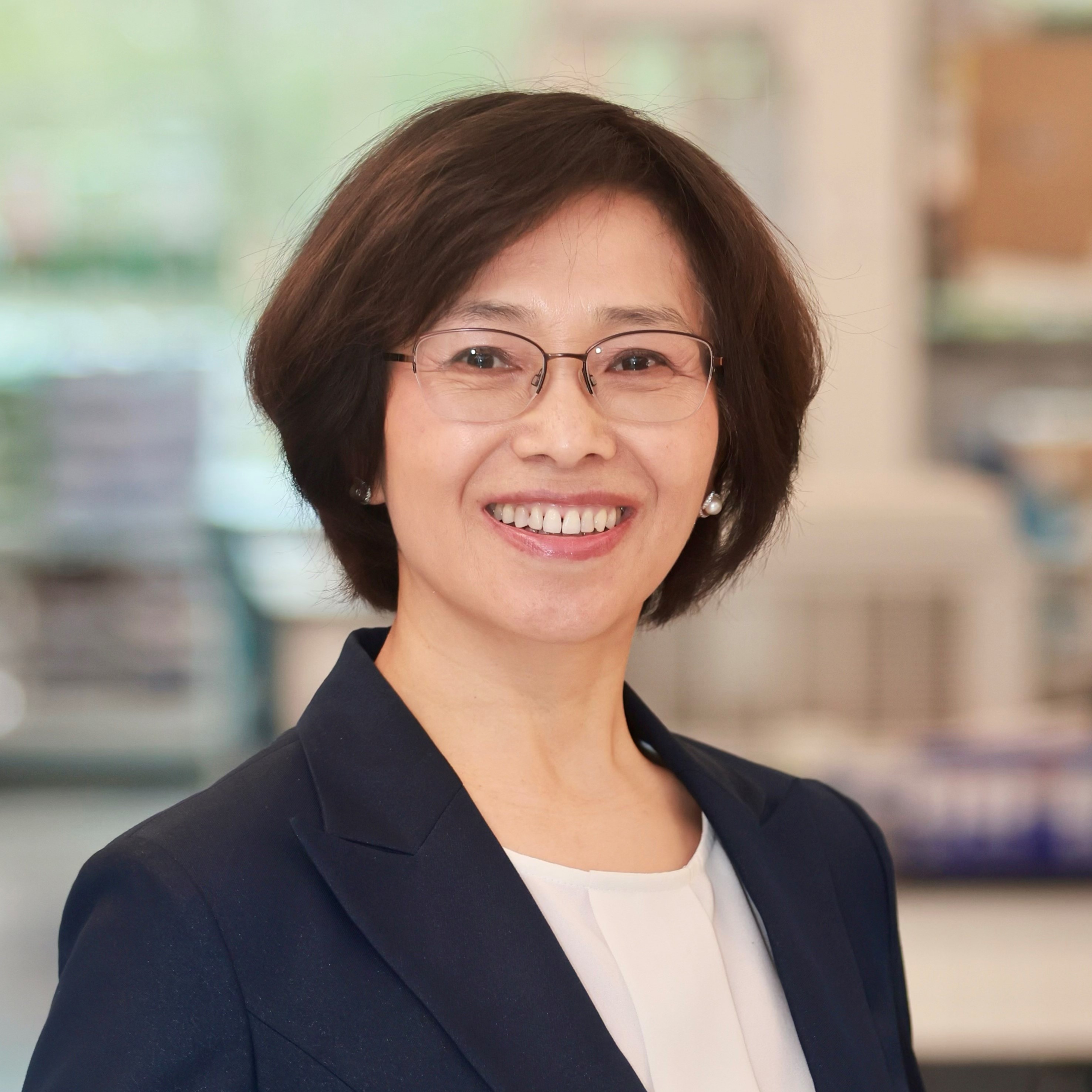
Jin does not appear to have a Twitter account. Her LinkedIn is sparse. Search engines return the same handful of press releases, an ExecAtlas biography page, a Crunchbase profile, and Ensem's own about page, on which her portrait is the one at the top of this article.
This is, in its own way, a kind of positioning. Biotech has a spectrum of founder-CEO personalities. On one end are the ones who tweet through every clinical readout. On the other end are the ones whose public footprint is small enough that when Ensem's first pivotal readout arrives, whichever way it lands, there is no back catalog of promises to compare it to. Jin is closer to that end.
Her Ensem bio credits her with more than 80 peer-reviewed publications and issued patents. That is the currency she has been accruing. It is also a currency that compounds slowly and is not, in the short term, especially good for the share price of anything.
What she has said publicly, in the two sentences on the record, is that Ensem's mission is transformative medicines using the Kinetic Ensemble platform. What she is doing, per the last three years of press releases, is executing on a version of that sentence in which each word gets more expensive as you approach it.
Why Ensem Sits On Winter Street
The address 880 Winter Street is in Waltham, Massachusetts, which is a suburb of Boston that has, over the last twenty years, become one of the densest concentrations of oncology drug discovery in the world. Alkermes is here. Foundation Medicine used to be nearby. Agios, where Jin used to work, is a short drive away. The corridor exists because of Route 128 and MIT and a lot of overlapping venture capital, and it self-reinforces because scientists who leave one company to start the next one keep signing leases within a few miles of the last office.
Ensem's choice of Waltham is not a story on its own. It is, however, the practical answer to a question every biotech founder answers by picking a zip code: whose talent do you want to be able to hire without asking anyone to move. In Waltham, Jin can hire the biophysicists who leave Agios and the computational chemists who leave Relay and the medicinal chemists who trained at Merck's old research center in Boston.
Ensem's headcount, per its own filings and Apollo's estimate, is around 21. For a company at Ensem's stage, with two clinical programs and a platform to maintain, that is small. It suggests a company that is spending money where the pipeline is, and not on floors of empty desks. It also suggests that Jin, whose career has repeatedly involved running large teams inside larger companies, is doing the opposite kind of leadership here.