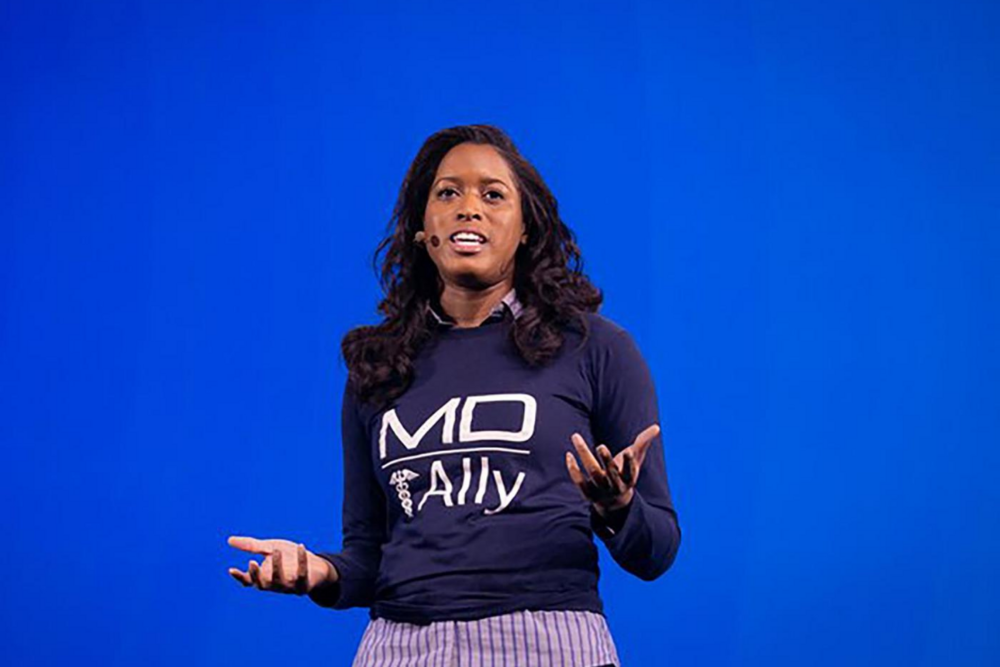
The number that doesn't ask your bank balance
Most calls to 911 are not emergencies. A prescription ran out. A new symptom appeared overnight. A question that needed a clinician, not a fire truck. The system answers all of them the same way - with lights, sirens, and a bill that lands hardest on the people least able to pay it. Shanel Fields looked at that machine and decided the math was broken.
Her company, MD Ally, is the off-ramp. It plugs virtual care directly into the dispatch console, so when a low-acuity call comes in, the caller can be routed to a telehealth provider, a mental health professional, or a social service - instead of an ambulance they may not need and an emergency room that's already full. The ambulances stay free for the people who are actually dying. The phone keeps its promise.
"Whether you have $5 dollars in your pocket or $5 million - you call the same number."
- Shanel Fields, on why 911 is the great equalizer worth fixingMD Ally is free for the 911 call centers that use it. That is a deliberate choice, not an accident of generosity. The company makes its money on the other side - through telehealth referrals and insurance partnerships - so the agencies under the most budget pressure pay nothing to adopt it. Fields engineered the business model the same way she engineered the product: by removing the friction at the exact moment a person reaches for help.
She rode in the ambulance before she wrote the code
Plenty of founders study a market. Fields climbed into it. Before MD Ally shipped anything, she spent roughly a year crossing the country doing ride-alongs with first responders and sitting beside dispatchers, watching the actual software they used under pressure. She wasn't sketching a product in a coffee shop. She was learning where the seams were, so telehealth could be stitched into systems that already existed rather than bolted on from outside.
The instinct runs in the family. Her father was a volunteer EMT. Her sister served in military police. Public safety wasn't a vertical she picked off a slide - it was the dinner-table backdrop of her life. "I have a strong love and passion for public safety," she has said, and it reads less like a tagline than a family inheritance.
"I did several ride-alongs with first responders and dispatchers to look at the technical systems they were utilizing and create a way to integrate telehealth into their systems."
- Shanel Fields, on year one of MD AllyThe path to that first year ran through some serious rooms. Fields earned her bachelor's at Cornell, then an MBA at The Wharton School (WG'19), concentrating in healthcare management and entrepreneurship. Before that she led teams at AT&T and ran enterprise sales at athenahealth, working with national health systems and payors - which is to say she already knew how hospitals buy, how payors think, and how slowly both move. That knowledge became the company's unfair advantage.
A founding team of one
Conventional venture wisdom says you need a co-founder. Fields built MD Ally without one, and she has a tidy argument for why that's fine. The first employees of any company, she points out, are its founding team - the title on the cap table matters less than the people in the room. She met her first lead investor, Brett Topche, in Professor Laura Huang's entrepreneurship course at Wharton, and landed her first customer the unglamorous way: cold outreach. "You've just got to get out there," is roughly the whole strategy.
It worked. A roughly $1M initial round in early 2020 gave way to a $3.5M seed in 2021 led by General Catalyst's Hemant Taneja, with Seae Ventures alongside. Then, in August 2024, MD Ally closed a $14M Series A led by Frist Cressey Ventures, pushing total funding to about $23.5M. Along the way she ran the gauntlet of the Techstars accelerator, and later took a seat on the Techstars Board of Directors - where, asked what more could be done for diverse founders, she gave a one-word answer: "Invest."
"The first employees at a company make up its founding team; it doesn't necessarily need two co-founders."
- Shanel Fields, rewriting the co-founder rulebookThe press took notice. MD Ally landed on the front page of The New York Times Business section, and Fields herself was interviewed on Good Morning America - the kind of mainstream coverage that's rare for infrastructure that lives quietly inside emergency dispatch software. She also went back to Wharton, not as a student this time, but to teach the next class of founders the thing she'd had to learn on the road.
Equity, written into the dispatch layer
The reason any of this matters sits in an uncomfortable statistic: in lower-income communities, non-urgent 911 calls pile up exactly where response times are slowest and outcomes are worst. The same neighborhoods with the least access to routine care lean hardest on the emergency number, which then strains under the weight. Fields didn't build MD Ally to make 911 faster for everyone equally. She built it to lift the floor for the people standing on it.
That's also why mental health sits at the center of the pitch. A crisis call that today might summon police can instead be routed toward psychological services and de-escalation. Fields has talked about being genuinely excited to "provide a range of resources to de-escalate scenarios" - care pathways that didn't exist at the point of the call until she drew them. The most rewarding part of the work, she says, is watching those pathways get embraced by the patients who needed them most.
For all the intensity, she's pragmatic about endurance. Her advice to founders cuts against the hustle-porn grain: take the breaks early, build sustainable infrastructure before the excitement burns you out, because the company you're trying to save needs you to still be standing. It's the same logic she applies to the 911 system - protect the resource so it's there when the real emergency comes.
Sell to the system, not around it
What makes MD Ally hard to copy isn't a clever algorithm. It's the placement. Plenty of telehealth companies ask patients to download an app, remember a login, and reach for it in the right moment. Fields refused to build anything that depended on a person in distress changing their behavior. MD Ally intervenes at the live 911 call, the one moment when someone has already decided they need help and is willing to be guided. There is no funnel to fill, no habit to form. The platform meets people where they already are - on the line with a dispatcher.
That design choice is why her years at athenahealth mattered so much. Selling into health systems and payors is a slow, relationship-heavy craft, full of procurement cycles and committees that can stall a startup to death. Fields had already lived inside that world, so when she walked into 911 centers and payor offices, she knew the language and the landmines. The cold outreach she's quick to recommend works partly because the person doing it understands exactly what the buyer is worried about before the buyer says it out loud.
The result is a company that reads less like a flashy consumer health app and more like quiet public infrastructure - the kind of thing you only notice when it's missing. An avoidable ambulance dispatch that never happens. A mental health call that reaches a clinician instead of a squad car. A caller in an underserved neighborhood who, for the first time, gets connected to a provider relationship that outlasts the emergency. Fields has said the most rewarding part of the work is watching new care pathways get embraced by the patients who needed them. That's the whole thesis in one sentence: build the road, and people will travel it.
Quotable
You call the same number, whether you have $5 or $5 million.
You don't necessarily need two co-founders - your first employees are the founding team.
Cold outreach. You've just got to get out there.
I have a strong love and passion for public safety.