The first Bitrix business ended with dinner. Sergey Rizhikov and his fellow students had written a programming book, arranged its publication, sold the print run and repaid their loan. Then they went to a restaurant. By his later account, the money left over was zero. A respectable result, if your accounting system allows a good evening to count as retained earnings.
The book ran to roughly 400 pages. The print run was 5,000 copies. Its subject was microprocessors and programming, which gives the venture a certain charm: three students trying to persuade the world to buy something considerably more demanding than a beach read. When publishers would not take it on, they set up a publishing business themselves. Bitrix was a name before it was a software company.
Today, Rizhikov is the CEO and co-founder associated with Bitrix24, the business software platform that puts customer management, tasks and communication in one place. Between the book and the platform lies a series of decisions about what to keep, what to share, and what to stop doing. His career makes an interesting case for subtraction.
A name looking for a business
Born in Leningrad in 1972, Rizhikov grew up in a military family and attended a mathematics school in Kaliningrad. He entered Belarusian State University in 1989 and graduated in 1994, having studied radiophysics and electronics. That education belonged to a period when learning about computers could involve making one, as well as telling it what to do.
The student publisher later returned to Kaliningrad. In 1996, he joined Investbank, working in internet technology and payment systems. Then came the financial crisis of 1998. Rizhikov and partners established the software business called Bitrix, taking on outsourced development for American customers before moving into their own projects.
There is an appealing tidiness to the sequence when it is reduced to dates. His own recollections are less tidy. Several product attempts failed. A website management system found customers; another venture cost the business more than a million dollars, he later recalled. Bitrix24 followed only after those experiments. The useful product was something they had to find, with expensive wrong turns along the way.
The contract he gave away
For a software developer, a successful web studio can become a comfortable trap. Another customer wants another website. Revenue arrives, the team gets busy, and the reusable technology underneath remains a supporting actor. Rizhikov came to see a second customer hiding behind the first: the studio that needed software to build websites for other people.
In his account of the transition, the company closed its web studio in 2004 and moved its developers onto the product. He recalled taking a $20,000 website contract to Alexey Sidorenko of the Machaon studio. Sidorenko could have the job on one condition: build it using Bitrix. Rizhikov was handing away immediate work to encourage a partner to use the platform.
That is a curious sales technique. Most businesses prefer to receive the attractive contract. Here, giving it away helped establish the relationship the software business needed. It also made the choice visible. A company promising to supply web studios with technology would have trouble winning their confidence while competing for their customers.
“Before learning to multiply, you need to learn to divide.”
Sergey Rizhikov, 2016 interview · translated from Russian
He used that arithmetic metaphor to describe the partner model. Bitrix would provide the technology; partners would develop solutions, serve customers and earn their own money. Growth depended on leaving useful work for somebody else. The principle sounds polite enough until a desirable project arrives and somebody has to resist taking it.
His accompanying rule was about what the company must retain. Core competence, he argued, should stay inside the business. Sharing the market did not mean surrendering the ability to make the product. The resulting arrangement required both generosity and a boundary: give partners room to operate, keep responsibility for the software.

Two companies, one practical connection
The 2007 partnership with 1C connected the website business to a different part of a company's working life. A shop's online presence has to make sense alongside its business systems. The partnership brought together people already dealing with those adjacent problems. The joint venture, 1C-Bitrix, was owned equally by the two companies.
Boris Nuraliev, the founder of 1C, described Rizhikov as someone who put the business itself first and remained immersed in it. Money mattered, in Nuraliev's description, but came after the work. That is a partner's assessment, and a useful glimpse of how Rizhikov appeared across the negotiating table.
By 2011, he was discussing a cloud product aimed at the US market. His concern was how a company could bring employees together inside a shared working environment. The idea had moved beyond publishing websites. There were conversations, decisions and tasks inside the business that also needed a home.
The office that fits inside a browser
Bitrix24 launched on April 12, 2012. Its mix of communication and business tools gave Rizhikov a new version of the old distribution problem: build software that travels, while working with partners who understand the people buying it. The launch included English, Russian and German versions.
In a later account of international expansion, he described watching a partner present the product in India. An explanation in English was meeting with confusion. Switching to Hindi changed the response. It was an ordinary interaction with an unusually useful lesson: translating a product can be part of making it understandable, rather than merely dressing it for export.
That attention to communication runs through his description of Bitrix24. A business can scatter its work across separate tools until nobody has a complete picture. A conversation in one place, a task in another, and a customer's history elsewhere may each look manageable. Together, they leave employees searching for the thing that somebody certainly remembers discussing.
In 2015, Rizhikov opened a press briefing on remote employment, discussing the role of internet technology in changing workplaces. By the time he described his own setup the following year, he was already conducting meetings through a large screen beside his desk. The photograph looks like an office learning to stretch beyond its walls.
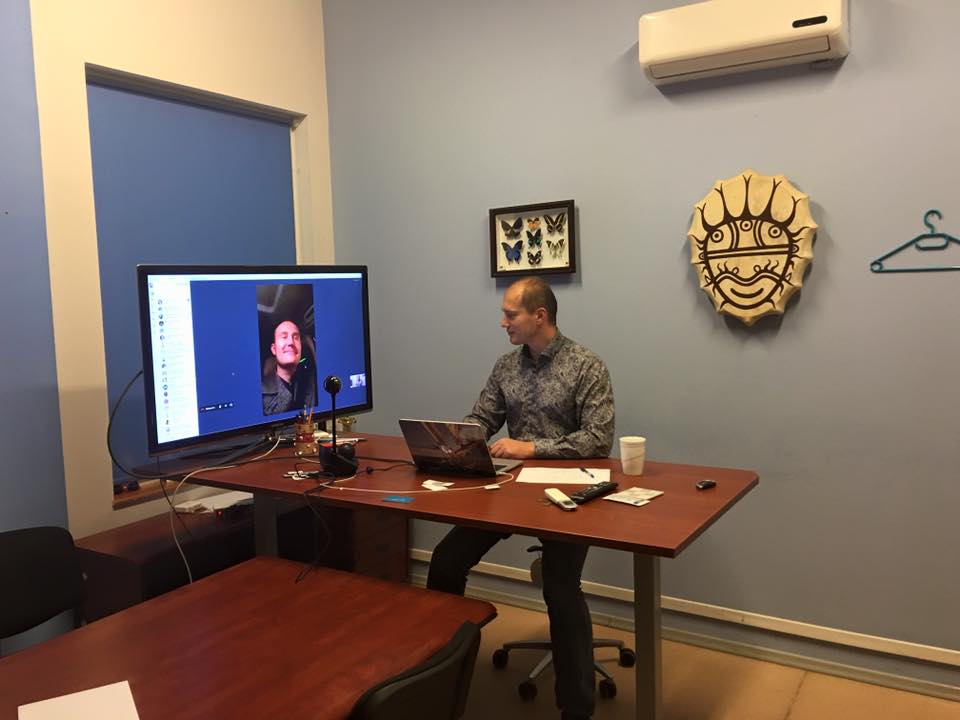
The business continued to widen its reach. In a 2020 interview, Rizhikov said foreign revenue had become comparable with Russian revenue over five years. That comparison is more revealing than a grand declaration about being international. Customers elsewhere were contributing on a scale that changed the balance of the business.
Recognition arrived along the way. In 2018, he won the digital technologies category of EY's Russian Entrepreneur Of The Year competition. It is one milestone in a career spent working on the less glamorous machinery of business: the software behind a website, the conversation behind a sale, the task somebody must remember to finish.
A meter with an inconvenient opinion
Rizhikov's interest in systems also reached his home. He documented building a solar installation near Kaliningrad, complete with storage and the ability to send surplus electricity into the city grid. The account is full of equipment choices and practical complications. It reads like a programmer discovering that the outside world has dependencies, too.
Connecting it required conversations with the electricity company and a meter able to record energy moving in both directions. When the connection worked, he described a group of men celebrating outside the house as the meter ran backwards. This was a small engineering victory with a pleasingly visible result.
The accounting system proved harder to persuade. His new reading was lower than the earlier one because the house had exported more electricity than it consumed. The software would not accept the decrease. He wrote that he had to keep entering the original reading. Somewhere between the panels and the bill, an assumption about how the world worked had become a rule.
He thanked the utility employees who helped make the connection happen. That detail matters. A technical experiment still depended on people willing to work through an unfamiliar request. The satisfaction came from a system behaving differently, and from the practical help that allowed it to do so.
Another kind of electricity
By 2026, Rizhikov's public writing was focused on another technology changing how work gets done. In January, he described artificial intelligence as part of a new economic infrastructure. His emphasis was on the speed at which companies could learn, and on the quality of the information their systems could use.
In an autumn account of a conference talk, he reported that employees had created 1,300 applications using Bitrix24's internal AI development tools. Examples included an office map, desk booking and a book club. These are his reported results. Their interest lies in the everyday scale of the work: colleagues making small tools for needs they understood firsthand.
He also described an AI agent producing a presentation before an architecture committee meeting, with little time remaining. Decades after publishing a demanding technical book, he was describing software that could help assemble the next explanation. The tools had changed considerably. The desire to make an idea usable by other people was familiar.
There is a thread connecting the student publisher, the contract handed to another studio and the electricity meter. Each involves a practical obstacle that becomes more interesting when examined closely. A publisher refuses the manuscript. A studio needs a product. A billing system expects consumption to move in one direction. Rizhikov's story keeps returning to the work of changing the arrangement.
The restaurant bill remains a fitting opening. That first enterprise sold something difficult, paid back what it owed and left its founders with experience. Later, he learned to leave revenue opportunities for partners. The arithmetic grew more complicated. Learning what to divide was still part of the job.
More of the conversation
- Bitrix24 website ↗
- LinkedIn ↗
- Twitter / X ↗
- Facebook ↗
- His Bitrix24 writing (Russian) ↗
- Habr profile (Russian) ↗
- Developer blog (Russian) ↗
- Watch: founder interview (Russian) ↗
- Watch: SaaS Q&A (Russian) ↗
- His solar experiment (Russian) ↗
- Read: the partner model (Russian) ↗
- Read: AI tools at work (Russian) ↗