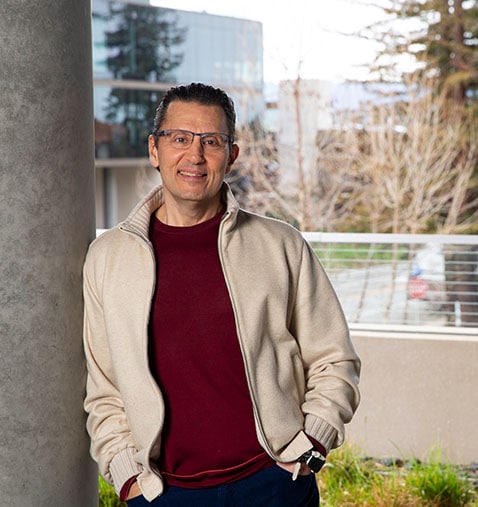
Sasan Goodarzi is the chairman and chief executive of Intuit, which means - in practice - he is the person responsible when QuickBooks doesn't reconcile, when TurboTax misroutes a refund, when Credit Karma misreads a credit pull, and when Mailchimp drops a campaign at 4:55pm on a Friday. He sits at the top of an $18.8 billion machine that quietly handles the moving parts of American financial life. The strange thing is how unfamiliar his name still is, given how often you've already used his software this year.
Goodarzi runs Intuit from Mountain View, but the operating manual was written earlier, on a one-way flight out of Tehran. He was ten years old. The Shah was falling, the streets were full of protesters, and his older brother was already in Orlando running an import/export business in Middle Eastern food. The family flew west with what they could carry. The brother, in effect, became the household's CFO before Sasan ever opened an accounting textbook.
An engineer who kept getting promoted out of engineering
Goodarzi studied electrical engineering at the University of Central Florida, graduating in 1989. He took the standard engineer's path into the standard engineer's employer: Honeywell, on the automation controls side. He co-founded a small company along the way (Lazer Cables Inc.) and then jumped to Invensys, an industrial-controls business where he ran a global product group. By 2002 he had picked up an MBA at Kellogg, and in 2004 he landed at Intuit for the first time, running its Professional Tax division.
In 2010 he did something that, on paper, looked like a mistake. He left Intuit to become CEO of Nexant, a smart-grid software company - the kind of move that usually ends with a polite goodbye. A year later, Intuit's then-CEO Brad Smith called him back as Chief Information Officer. The brief: move the entire company to the cloud. He did. By 2016 he was running Small Business & Self-Employed, the engine room that includes QuickBooks. By 2019 he had the keys.
The AI bet, stated plainly
On the day Goodarzi became CEO, he declared Intuit's strategy in one sentence: "an AI-driven expert platform." Most people heard the AI part. Goodarzi insists the part that matters is "expert platform" - software that learns the customer well enough to put a human expert in front of them at the exact moment they need one. The data is the moat. The model is rented. Anyone can buy GPUs.
He'll tell you so directly. Speaking with Semafor in early 2026, he said large language models are commodities, and the companies that win are the ones holding decades of contextual data about how real customers earn, spend, borrow, file, and grow. Intuit has thirty years of that. It's why he wired QuickBooks into Mailchimp - so the small business sees its books and its marketing as one - and why he was willing to pay roughly $8.1 billion for Credit Karma in 2020 and $12 billion for Mailchimp in 2021. He wasn't buying brands. He was buying connective tissue.
Grit, hiring for
Ask Goodarzi what he looks for in people and he keeps using the same one-syllable word. Grit. At the Wall Street Journal Leadership Institute he told the room: "I was interviewing somebody yesterday, and the whole time my focus was - do you actually have the grit?" He has reasons. As a teenager in Orlando, fresh off the plane, he was bullied for being foreign. His English was the second language in the house. The story he tells about that period isn't about pain. It's about the muscle that grew because of it. He is now, in his late fifties, the kind of CEO who treats grit as a hiring filter rather than a slogan.
The Dome
If you watch the Los Angeles Clippers play at home, you're sitting inside a building that bears his company's name. The Intuit Dome opened in Inglewood in 2024. Goodarzi was at the groundbreaking in 2021 with Steve Ballmer, and at one point during the ceremony someone handed him a Clippers jersey. He stood there in a suit, holding a basketball jersey, in a half-built arena named after a tax-and-accounting company. It is the most accurate photograph of his career.
What he is building now
In 2024 Intuit pushed Intuit Assist - its generative-AI assistant - across the entire platform. By 2025 the company had crossed $18.8 billion in annual revenue, a roughly 144% lift from the $7.7 billion it was doing the year he took over. The next bet is harder than the last one. Goodarzi wants Intuit to feel less like four products on one campus and more like one connected service: your tax person knows your accountant, who knows your credit, who knows your customer list. None of that is impossible. All of it is unsentimental engineering of the kind Goodarzi has done since he was twenty-two.
He doesn't talk much about his personal life publicly, and we won't either. What's on the record is the work. The work is, by now, a thirty-year argument that the immigrant kid from Orlando who got handed a Clippers jersey by Steve Ballmer was always exactly the right person to run the company you trust with your refund.