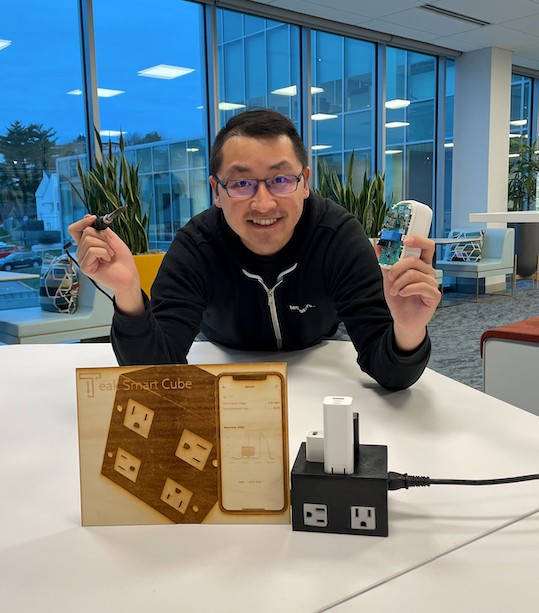
The man counting the electricity nobody uses
A Peloton treadmill costs you sixty dollars a year - even if you never run on it. Ryan Li can tell you that off the top of his head, because finding numbers like it is the entire premise of his company. Revert Technologies, which he co-founded and runs as CEO, builds small AI-powered power adapters with a single, almost stubborn job: notice when a plugged-in device is doing nothing, and quietly stop it from drinking power.
The industry calls it "phantom load." It is the standby hum of a coffee maker, the glowing logo on a turned-off TV, the charger left in the wall with nothing attached. Boring, individually. Enormous, in aggregate. Idle electronics burn roughly 25 gigawatts across the United States and account for an estimated 10 to 15 percent of an electricity bill - somewhere north of $40 billion a year and 44 million metric tons of carbon. Li's pitch is that this is not a behavior problem to nag people about. It is a design problem to engineer away.
What makes him interesting is not the gadget. It is the route he took to get to it. Before Revert, Li was about as far from a climate-tech founder as a résumé can get.
From oil rigs to off switches
Li trained as a chemical engineer at Cornell. His first chapters read like an energy-sector grand tour, taken in reverse moral order. He drilled horizontal injector wells in the deep water of the Gulf of Mexico. He designed green hydrogen production facilities for Shell. He worked as an investment banker merging energy-efficiency companies, then crossed industries entirely to manage Alibaba's US business, building software for small merchants trying to sell across borders.
It is a strange portfolio - hydrocarbons, hydrogen, high finance, e-commerce - but a useful one. He has seen how energy gets made, how it gets financed, and how software gets sold to people who do not care about software. Each of those became load-bearing later.
The turn came at the Yale School of Management, where Li earned his MBA. There he met Joe Lybik, a Yale undergraduate who shared the same itch about sustainability. Their first idea was not smart plugs at all. It was batteries - specifically, repurposing the big batteries inside electric lawn mowers into off-grid energy storage for professional landscapers. To test it, the two of them followed Yale's grounds crew around campus, measuring how much power the equipment actually pulled.
That fieldwork is where the real company was hiding. While measuring appliance draw, they kept noticing devices sipping electricity after being switched off. The lawn-mower idea faded. The phantom-load idea would not let go.
A power strip with a conscience, made in Maine
Revert's first product, the Teak Smart Cube, arrived in the winter of 2022 by way of a successful Kickstarter campaign. It is a multi-outlet smart surge protector for the home: a charging hub boosted by software that runs energy-conservation and carbon-reduction schedules on whatever you plug in, recommends efficiency upgrades, and even nudges you toward recycling old electronics. The patented device is designed in New York and assembled in Maine - the "made in USA" detail is not marketing garnish to Li, it is a thesis about controlling your own hardware.
In 2023 came the Acorn Smart Plug, a single-outlet unit aimed at commercial buildings, where one office floor of idle monitors and vending machines adds up fast. By 2024 both products lived under one roof: the Revert Technologies plug-load management platform, which pairs the IoT adapters with utility grid-pricing analytics and machine learning so a business can automatically throttle equipment when power is most expensive or most carbon-heavy.
Li is unsentimental about how this gets made. His rule for hardware is blunt.
Two products, one job: stop the waste
Teak Smart Cube
Patented multi-outlet smart surge protector. AI-run conservation schedules, efficiency tips, e-waste prompts. Launched via Kickstarter. Designed in NY, assembled in Maine.
Acorn Smart Plug
Single-outlet device for facilities and offices. Feeds the Revert plug-load platform with utility pricing analytics and machine learning to cut commercial waste.
One metric, measured in carbon
Most startups track revenue, users, churn. Revert tracks those too, but Li insists the company has exactly one north star: the total tons of CO2 its users eliminate. The stated ambition is to remove one million tons within three years - through energy-conscious gadgets, AI-driven conservation, e-waste recycling, and carbon offsets stitched together into something an ordinary person can actually use.
It is an aggressive number, and Li frames the urgency in plain terms. Sustainability, he argues, is not a gift to some far-off generation - the fumes, fires, and floods are already here. His move is to make the green choice the easy choice, ideally the invisible one, so it happens without anyone having to feel virtuous about it.
Illustrative - phantom draw varies by device. The point: it never reaches zero on its own.
The CEO who calls himself a plumber
Ask Li to describe himself and he reaches for a humble word: plumber. Not visionary, not disruptor - plumber. Someone whose job is the unglamorous, hands-on work of making sure resources flow where they should and stop where they shouldn't. It fits a founder who would rather solder a prototype than pitch a slide.
The company keeps that tone. Revert calls itself "a small and mighty mission-driven team of technology lovers and climate optimists, working hard to turn things off." The tagline - "the easiest energy decision you'll ever make" - is doing a lot of quiet work, promising that the hard part is the engineering, not the customer's willpower.
His personal advice on burnout rhymes with the product. Unplug literally, he says, to stop your devices draining power. And unplug mentally, to keep yourself from draining too. For a man whose whole company is about switching things off at the right moment, it is a fittingly on-brand piece of wisdom.
The recognition has followed. Li and Lybik won the WeWork Changemakers: Sustainability Series pitch competition, were selected for the Roux Institute Techstars Accelerator in Portland, and drew backing from the Maine Venture Fund and the FORGE manufacturing network. The seed-stage company now runs out of Brunswick, Maine - a long way from a Gulf of Mexico drill floor, which is exactly the point.
A chemist, a builder, and a designer
Revert is not a solo act, and Li does not pretend otherwise. The company was founded with Joe Lybik, the chemistry-to-code counterpart who serves as CTO and who chased the lawn-mower batteries around Yale's campus alongside him. Albert Gan came aboard as industrial designer and advisor, shaping how a piece of energy hardware should actually look and feel sitting on a desk or screwed into a baseboard. Cecil Gilliard runs operations. It is, by design, a small team - the kind where the CEO still wants to know whether the enclosure tooling came in on spec.
The Yale connection runs deeper than a diploma. When Li recounts the early days, he credits SOM professors, alumni mentors, and the university's entrepreneurship centers - the Center for Business and the Environment and Tsai CITY - for the scaffolding that let two students turn a class project into a shipping product. He has singled out Amandeep Heyer, a Yale computer science major, for her work on getting the product itself to function. For a founder who prizes building things with his own hands, the willingness to name the people who built alongside him is telling.
By the time the Yale community first wrote about the company in early 2022, the team had already done the unglamorous work: final hardware and software prototypes tested, manufacturing contracted, and 500 people waiting on a list for a power strip. That is not the trajectory of a science project. It is the trajectory of a company that intends to ship.
The case for boring infrastructure
There is a temptation, in climate technology, to chase the dramatic - the fusion reactor, the carbon-sucking tower, the moonshot. Li's bet runs the other way. The biggest wins, he seems to believe, are hiding in the most boring places: the outlet behind the couch, the surge protector under the desk, the charger nobody unplugs. Phantom load is unglamorous precisely because it is everywhere, and everywhere is where the carbon adds up.
His mixed pedigree is the secret weapon here. The Shell years taught him how energy is produced and how serious infrastructure gets engineered. The banking years taught him how efficiency is valued and financed. The Alibaba years taught him how to put software in the hands of people who have no patience for it. Revert sits at the intersection of all three: hardware that has to be manufactured at cost, software that has to be invisible, and a financial story that has to convince a facilities manager the payback is real.
That is why the "made in USA" detail keeps surfacing. For Li, controlling the manufacturing is not patriotism - it is the only way to iterate fast and keep costs honest. Build it yourself, or stop expecting a factory to do the impossible for you. It is the plumber's philosophy applied to a supply chain.
"Our work is to make it easy, fun, and with measurable impact for everyone to choose the eco-friendly option."