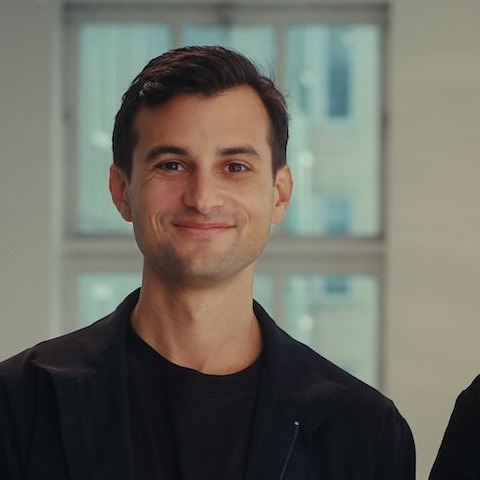
A law firm that runs at the speed of AI
Crosby will read your master services agreement, redline it, and hand it back before your coffee goes cold. The median is 58 minutes. Ryan Daniels wants it to be minutes, and he is not selling you software to make that happen. He is selling you a law firm.
That distinction is the whole bet. Most legal-AI companies build a tool and ship it to lawyers, then hope the lawyers use it. Daniels and his cofounder John Sarihan did the harder, stranger thing: they started an actual law firm - one that carries malpractice insurance, charges a fixed price per document instead of billing by the hour, and runs proprietary AI agents behind every review, with a licensed attorney signing off. Cursor, Clay, Unify and Cartesia send their contracts here. The reviews come back in under an hour.
The insight came from pain. At a previous startup, Daniels was the only legal person on staff, the single set of eyes that took the company from ten employees to a hundred. Every NDA, every data processing agreement, every vendor MSA crossed his desk. The contracts were the thing slowing the whole company down, and he was the contract. "For startups that are growing really fast," he has said, "the top thing that's slowing them down is the contract."
I am building the product I wish I had.
He had the background to try. Daniels is the son of two law professors and grew up around the discipline before he ever chose it. He did his undergrad at the University of Pennsylvania, then went to Stanford Law School, where he studied legal AI back when that phrase sounded like a contradiction. He cut his teeth in big law at Cooley, the firm that serves much of the technology industry, and then spent the better part of a decade as general counsel inside startups - including HiredScore, later acquired by Workday, and A.Team, where he ran partnerships and legal affairs.
So when he says contract review is a grind, he is speaking from inside it. The reason he and Sarihan decided to own the entire process end to end - rather than hand a model to outside counsel - was that they had both watched the model break the moment it left their hands. "We had to build our own law firm in order to own the entire process, end to end," Daniels has said. The firm is the product.
Field research, in person
Daniels does not theorize about workflows from a conference room. To understand how high-volume contract review actually happens, he flew to India and sat with the legal-process-outsourcing teams who do the work at scale. His investors at Bain Capital Ventures only found out where he was when they noticed the background on a Zoom call. That is roughly the energy of the whole company: go see the thing, then rebuild it.
The founding partnership has its own origin myth. Early on, Sarihan - a Penn M&T graduate who spent four years at Ramp climbing from engineer to tech lead - challenged Daniels to what they call an AI-versus-human duel. Sarihan stayed up overnight building a data pipeline that could match much of a manual contract review. The result was not a knockout for either side. It was a draw, and the draw was the point: human judgment plus AI beat either one alone. That finding became the company's architecture.
When Daniels couldn't make a Fortune 200 general counsel conference, Sarihan went in his place. He traded the engineer's hoodie for a suit, worked the room, and came back having collected all 200 attendees' business cards. Crosby is a legal company built by people who will do the unglamorous legwork themselves.
Leverage for lawyers, not replacements
It would be easy to frame Crosby as lawyers being automated away. Daniels frames it the opposite way. "We like to think of ourselves as leverage for lawyers, not replacements," he says. The AI handles the first thousand passes; the attorney handles the judgment. And because the system learns from every contract it touches, the work compounds. As Daniels puts it, "the next thousand contracts will always be easier than the last."
The numbers suggest the flywheel is real. Crosby soft-launched in January 2025 and emerged from stealth that June. Within its first year it had negotiated more than $1 billion in contracts for clients - up from $30 million at launch - while growing roughly 30% month over month. It reviews MSAs, NDAs and data processing agreements, the three documents that quietly eat a growing company's legal hours, and it returns them at a price you can predict in advance.
The capital followed the curve. A $5.8 million seed from Sequoia and Bain Capital Ventures. A $20 million Series A co-led by Index Ventures and Bain Capital Ventures, with Stripe's Patrick Collison and AI angel Elad Gil putting in their own money, and Cooley - Daniels' old firm - on the cap table too. Then a $60 million Series B co-led by Lux Capital and Index at a reported $400 million valuation. About $85.8 million in all, behind a company that is, technically, a law firm.
The next thousand contracts will always be easier than the last.
What makes the wager interesting is the dead zone Daniels is aiming at - the gap between a $1,200-an-hour outside firm and a founder squinting at a template at midnight. That space has resisted disruption for a long time because the people who understand it deeply are billing by the hour to stay inside it. Daniels understood it deeply and walked out. He turned his own worst week as a general counsel into a category. Whether the hybrid model holds as Crosby scales is the open question, but the early traction is the kind that makes a lot of lawyers look up from their billables.
For now, the pitch is almost rude in its simplicity. Send the contract. Get it back before lunch. A lawyer stands behind it. The firm carries the insurance. And somewhere in the loop, an AI that has already seen a thousand versions of the clause you are worried about is quietly making the thousand-and-first review easier than the last.
Two founders, two halves of one problem
Crosby works because each founder owns a side of the problem the other can't fake. Daniels brings the legal and operational decade - the lived knowledge of which clauses matter, what a general counsel actually loses sleep over, and how a deal stalls when one person is the chokepoint. Sarihan brings the engineering. He spent four years at Ramp, the fast-growing fintech, rising from engineer to tech lead, and he watched there how badly fast companies are served by their legal support. He came out of the University of Pennsylvania's selective M&T program, which trains people to live in exactly that seam between business and code.
That division of labor is why the company could credibly try the thing nobody else tried. Plenty of teams can build a contract-reading model. Far fewer can also staff, license, insure and run the law firm that stands behind the model's output. Daniels had already done the lonely version of that job for a living. Building it as a company, with a technical cofounder embedding AI into every step of the contracting process, was the natural next move rather than a leap.
It also explains the customer list. The companies that trust Crosby early - Cursor, the AI code editor; Clay; Unify; Cartesia - are themselves fast-moving, AI-native startups that feel the contract bottleneck acutely and have no patience for hourly billing. They are, in other words, exactly the company Daniels used to work for. He is not guessing at what they need. He spent a decade being the person who had to provide it, alone, at midnight, between funding rounds.
The wager underneath all of it is a quiet argument about where value sits in legal work. For decades the answer was the lawyer's hour. Crosby's answer is the accumulated contract - the pattern library that gets sharper every time a new MSA or DPA passes through. If Daniels is right, the firm that has reviewed the most contracts wins, not the firm that bills the most hours. That is a strange thing for a Stanford-trained, Cooley-pedigreed lawyer to bet against his own profession's economics. It is also, by his own account, exactly the product he always wished someone had handed him.