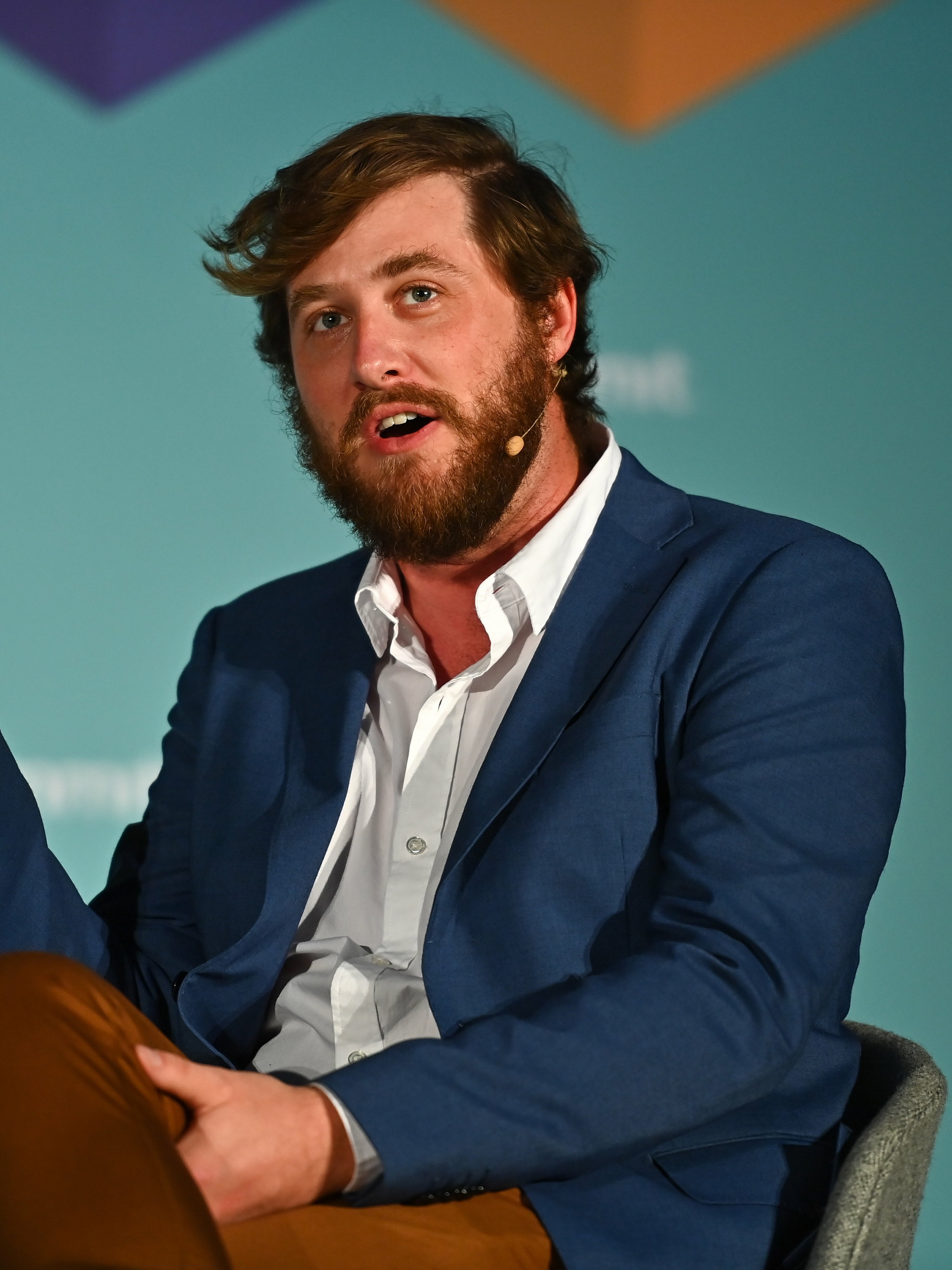
The Internet's Most Honest Beat Reporter
Every Monday, Wednesday, and Friday, Ryan Broderick sits down at his desk and reads a truly alarming amount of internet. Not to be hip. Not to prove a point. Because someone has to, and he has spent 15 years building the skills to understand what any of it actually means.
Garbage Day, the newsletter Broderick founded in 2019, is what happens when a trained journalist decides that the web is the biggest story nobody is covering correctly. It is not a social media roundup or a trending-content aggregator. It is reported analysis of why the internet behaves the way it does - the memes, the moral panics, the platform incentives, the human psychology underneath all of it. Three times a week, roughly 6,000 words. Over 100,000 people subscribe. Thousands of them pay for it.
He built this from nothing, after getting fired.
"I think American media has a tendency to turn the volume up to 11 on everything. And when you do that with the internet, you lose some really important details, particularly because the internet is just people messing around."- Ryan Broderick
Broderick grew up in Massachusetts and studied journalism at Hofstra University, where he edited the campus paper and drew cartoons. He started pitching stories about MySpace drama to blogs while he was still a student - which tells you basically everything you need to know about the arc of his career. He has been fascinated by the social dynamics of the internet since before most journalists admitted the internet had social dynamics.
He went to BuzzFeed in 2012, starting as a community moderator before becoming one of the outlet's most prominent writers on internet culture. He eventually rose to Deputy Global News Director of BuzzFeed News UK, spending years based in London before returning to New York. Then, in June 2020, BuzzFeed fired him.
Garbage Day by the Numbers
Fired on a Friday. Built a Business by Monday.
The plagiarism investigation at BuzzFeed found improperly attributed passages in at least 11 articles, spanning his entire time at the company. BuzzFeed issued a public apology and ran editor's notes on the affected pieces. Broderick disputes the characterization. What he did with what came next is more interesting than the incident itself.
The BuzzFeed Exit, 2020
An internal plagiarism investigation led to Broderick's dismissal in June 2020. At least 11 articles were flagged for improperly attributed passages, dating back to 2013. Sources that had been misattributed included the Associated Press, The Washington Post, HuffPost, the New York Times, and the CBC. BuzzFeed News issued a formal apology and updated the affected pieces.
Broderick disputes the finding. What is not disputed: the incident directly shaped how he runs Garbage Day - obsessively transparent about sourcing, and deliberately, proudly human in its voice.
By the time BuzzFeed fired him, Garbage Day already existed. He had started it the year before, in 2019 - the same year he was promoted. The first issue was about the Sonic the Hedgehog movie trailer. He was already hedging his bets, quietly building the thing that would become his entire career.
After leaving BuzzFeed, he freelanced for The Verge, WIRED, Fast Company, and The Nation. He co-hosted the Content Mines podcast. He wrote the kind of long-form internet analysis that his newsletter was already doing, but for other outlets. And he kept growing Garbage Day, which at that point had a few thousand subscribers.
By 2024, it had crossed 100,000.
"Long-term growth is better if you ignore it. Just do your thing and if they don't stay they weren't ever going to stay."- Ryan Broderick on newsletter growth strategy
Garbage Day: Body Horror, But for the Internet
Broderick describes Garbage Day as "body horror, but for the internet." The tagline is "We doomscroll so you don't have to." Both of these are funnier than they are cute - they actually describe the editorial project accurately.
He publishes Monday, Wednesday, and Friday. He writes from 9 AM to 3 PM on newsletter days. Tuesday and Thursday are for freelance work, the podcast, and longer projects. He takes two or three vacations a year. He talks about this schedule the way a serious athlete talks about recovery - deliberately, because sustainability is the job.
The newsletter covers platform mechanics, viral memes, online moral panics, AI content proliferation, and the way online behavior bleeds into real-world events. It is not panic-driven. Broderick's consistent editorial position is that the internet is not a catastrophe to be survived but a phenomenon to be understood - and that understanding it requires patience and context, not just outrage.
The Test: Would You Forward This?
Broderick has a single editorial filter for every piece of content he considers including in Garbage Day: "Would someone forward this email to someone else?"
Not would it go viral. Not would it generate clicks. Would one specific person think another specific person would want to read it. That question has driven the newsletter to 100,000 subscribers.
One of Garbage Day's defining features is also one of its stranger ones: Broderick intentionally leaves typos in the newsletter. This is not sloppiness. It is strategy. In an era when AI-generated text has flooded every platform and inbox, a typo is proof of human origin. It is a small but deliberate signal that says: a person wrote this. The typo is the watermark.
In September 2025, Broderick and co-author Adam Bumas published "Charlie Kirk was killed by a meme" - an analysis of the online subcultures that shaped the man who killed the conservative influencer, including a bullet inscribed with a reference to furry roleplay memes. The piece was viewed nearly 600,000 times. It is the kind of story that only exists because someone has been patiently mapping internet subcultures for 15 years and can explain why "Notices bulge OwO whats this?" matters to a criminal investigation.
"We spent a decade letting Twitter lead America... realizing that we weren't really doing that. We were just letting people who were important before Twitter use it to prove they were still important. Which was not true, it turns out."
"The distinction between 'internet culture' and just 'culture' dissolved a long time ago. Traditional media just hasn't fully admitted it yet."
"Typos are intentional. In 2024, a typo is proof of authorship. It means a human sat here and wrote this thing."
"The internet is just people messing around. When you turn the volume up to 11 on that, you lose the most important details."
Garbage Media Inc.: Eight People, One Entire Internet
Garbage Day is no longer a one-person newsletter. Broderick built Garbage Media Inc. around it, and it now employs eight people. The company runs three distinct operations.
The newsletter remains the core. Three issues a week, six thousand words, that relentless editorial filter. But alongside it, Broderick launched Panic World - a weekly podcast about how the internet warps minds, culture, and eventually reality. Each episode, he brings in a guest to unpack a different online witch hunt or moral panic, recent or historical. In 2025, it won two Signal Awards: Conversation Starter and Weird. Both awards are correct.
Panic World Podcast - 2025 Signal Awards
Panic World won two Signal Awards in 2025: "Conversation Starter" (for content that sparked cultural dialogue) and "Weird" (which is exactly what it sounds like). Both are fitting for a podcast that systematically examines how the internet turns ordinary people into subjects of mass outrage, and why.
The third arm is Garbage Day Media Intelligence - a research service launched around 2024 that applies Broderick's internet-reading skills to client needs. It is the most conventional-sounding thing Garbage Media does, and probably the most lucrative.
The company also does live events. Sold-out shows in New York and London. There is something very specific about the demographic that will pay to watch someone explain memes in person, and Broderick has found it.
In January 2024, Broderick wrote a newsletter called "It's time to leave Substack" and then actually left Substack. He migrated the entire operation to an independent platform at garbageday.email. This is notable not because leaving a newsletter platform is particularly dramatic, but because he did it publicly, on principle, and kept all 100,000 of his subscribers through the move. That is harder than it sounds.
From MySpace to Media Empire
Things Worth Knowing
Awards & Achievements
Garbage Day has won multiple Webby Awards. The Panic World podcast took two 2025 Signal Awards: one for "Conversation Starter" and one for the category literally called "Weird." Both are correct characterizations. The Salzburg Global Seminar fellowship in 2018, focused on disinformation and fake news, came while he was still at BuzzFeed - the kind of academic recognition that foreshadowed the independent career that would follow.
What Ryan Broderick Actually Figured Out
The internet has had culture reporters for a long time. Most of them treated internet culture as a beat that lived next to other beats - beside politics, beside entertainment, beside business. Broderick's bet, made early and held consistently, is that it is no longer a separate beat. The internet is not adjacent to culture. It is culture.
That is not a new argument in 2025. But Broderick has been making it, week after week, with reported evidence, since before it was fashionable. His advantage is not the insight itself - it is the years of archive, the pattern recognition, the ability to place any given weird thing in context.
He can tell you why a specific meme about a mass casualty event was inevitable if you understand the online community it came from. He can explain how an influencer's audience became radicalized using the same analytical tools you would use to explain how a newspaper's editorial line drifted. He treats the internet as a system that can be understood, not a chaos to be catalogued.
That approach, applied consistently, for free three times a week to 100,000 readers, with some paying for the privilege - is its own kind of argument about what journalism can look like without a legacy institution behind it.
"The distinction between 'internet culture' and regular culture dissolved a long time ago. Traditional media just hasn't fully admitted it yet."- Ryan Broderick
He is not a digital utopian. He is not a doomer. He is a reporter who found a subject no one else was covering seriously, built a sustainable independent business around covering it, and kept the typos in to prove he was human.