Roi Tiger has chosen a wonderfully impolite place for his second act: the corporate laptop. It is where neat diagrams go to acquire crumbs. Employees install tools, developers summon packages, assistants inherit permissions, and an AI agent may begin doing useful work before anyone has finished debating the policy. The endpoint is intimate, unruly, and increasingly important. After years spent building at a scale where tidy abstractions are expensive, Tiger has returned to founder life to make sense of it.
Glow, the company he co-founded in 2025 with Omer Singer and Ophir Arie, emerged from stealth in July 2026 with $180 million in funding and a reported $1.2 billion valuation. The round attracted Sequoia, Cyberstarts, Greenoaks, Redpoint, Index Ventures, Swish Ventures, Lux Capital, Operator Collective, and Holly Ventures. Numbers like those tend to enter a room before the people do. Yet the more revealing figure may be the hundreds of conversations the founders held with security leaders before launch.
Those conversations kept circling the same frustration. Security teams could respond after something went wrong, or they could impose controls so blunt that employees worked around them. AI raised the tempo on both sides. New software arrived faster. Attackers gained better tools. Useful assistants could also pull in a malicious package, browse sensitive material, or act with the permissions of the person using them. Tiger and his co-founders decided the old compromise had become untenable.
“AI is landing on the endpoint as the first and primary surface.”Roi Tiger, 2026
The useful obsession with invisible things
Tiger's career has repeatedly settled beneath the visible interface. He met Guy Rosen during their service in Israel's Unit 8200. Afterward, Tiger became one of the early employees at Modu, Dov Moran's attempt to build a modular mobile phone. Rosen also worked there. Their paths crossed again in 2009, when they started Onavo around a problem every early smartphone owner understood viscerally: mobile data was expensive, mysterious, and easy to waste.
Onavo made that invisible meter legible. Its apps measured usage, compressed traffic, and helped users stretch their data plans. The company grew to about 40 employees across Ramat Gan and Palo Alto and raised $13 million. Facebook acquired it in October 2013 for a sum widely reported between $150 million and $200 million. The acquisition became the foundation of Facebook's research and development center in Israel.
At Facebook, Tiger moved from acquired founder to operator. In 2014 he was directing development in Israel and working on the engineering behind Internet.org, the company's push to make basic online services available in markets where cost kept people offline. He spoke then about Facebook feeling like a large startup, a place where engineers could invent and take risks. Over nearly nine years he rose to vice president of engineering and eventually led major commerce engineering work. The title changed; the subject remained systems that had to behave under enormous load.
The Onavo chapter also carried a warning about data and trust. Years after the acquisition, its Protect app drew criticism over the information it collected about the use of other apps. Apple removed it from the App Store in 2018 for violating data-collection policies. Any modern security founder inherits a public that is more alert to the bargain hidden inside helpful software. Glow's product will be judged not only by what its agents can see and do, but by how clearly customers govern that power.
Leaving scale for the blank page
Tiger left Meta in 2022. For someone who had already experienced an exit and a senior platform career, startup life offered fewer obvious comforts. A second-time founder knows too much. He knows that the bright product sketch will become an argument with edge cases, hiring, reliability, and customers whose environments refuse to resemble the demo. He also knows the peculiar pleasure of earning the first serious user's attention.
Glow began in February 2025. Singer brought cybersecurity strategy experience from Snowflake. Arie brought research and development leadership from Claroty. Chief Product Officer Arnon Joseph had spent eight years at Meta. Chief Operating Officer Emily Heath had occupied the CISO seat at United Airlines and DocuSign, served on Wiz's board, and worked as a Cyberstarts partner. The composition is revealing: engineering scale, security depth, product craft, and the buyer's scar tissue in one room.
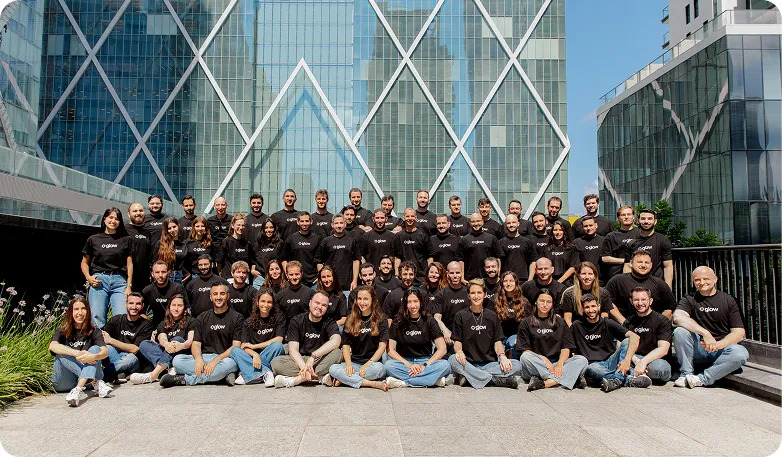
Before that team had a public launch, it had to convince security leaders to engage with a company in stealth. Singer has recalled that early prospects sometimes received little more than a PDF report in return for their time. That is a useful antidote to the polished mythology of a well-funded debut. Every startup begins by asking someone busy to believe in an unfinished thing.
Tiger described the first eighteen months as late nights, customer conversations, and a conviction that kept hardening. The customers mattered because endpoint environments are stubbornly specific. A healthcare organization, retailer, and financial-services company do not share one simple tolerance for risk. Policies, software, people, and consequences differ. The product had to learn context rather than merely recite a generic list of threats.
Context before confidence
Glow starts by building what it calls a living inventory across devices, people, and software. Its agents discover the layers running on an endpoint, research unfamiliar components, reconcile conflicting records, and evaluate the result against an organization's policies. The goal is a decision grounded in the customer's environment: allow, remove, remediate, or ask a human.
Glow uses foundation models from Anthropic and Google's Gemini through Amazon Bedrock. The models are ingredients, not the meal. Tiger has emphasized the engineering around reliability: supply the model with enterprise context, security policy, and validated organizational data so that its judgment becomes useful enough for operations. In Glow's telling, an average organization contains more than 12,000 unique pieces of software, and 67 percent is invisible to existing tools. A charming chatbot cannot tidy that cupboard by charm alone.
The automation is meant to be graduated. Customers can begin with a person reviewing recommendations. They can authorize lower-risk policies to run autonomously. Higher-risk remediation can continue to require approval, even when an action plan has already been assembled. This policy-by-policy approach is less cinematic than an all-knowing security robot. It is also more plausible. Trust grows by surviving small assignments.
“We think the prevention approach is the right frontline defense for every organization.”Roi Tiger, 2026
The platform has already encountered the sort of mundane danger that makes security real: malicious npm packages, software pulled in by AI agents, and devices where endpoint detection tools were absent or weakened. Prevention here is not a philosophical trophy. It is the ability to stop a dubious component before installation without turning every employee request into a week-long tribunal.
A founder's recurring move
There is a straight line from Onavo to Glow, although it bends through one of the world's largest technology companies. Onavo turned opaque mobile traffic into something a person could measure and manage. Glow wants to turn an opaque endpoint estate into something a security team can understand and control. Both companies begin with an unruly hidden layer. Both promise a map, then a lever.
The difference is moral as much as technical. Compression asks whether a system can do more with less. Security asks who gets to decide, what is visible, and when software may act. Tiger's current answer is supervised autonomy: let AI carry the repetitive load, let policy define the boundaries, and keep humans close to decisions whose consequences travel.
Glow entered a field with established companies including Microsoft, CrowdStrike, SentinelOne, and Palo Alto Networks. Its wager is that AI has changed the endpoint enough to create a distinct opening. Agents live beside employees, not merely in a distant cloud. Developer tools can alter a machine in seconds. The old safety net remains necessary, but Tiger wants a stronger front door.
This is a founder story with an unusually useful rhythm: learn in a secretive technical unit, build a small company, sell it, operate inside a giant, leave, listen, and begin again. The lesson is not that the second attempt arrives fully formed. Glow's public debut came after eighteen months of uncertainty and customer work. The lesson is that experience can sharpen the questions without making the blank page any less blank.
Tiger's latest question is plain enough to fit on that page: can security know the endpoint well enough to prevent trouble without preventing work? The answer will emerge one device, policy, and awkward exception at a time. Somewhere, an employee is already installing the next thing.