The most revealing software in a company is often the file nobody planned. It sits one window to the right of the expensive system of record, named something like FINAL_v7_use-this-one.xlsx. Inside are the exceptions, instincts, favors, constraints, and small acts of judgment that keep an operation moving. Rodrigo Mosqueira has spent enough time around orders and inventory to take that file seriously.
His new company, Bizmark, starts with an unfashionable observation: an ERP may record what a business did without knowing how the business decides what to do next. A factory still has to choose which job runs when a machine goes down. A distributor has to decide what to buy, from whom, and with how much cash tied up. A sales team has to turn a peculiar request into a price that protects both margin and a promise date. The answers rarely live in one database. They are distributed across systems, inboxes, spreadsheets, documents, and the memories of people who have seen the movie before.
Mosqueira, the San Francisco founder and CEO of Bizmark, wants to turn that scattered logic into software that can be inspected, approved, and executed. The company calls its product a system of applied intelligence. The phrase is intentionally workmanlike. This is artificial intelligence wearing steel-toed boots, arriving with a clipboard, and asking what actually happens after the purchase order lands.
An education measured in orders
Before Bizmark, Mosqueira was the first employee at Favo, the Latin American social-commerce and e-commerce logistics startup founded in Peru in 2019. He later served as chief growth officer. Favo let local entrepreneurs run online grocery stores without putting up inventory capital, while the company handled a difficult backstage production: catalog, acquisition, fulfillment, delivery, retention, and the daily choreography of perishable demand.
Those numbers are Mosqueira's own shorthand for the experience: zero to $60 million in revenue, 100,000 orders a month, and 10,000 SKUs. In his farewell to Favo, he added more texture. The company had touched 822,000 users, acquired customers at a reported $1 cost, doubled retention in six months, and produced an app rated 4.8 out of 5 in Peru. Scale, in this case, was not a line going up on a pitch deck. It was thousands of items repeatedly being promised, picked, paid for, moved, and explained.
Favo closed on February 29, 2024, after four and a half years. Mosqueira's public note held two emotions together: sadness about the ending and pride in the team. He wrote that, even knowing the outcome at the beginning, he would do it again. Then he did something practical. He shared a document with the profiles and résumés of Favo employees and offered the recommendation of the company's leadership to anyone considering them. Even the goodbye had an operating layer.
The useful residue of a startup is not a slogan. It is better taste in problems.
Mosqueira did not leave physical operations for a tidy software category. He went to the University of Chicago, studied computer science, and completed an MBA at Chicago Booth on a full-ride scholarship awarded to fewer than one percent of students. The classroom added languages for code, markets, and organizations. Favo had already supplied the cases, each with actual stock attached.
There was an earlier vantage point too. Public startup profiles place Mosqueira at Ataria Ventures while he was an economics undergraduate. The sequence is useful: first looking at young companies through the lens of capital, then joining one at employee number one, then studying both computation and management, and finally founding his own. Each seat asks a different question. An investor asks whether a market can become large. An operator asks whether today's orders can leave the building. A founder has to keep both clocks visible.
That may explain why his public writing about Bizmark rarely floats away into general claims about intelligence. He writes about supplier RFPs, purchase orders, deliveries, quote design, customer history, margin, lead times, and the awkward economics of serving small jobs. These are nouns with owners. Somebody sends the email, checks the figure, approves the exception, and answers when the promise slips. Mosqueira's chosen unit of analysis is not the model response. It is the business decision that survives contact with Tuesday afternoon.
The cousin with the constraints
Bizmark began with a family connection. Mosqueira's co-founder and CTO, Oscar Aguilar, is his cousin. The pair describe themselves as people who love seeing how things get built in the real world. Aguilar brought an operations-research background and experience leading process optimization at Intel, Amazon, and Johnson & Johnson. Mosqueira brought the scar tissue of growth: the knowledge that a clean customer experience is often balanced on a disorderly stack of human decisions.
They spoke with 150 operators before presenting Bizmark publicly. Across manufacturers, distributors, and retailers, the nouns changed while the frustration rhymed. Quotes took too long. Inventory absorbed cash without delivering the right service level. Rush orders collided with finite capacity. Teams bought new systems, migrated records, and discovered that the work still depended on the same experienced employees and their unofficial tools.
One of those patterns is a familiar enterprise ritual: when work becomes heavy, replace the system of record. The migration moves customer tables, order histories, and item masters. It does not automatically carry over why a buyer favors one supplier under pressure, which customer can accept a delay, or how a scheduler protects a scarce machine hour. The new system arrives immaculate. The old spreadsheet quietly reopens. Bizmark is built around that return visit.
The missing layer in an operating decision
The company's architecture mirrors that diagnosis. A data layer gives people, applications, and agents the same operating state. A logic layer combines probabilistic interpretation with deterministic constraints. An execution layer carries a governed decision through the administrative work, updates systems, coordinates participants, and escalates exceptions. The vocabulary is technical; the promised outcomes are pleasingly mundane: a quote prepared, a production sequence repaired, a purchase order placed.
The economics of the person who knows
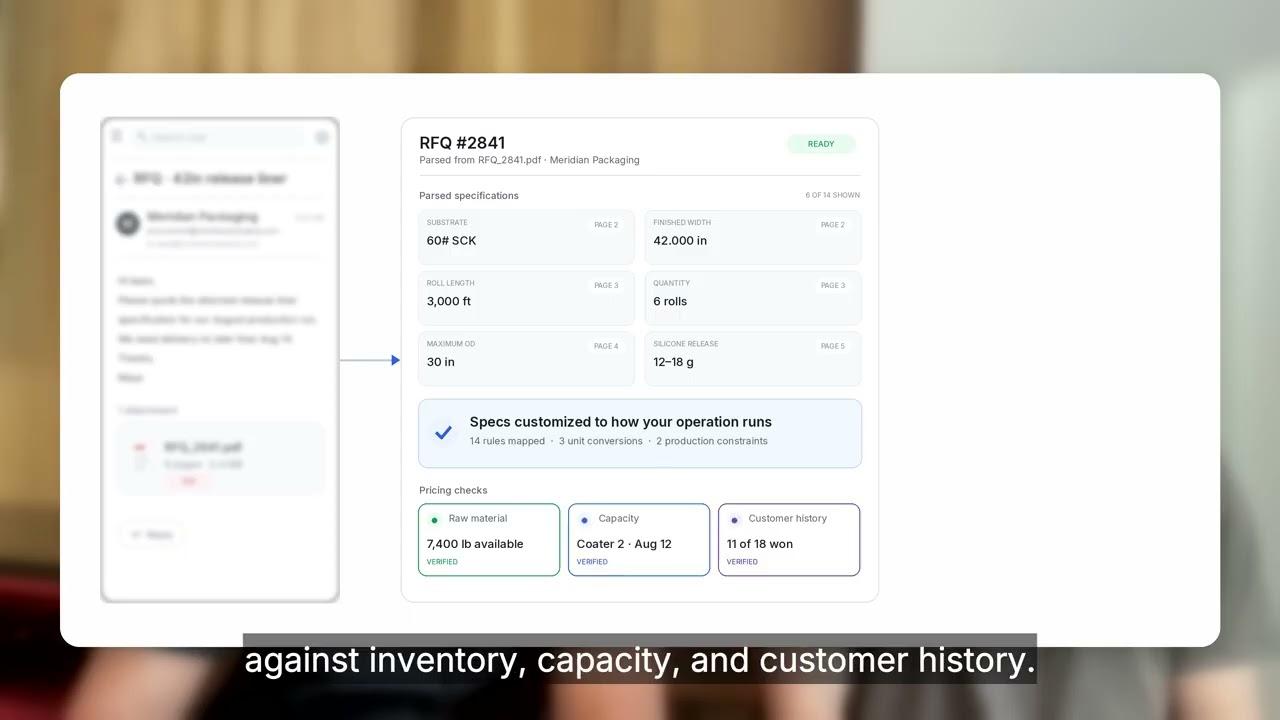
Mosqueira's recent writing keeps returning to quoting, perhaps because a quote is a tiny model of the whole company. To price an order, someone may need to understand its design, the margin the business requires, current capacity, a defensible lead time, and what this customer paid before. Each fact can exist somewhere in the stack while the decision still waits for one or two people capable of composing them.
That waiting has an economics. When volume rises, the usual answer is to hire more estimators or ignore the smaller jobs. The first increases overhead. The second hands a long tail of demand to competitors. Mosqueira's argument is that the knowledge is not mystical. Capture how the price is set, make that logic executable, and let the team approve the result. Quote throughput no longer has to equal the available hours of the senior person who knows.
Before automating a workflow, locate the decision bottleneck. Ask what one experienced employee weighs, where each input lives, which rules cannot bend, and which exceptions deserve a human.
This is also where Bizmark's thesis becomes more demanding than a clever assistant. A useful operating system cannot merely sound plausible. Production plans face machine limits, labor availability, material arrival times, changeover costs, and service commitments. Procurement has to balance inventory, cash, supplier terms, and compliance. A fluent answer that violates a hard constraint is simply an eloquent mistake.
Bizmark therefore pairs models that interpret context with rules that govern execution. Humans remain in approval and exception paths. The product is meant to adapt to the company rather than press the company into a universal template, and the team promises working deployments in weeks rather than years. It is a sharp promise. Every organization believes it is special; every successful software company must discover precisely where that belief is true.
A second attempt, with memory
Bizmark entered Y Combinator's Summer 2026 batch and launched from San Francisco as a two-founder company. Its opening market is broad in industry and narrow in need: organizations that make, move, or sell physical goods, with high-consequence decisions stranded between the official system and the actual operation. The website lists deployments across factories, retailers, universities, and distributors, from businesses with $10 million in revenue to organizations with billions.
There is a neat temptation to tell Mosqueira's story as a straight conversion of failure into wisdom. Real careers are less obedient. Favo achieved striking growth, served hundreds of thousands of users, and still ended. Bizmark is new, and the work ahead is not redeemed by the clarity of the pitch. Enterprise integrations are stubborn. Operating rules conflict. The employee who owns the heroic spreadsheet may reasonably wonder what becomes of the hero once the spreadsheet can act.
What Mosqueira offers is not certainty but continuity. He has chosen a problem whose details resemble the work he already knows: growth constrained by coordination, margin hiding inside process, and human judgment compensating for systems that stop a few feet short of reality. The aspiration is to preserve that judgment while letting it travel farther.
A record tells you that an order shipped late. An operator tells you the supplier changed the material, the best machine was occupied, the customer mattered, and Tuesday was the least bad promise. Bizmark wants software to hold that whole sentence. For Mosqueira, after 10,000 SKUs and one very public ending, the spreadsheet beside the ERP is no longer a nuisance to eliminate. It is a map of the company thinking.