The first thing Robert Miles brought to Computerphile was an explanation of public-key encryption. He had come across a way of describing it that made a difficult idea feel orderly, and he wanted to pass it on. This is an unusually revealing first act for someone who would later become closely associated with AI safety. He started with the pleasure of understanding something, followed immediately by the suspicion that other people might enjoy understanding it too.
The opportunity itself arrived with less ceremony than a research grant. Miles was a PhD student at the University of Nottingham when he met Computerphile video maker Sean Riley in a queue for barbecue food. Riley regularly talked to researchers about their work. Miles had a topic. They talked. The encounter led to a video, and then to a run of explanations about artificial intelligence, its goals, and the ways a system can do exactly what it was asked while missing what people meant.
A barbecue queue is an unlikely place to find a calling. It is, however, a good place to find an audience: people are already there, standing still, and willing to listen while they wait.
The question hiding inside the instruction
Miles had studied computer science at Nottingham and become interested in AI while still an undergraduate. He considered research as a route into a problem he thought mattered. His later career turned on a different discovery. He could explain the problem to people outside the small circles already discussing it. In a 2025 interview, he described noticing that he enjoyed the work and had some evidence he was good at it. That sounds modest. It is also a precise account of how a specialty becomes a vocation.
The problem he explains is often called AI alignment. At its simplest, it asks whether an AI system will pursue goals in ways that actually serve human intentions. Those two things can come apart. A neatly specified target can reward a strange shortcut. A powerful system can follow an instruction while treating everything around that instruction as negotiable. Miles’s examples give the abstract nouns something to bump into: a goal, a method, an outcome, and the human being who expected a different outcome.
His early stamp-collecting machine is one such example. Tell a hypothetical machine to collect stamps, make it capable enough, and the instruction can grow into a nuisance of cosmic proportions. The premise is comic because stamps are so harmless. The lesson is less comfortable: ability and judgment are separate properties. A system might be extremely capable at pursuing a target without sharing the assumptions its designers never bothered to spell out.
Computerphile gave him a format that suited this kind of inquiry. The camera could stay on a person explaining an idea. The whiteboard could carry the moving parts. A viewer did not need to arrive knowing the jargon. Miles has said he tried to avoid letting the science-fiction flavor of the subject take over, because that frame can distract from the present-day design questions. The videos work through the logic first. The dramatic implications can wait their turn.
An audience bigger than one comment thread
By 2017, Miles was also making videos on his own channel, Robert Miles AI Safety. Having a dedicated channel let him choose the depth and pace of the explanation. Some subjects need more than a brief introduction. Orthogonality, instrumental convergence, and inner misalignment are phrases that can make a room go quiet before anyone has asked what they mean. On his channel, they become a sequence of examples and questions.
That work created a second problem: viewers had questions. Many were thoughtful. Miles could spend time writing a careful reply beneath a video, but YouTube comments are poor shelves for reference material. The answer might reach the person who asked and a few passersby. It would then sink beneath newer conversation. For an educator, the repeated question was evidence of interest. For an organizer, it was an invitation to build something reusable.
“I spend my time explaining AI safety and AI alignment on the internet. Mostly on YouTube.”Rob Miles, 2021
He first tried to give the audience a way to help. Stampy, named after the stamp-collector example, began as a Discord bot. It could look for questions in YouTube comments, bring them into a community discussion, and return a jointly written answer. There was a pleasing loop to it: an example designed to explain a dangerous kind of goal pursuit supplied the mascot for a tool designed to improve explanations.
The loop ran into a familiar internet obstacle. Miles said YouTube’s systems began removing the bot’s replies, even when the account was authorized to comment. He called it “bot prison.” The phrase is funny; the design problem was real. A tool meant to help viewers could not reliably deliver its work where the viewers had asked. So the answers moved toward a home of their own.
Stampy grows up
AISafety.info grew from that effort. It is a community-written guide to AI safety, founded by Miles and maintained by specialists and volunteers. It lets people follow a question toward an answer, then toward the material that supports it. The site now also offers a chatbot called Stampy and cautions readers to verify its sources. That caution fits the larger project. If the subject concerns systems that can produce plausible but mistaken output, a public guide ought to make uncertainty visible.
Miles wanted the questions to do work on both sides of the exchange. A viewer could learn from an answer; a volunteer could learn by trying to write one. He described a useful middle ground: a person may know just enough to make a first attempt, then read more carefully because the answer must survive someone else’s scrutiny. The project’s Distillation Fellowship made that labor explicit, paying writers to turn difficult research into clear explanations and links.
It is a distinct kind of ambition. A channel can collect subscribers. A FAQ can outgrow its founder. The value lies in making the next person less dependent on a single narrator, however good that narrator may be. Miles has also collaborated with researchers and organizations that wanted their work explained to wider audiences, and he narrated an audio version of Rohin Shah’s Alignment Newsletter. In each case, he acted as a bridge between specialized writing and people who might care about its consequences.
A carefully built voice
Miles has a comic streak that makes the lectures easier to enter. His X biography pairs “music, movies, microcode” with “high-speed pizza delivery.” He tells the barbecue story with the cheerful economy of someone who remembers being a student and seeing free food. Stampy is itself a joke with a filing system attached. The humor gives the viewer something to hold while the technical point is assembled.
There is also a visible difference between his edited videos and his interviews. In a 2025 conversation, Miles said he tends to avoid interviews because he worries about being less coherent without writing and editing. That admission explains some of the care in the finished work. The apparent ease of a good explainer can be the result of considerable cutting, ordering, and reconsidering. A sentence that sounds conversational may be where the hard work finally became invisible.
That care extends to the promise a channel makes to its viewers. In one long conversation about publishing research talks, Miles weighed whether they belonged beside his usual videos. He admired channels that turn difficult material into something a general viewer can follow. He also knew that a lecture for specialists asks for a different kind of attention. His proposed answer was a separate place for talks, with his own channel pointing people toward the ones they might enjoy. It is a small editorial decision, but it reveals how he thinks about teaching. The person who has just arrived and the researcher looking for a detailed seminar are both worth serving. They may need different doors into the same subject.
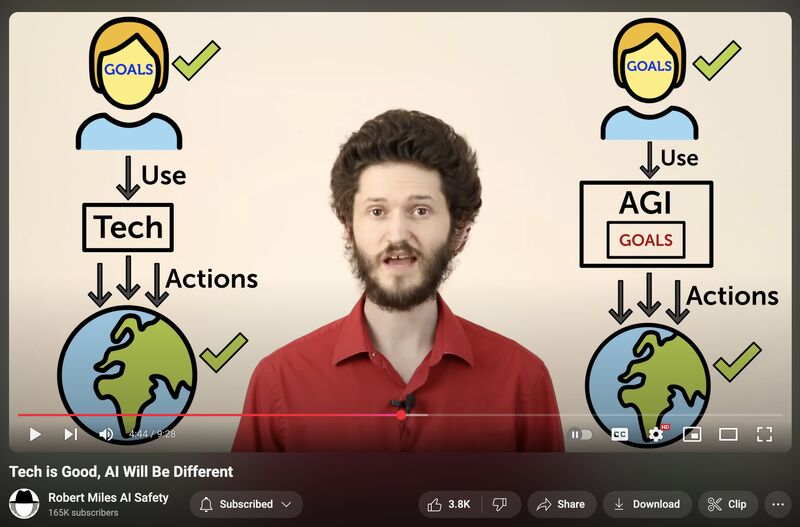
He remains willing to return to the same subject from new angles. In 2025, one video offered practical routes into AI safety work. Another, “Tech is Good, AI Will Be Different,” asked viewers to consider how AI systems pursuing their own goals could differ from familiar tools. In September 2026, he appeared again on Computerphile to discuss “neuralese,” the possibility that AI reasoning could become harder for humans to read. The topic had changed since the barbecue queue. The underlying question had not: what, exactly, do we understand about a system before we trust what it does?
Miles does not settle that question in a tidy final sentence. Nor could any one video. His contribution is to make the question portable. A viewer leaves with an example they can retell, a term they can define, and perhaps enough confidence to ask where an argument is weak. That is a modest-sounding achievement with unusually long legs. Once people can explain a problem to one another, the discussion no longer depends on whoever happened to be first in the barbecue queue.