Robert Hoopes went to work on Joe Biden’s presidential campaign in New Hampshire in 1987. He was still a Colby student. The title of founder was twenty years away; the title of president would take considerably longer to reach Biden. What began as an early campaign job became a professional relationship that survived changes of office, changes of ambition and several generations of campaign technology. Some people leave college with a forwarding address. Hoopes left with a connection that would keep producing work for decades.
Two years earlier, in 1985, he had entered Sandy Maisel’s introductory government class at Colby. That classroom supplies another starting point for his story. Maisel became a mentor, and the connection continued well beyond graduation. Much later, Hoopes would describe watching his former professor work from seats alongside him on college boards. His career has a recurring shape: an institution introduces him to someone, and the introduction turns out to have a very long afterlife.
He graduated from Colby in 1989 with a bachelor’s degree in government. He later earned a master’s in legislative affairs at George Washington University, graduating in 1992. The subjects fit the work that followed. Government teaches the architecture; legislative affairs gets closer to the corridors. A career in public affairs requires some familiarity with both, including the inconvenient fact that a sensible argument can still lose.
After the New Hampshire campaign, Hoopes joined Biden’s Senate office in Washington. His time there included the first Gulf War and Supreme Court nominations. He also worked for Senators Chris Dodd and Alan Dixon. This was an apprenticeship across different offices, with different constituencies and demands. The later communications executive had first spent time inside the institutions that clients would want to understand.
The founder who stayed after the sale
His route into business included senior work at MCI WorldCom and an executive vice president role at Powell Tate, within Weber Shandwick. Those jobs added corporate and agency experience to the Senate background. Eventually he ran his own firm, Hoopes Strategies. The sequence matters because VOX Global did not begin with a founder discovering politics from a conference-room presentation. Hoopes had already worked on both sides of the conversation between companies and government.
In 2007, FleishmanHillard acquired Hoopes Strategies and appointed him president of VOX Global. The sale and the founding belong to the same chapter. It is a less tidy origin than the familiar story of an entrepreneur leaving a large organization to escape its gravity. Hoopes built the next business inside an established communications network. The founder stayed to operate it. Ownership changed; responsibility acquired a new name.
VOX began with ten people. That is a useful number to keep in mind when reading the titles that accumulated afterward. Ten people is small enough that a founder’s judgments about clients, colleagues and the kind of work worth doing have an immediate effect. The firm’s remit joined public policy with reputation and storytelling, serving businesses, educational institutions and nonprofit organizations. Its product required understanding a situation before finding the language for it.
In July 2016, Hoopes added another management job: general manager of FleishmanHillard’s Washington office, while retaining the VOX presidency. He was also a member of the firm’s Global Cabinet. The appointment expanded his responsibility from one agency to the operations of two Washington businesses. At the time, he said the sector was changing and the teams were “evolving at a rapid pace.” For a founder, that meant a continuing obligation to revise the organization he had built.
There is an unglamorous pleasure in this part of the story. Public affairs promises access to consequential questions, but running a firm also requires colleagues, capabilities and repeatable work. A successful introduction cannot answer every client question or manage a growing staff. Hoopes’s career puts political relationships next to operating responsibility. The business had to function on the days when there was no convention, no presidential visit and no television camera.
Charlotte’s other campaign job
In 2012, five years after the founding of VOX, Hoopes took a leave of absence to become chief of staff for Vice President Biden’s Democratic National Convention team. The assignment was specific to the convention in Charlotte, North Carolina. His responsibilities included coordinating staff, working daily with Biden’s senior team and arranging the vice president’s engagement with party leaders, members of Congress, donors and stakeholder groups.
Convention television favors a microphone and a face. The work behind that picture has a longer cast list. A vice president’s time must accommodate people with competing priorities and reasons to believe their meeting matters. Hoopes’s assignment placed him in the business of making those demands coexist. It was political work with an operational deadline: the event would arrive whether or not every conversation had become convenient.
The relationship that started in New Hampshire was now twenty-five years old. It would continue through the 2020 election, when Hoopes spent time in Iowa and South Carolina helping recruit support and organize campaign participation. The continuity is striking without requiring a theory of personal destiny. He kept returning to the same political relationship while maintaining a separate business career. Two demanding lines of work ran beside each other.
In May 2017, those political and educational circles met in public. Biden delivered Colby’s commencement address, an appearance brought about through his connections with college trustees Pete Rouse and Hoopes. The former campaign worker was now helping connect a former vice president with the college where he had studied government. An alumni relationship can sometimes become rather more elaborate than receiving a magazine.
- 1987Biden campaign
New Hampshire - 2012Convention team
Charlotte - 2017Colby commencement
Waterville - 2021Fellowships commission
Washington
A nudge for the next founder
Another Colby connection produced a quieter encounter. Lisa Kaplan, a 2013 graduate, was considering a business that would help organizations respond to online disinformation. Economics professor Patrice Franko encouraged her to speak with Hoopes and former ambassador Robert Gelbard. Both supported the idea. Kaplan launched Alethea Group in May 2019. Hoopes’s contribution was the encouragement of an experienced founder looking at someone else’s proposed beginning.
What caught his attention was more particular than an attractive market. He saw a promising early idea and valued Kaplan’s ability to explain the meaning of what she found. His questions were compact: “What is the context? What is the cadence?” In a field where the quantity of information can be overwhelming, he was interested in how someone made it intelligible to another person. Discovery alone would leave the customer with more material to interpret.
Those questions offer a small, useful window into his professional judgment. Context asks how a fact belongs to a larger situation. Cadence asks about timing and delivery. Together they connect analysis with the experience of the person receiving it. A communications business can possess excellent information and still fail to help anyone act on it. Hoopes recognized an entrepreneur who could make that last part of the journey.
“What is the context?
What is the cadence?”
His educational relationships also took a formal shape at George Washington. In 2015, its Graduate School of Political Management gave him an Alumni Achievement Award. By 2018, he was serving as the advisory board’s Democratic, or blue, co-chair, alongside Republican co-chair Leigh Ann Pusey. Asked about their involvement, the pair described improving political discourse and engaging the next generation of leaders as sources of inspiration.
The arrangement put people from different political traditions into responsibility for the same school. It provides a concrete example of the institutional work that sits alongside Hoopes’s party campaigning. In one setting he helped a candidate; in another he helped an educational community whose work extended across parties. Those obligations could occupy the same career without becoming the same job.
The institutions that keep calling him back
On June 4, 2021, Biden announced Hoopes’s appointment to the President’s Commission on White House Fellowships. The commission recommends candidates for a program that gives participants experience at senior levels of the federal government. The former young campaign worker was being asked to help evaluate other people seeking a beginning in public service. It was another version of a role he had already performed informally: considering who might be ready for an opportunity.
His earlier school recognized the longer arc, too. Wilmington Friends named him its 2022 Distinguished Alumnus of the Year. Hoopes graduated there in 1985. He and Hilary Barnes Hoopes have three children who are fourth-generation Friends School graduates. That detail gives the educational thread a family dimension. The institutions in this story are places people return to, and places to which they send another generation.
He has also appeared before students as a practitioner. He delivered Ball State’s Vernon C. Schranz lecture in 2014, connecting strategic communications, risk-taking and a career path. The invitation offered a fitting question for someone whose work crosses party politics and corporate representation: whom do you stand for? It is a question with practical consequences whenever a communications adviser agrees to take on a client.
In 2020, a VOX statement associated with Hoopes committed the firm to supporting employees who joined peaceful protests, examining its pro bono work and using leadership roles to address racial injustice. Such commitments belong in the same account as the business titles. They describe choices about how an organization participates in public life, including the people whose work sustains it. A firm that advises others about reputation has a reputation of its own to attend to.
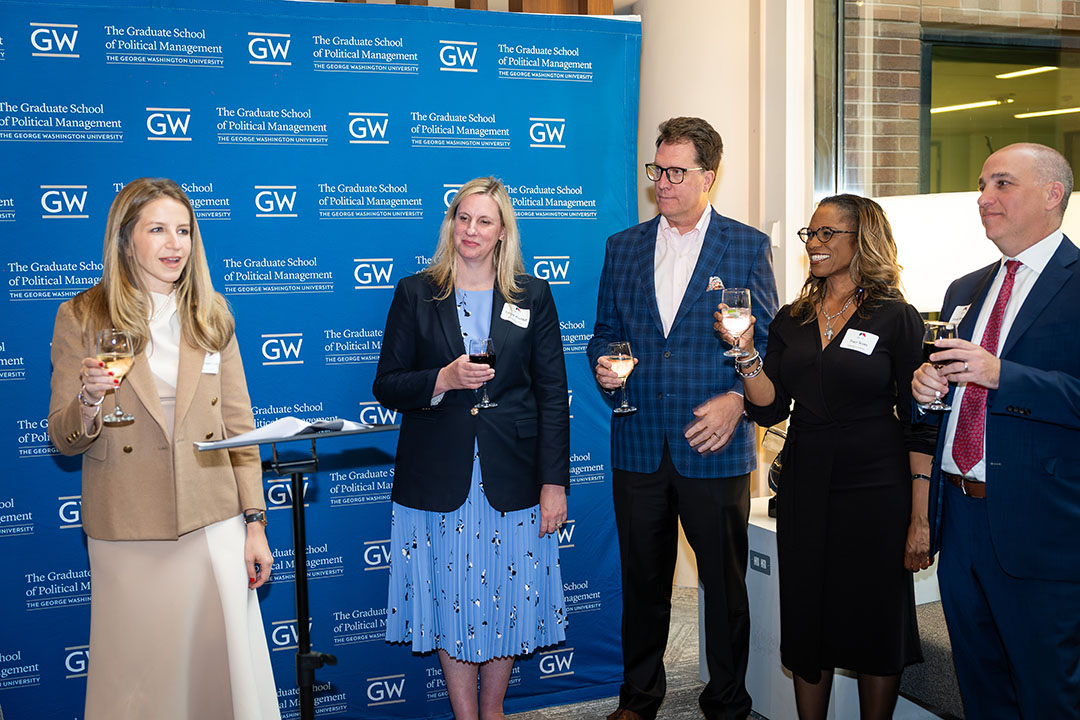
A photograph from GW’s May 2024 alumni celebration catches Hoopes among fellow board members raising their glasses. By December that year, he was a Colby trustee emeritus. In 2025, he and Hilary appeared among the named benefactors of the Colby Museum’s summer luncheon. The settings change from classroom to boardroom to reception, but the return visits remain. His first campaign opened one durable relationship. His first government class opened another. Decades later, he was still finding work in both.