At Mugello, on October 26, 2025, Rey Acosta had a rather different reporting deadline. Thirteen laps. A damp circuit. A Ferrari 296 Challenge. Behind him, a field of drivers with every intention of making his afternoon less agreeable. Acosta started on pole, kept the lead and finished 10.128 seconds ahead of Yahn Bernier. The AltaReturn co-founder and Allvue’s founding chief executive had become the Ferrari Challenge Coppa Shell world champion.
There are more conventional ways to follow a career in fund accounting software. Acosta chose one with a helmet. Yet the appealing detail of his move into motorsport is the familiar name beside his own: Custodio Toledo, the partner with whom he had founded AltaReturn in 2008. Their business relationship survived a company combination, a change of executive responsibilities and a journey into competitive racing. The meeting venue acquired a pit lane.
That continuity makes Acosta’s story more interesting than a straightforward executive escape. Before the trophies, he spent years helping investment firms connect the pieces of their working lives. Accounting, investor relationships, portfolio information and reporting all needed to agree. His commercial career grew around that problem. His racing career would give him another setting where preparation had to survive contact with events.
The trouble with a capital call
AltaReturn began in 2008 with Acosta and Toledo as its founders. Its customers occupied the operational side of private capital: private equity and venture capital funds, real estate managers, fund administrators and family offices. These are businesses that need to keep track of money over long periods, across complicated relationships. A successful investment still comes with paperwork. Quite a lot of paperwork, as it happens.
Acosta’s explanation of a capital call provides a useful glimpse of the product he was selling. A fund asks investors to contribute money they have already committed. That requires calculations, notices and delivery. AltaReturn connected the accounting allocations to letters produced through its customer relationship system, then published the documents through an investor portal. A sequence that crossed departmental boundaries could run through connected applications.
- 01CalculateInvestor allocations
- 02PrepareCapital call notices
- 03PublishInvestor portal
An illustration of the workflow Acosta described in 2015.
The company built on Microsoft technology, with applications available together or separately. For a specialist software business, that was a consequential choice. AltaReturn could concentrate on the requirements of its particular customers while using an established technology foundation. Its pitch was practical: bring the work into a connected system, then make that system available through the cloud.
A client list becomes a business
In June 2012, fund administrator AltResources selected AltaReturn for accounting and reporting. Acosta, then identified as managing partner, emphasized deployment speed and cost. The applications, he said, could suit established funds as well as newly formed ones. It was an early example of the customer he wanted to serve: a firm whose own service depended on getting other people’s financial information right.
By 2015, AltaReturn had appeared on CIOReview’s list of 100 promising Microsoft solution providers. Its customer base covered firms with assets ranging from $100 million to $35 billion. Those figures described the clients’ assets, rather than AltaReturn’s revenue. The distinction matters in financial software, where very large sums can appear in a sentence without belonging to the software company at all.
Another partnership addressed a stubborn family-office problem. In 2018, AltaReturn joined with Private Client Resources to bring aggregated investment information into its accounting platform. Acosta said family clients represented more than $60 billion in assets on the system. Investment data could arrive from multiple places and in different forms; connecting it to the accounts was part of the service.
International expansion added another milestone. Link Asset Services chose AltaReturn for private-equity accounting and reporting in April 2018, with Jersey first in line for the rollout. Acosta called Link its first multi-jurisdictional European client. By the company’s tenth anniversary that July, more than 275 general partners and family offices were using the platform. A business founded around specialist operational needs had found customers across borders.
Eleven years to a new name
On September 23, 2019, AltaReturn announced its acquisition by Vista Equity Partners and its combination with Black Mountain Systems. The new business was Allvue. Acosta became chief executive; Black Mountain co-founder Kevin MacDonald became chief operating officer. Toledo’s subsequent role was chief technology officer for private equity. The original partnership was still visible inside a larger organization.
The industrial logic was easy to follow. AltaReturn brought experience in private equity, venture capital, real estate and family offices. Black Mountain supplied software for credit investors and alternative asset managers. Together, the businesses could address more of an investment manager’s operations, including firms running several strategies. Headquarters remained in Miami, with offices across North America, Europe and Asia.
Acosta and Toledo found AltaReturn.
AltaReturn and Black Mountain combine as Allvue.
Acosta wins the Coppa Shell world final.
At formation, Allvue’s platform represented more than $2.5 trillion in assets and 90,000 limited partners, and served 50 of the top 100 collateralized loan obligation managers. For Acosta, the job now involved bringing together businesses with different areas of expertise. The financial scale supplied a striking introduction; the everyday test remained whether clients could get their work done.
Early in 2020, Allvue announced more than 20 new customer signings, including two of the five largest American banks, alongside new operations, finance and human resources leaders. Later that year, Mark Heimbouch succeeded Acosta as CEO, and Acosta moved to executive chairman. His founding role belongs to Allvue’s history. The company he helped assemble continued under new operational leadership.
Excel’s inconvenient popularity
Acosta’s writing from around the time of Allvue’s formation shows how he thought about the customer’s predicament. He acknowledged the attractions of spreadsheets: familiarity, convenience and relatively low cost. “Everyone loves Excel. And why not?” he wrote. A software executive conceding the appeal of a spreadsheet is at least beginning the conversation in the right room.
His argument concerned what happened as the work expanded. Errors, delayed statements and increasingly complicated investor demands could make familiar tools cumbersome. In Allvue’s 2019 private-capital CFO survey, 75 percent of respondents identified portfolio monitoring as a process they wanted to improve over the following year. Acosta connected that concern to investors seeking more information about underlying holdings.
“Everyone loves Excel. And why not?”
Rey Acosta, December 2019 / January 2020
There is a recognizable commercial temperament in that argument: start with the work people already do, then examine where it becomes difficult. The promised improvement was concrete. Collect information more reliably. Connect it to accounts and investor communications. Reduce the time between a question and a usable answer. It helps explain why AltaReturn’s story includes administrators and family offices as well as fund managers.
Back to school, with a Ferrari
Motorsport introduced a different education. Acosta’s path included track days and Ferrari’s Corso Pilota driving programme before Ferrari Challenge competition. He entered the North American championship in 2022. The following results were earned in named classes and individual races, where the distinctions between a podium, a regional championship and a world final are worth preserving.
At Imola in October 2022, he finished third in Coppa Shell Am North America. His post-race remarks revealed that he had visited a couple of weeks earlier to train. “I worked hard to recover at turns 5 and 6,” he said. It is a pleasingly specific detail. The former software chief’s account of progress came down to two corners.
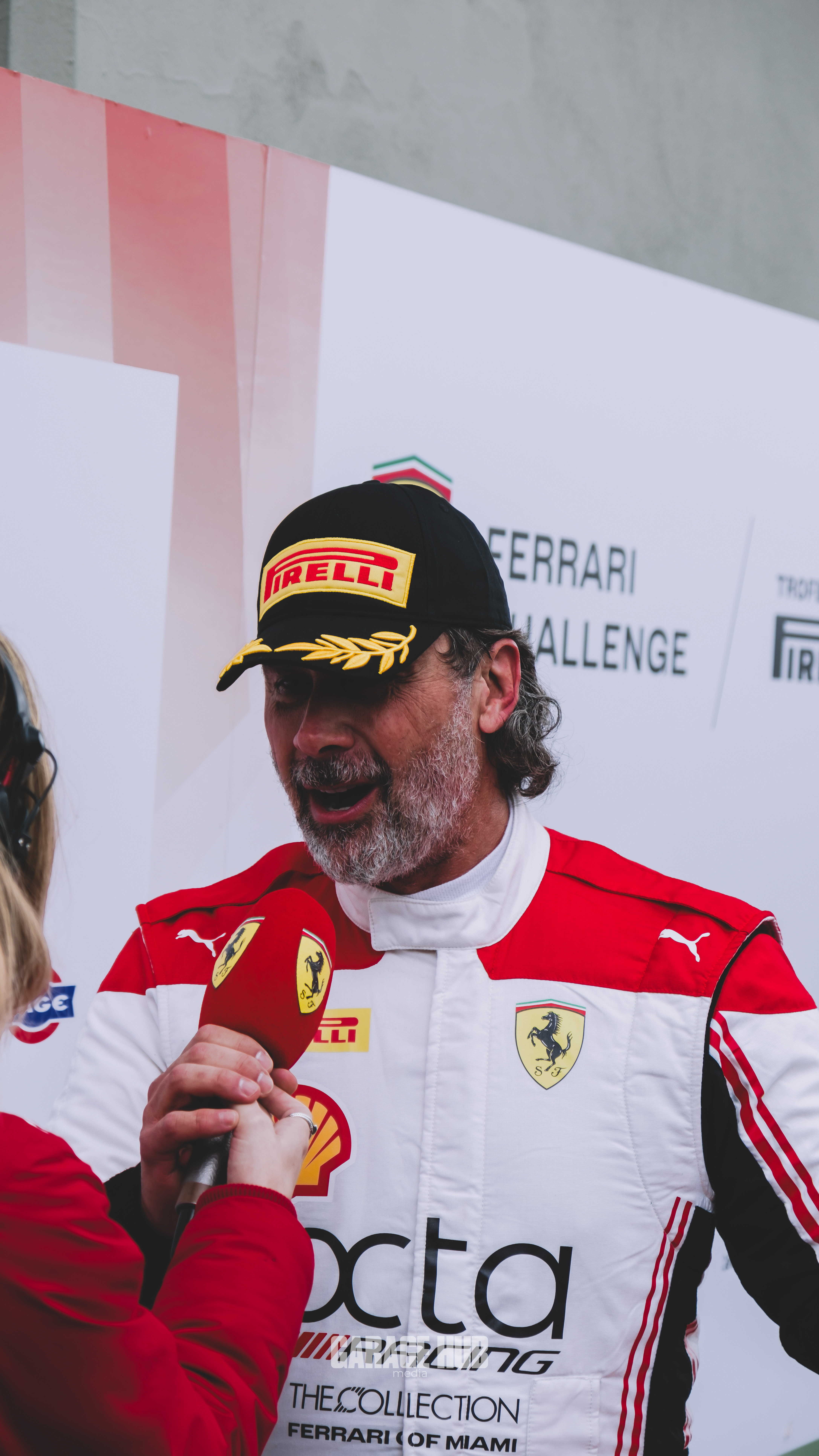
By September 2024, he was winning in Coppa Shell at Indianapolis, leading from start to finish. In Las Vegas later that year, he won again, his fifth consecutive victory. The next race supplied a useful corrective to any tidy success story: a time penalty left him with a podium finish while Robert McWilliams took the win. Racing keeps an unusually efficient red pen.
The margin at Mugello
The decisive weekend arrived in Tuscany in October 2025. Acosta earned Coppa Shell pole in a qualifying session interrupted by rain, ahead of Oscar Ryndziewicz and Fabrizio Fontana. He had been dividing his season between the European and North American series. Now the world final put those separate campaigns into a single contest.
The race began behind the safety car because of the damp surface. Acosta held the lead throughout. Bernier finished second, with John Dhillon third. The classification recorded 13 laps in 32 minutes and 20.310 seconds for Acosta, driving car 107 for The Collection. The winning margin was just over ten seconds. For once, a professional life accustomed to complicated accounts produced a very simple result.
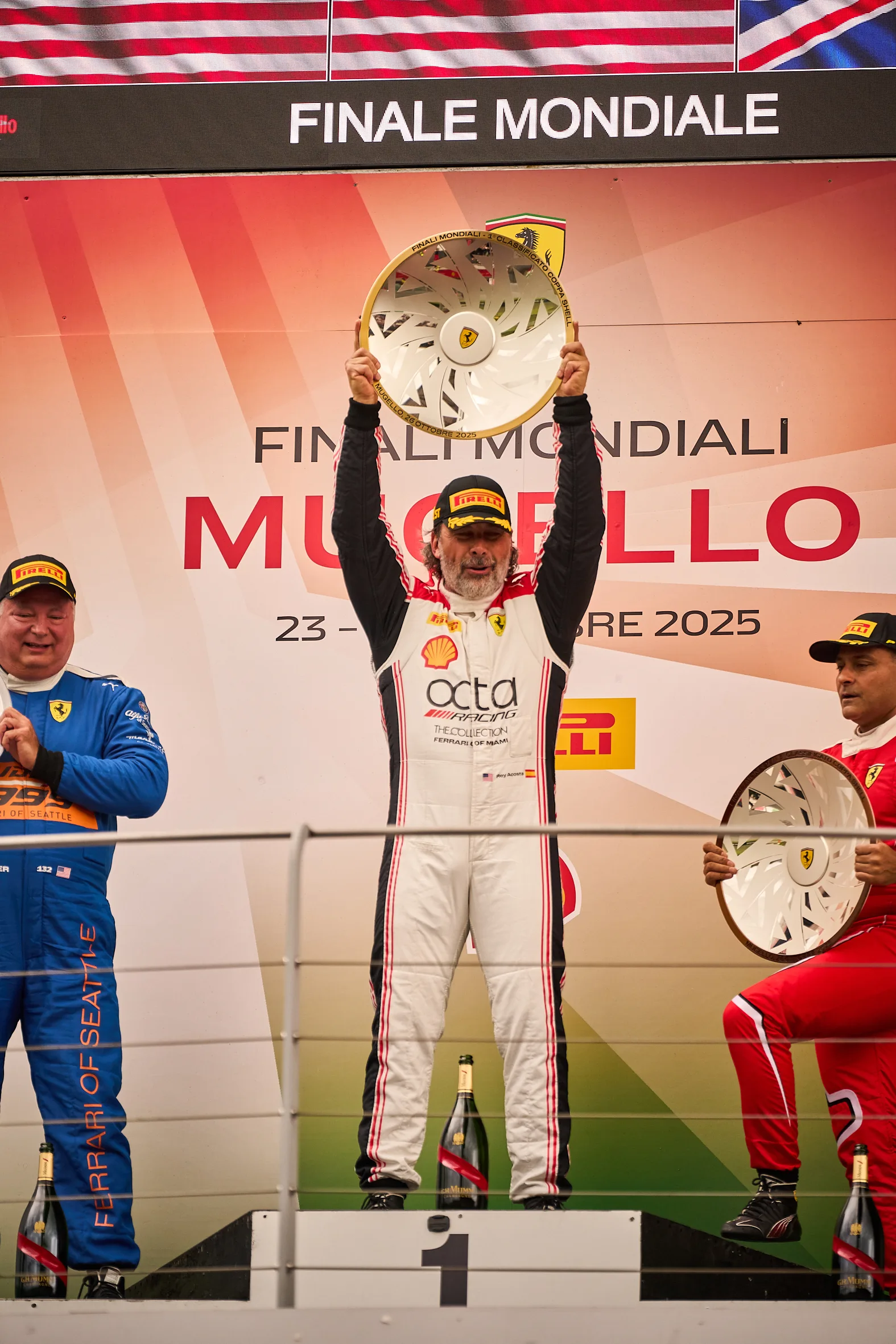
Acosta’s winning margin in the Coppa Shell world final.
In 2026, his racing continued in a Ferrari 296 GT3 with AF Corse. The Road to Le Mans entry list paired him with Marco Bonanomi in car 88, and Ferrari of Miami listed his Michelin Le Mans Cup campaign. Octa Racing brings Acosta and Toledo together again around their racing programmes. The partnership that began with fund software has acquired another working life.
Acosta’s route leaves two distinct achievements on the page: helping build a software business used by private-capital firms around the world, and winning a particular Ferrari world final on a particular wet weekend. Each stands on its own results. What joins them is the continued willingness to work through the details, whether the next problem is an investor notice or turns five and six.