SERIES B: Recall.ai closes $38M at a reported ~$250M valuation ONE API: Zoom · Meet · Teams · Webex · Slack Huddles · in-person SCALE: 3,000+ companies building on the platform VIRAL: "How WebSockets cost us $1M on our AWS bill" BACKERS: Bessemer · HubSpot Ventures · Salesforce Ventures · Y Combinator FORM FACTORS: bots, desktop SDK, mobile, Output Media SERIES B: Recall.ai closes $38M at a reported ~$250M valuation ONE API: Zoom · Meet · Teams · Webex · Slack Huddles · in-person SCALE: 3,000+ companies building on the platform VIRAL: "How WebSockets cost us $1M on our AWS bill" BACKERS: Bessemer · HubSpot Ventures · Salesforce Ventures · Y Combinator FORM FACTORS: bots, desktop SDK, mobile, Output Media
Company Dossier AI · Developer Tools San Francisco Est. 2022

Recall.ai

The single API that records every meeting - so the rest of the software industry doesn't have to.

$50.7M
Total Raised
~$250M
Reported Valuation
3,000+
Companies On Platform
~30
Employees
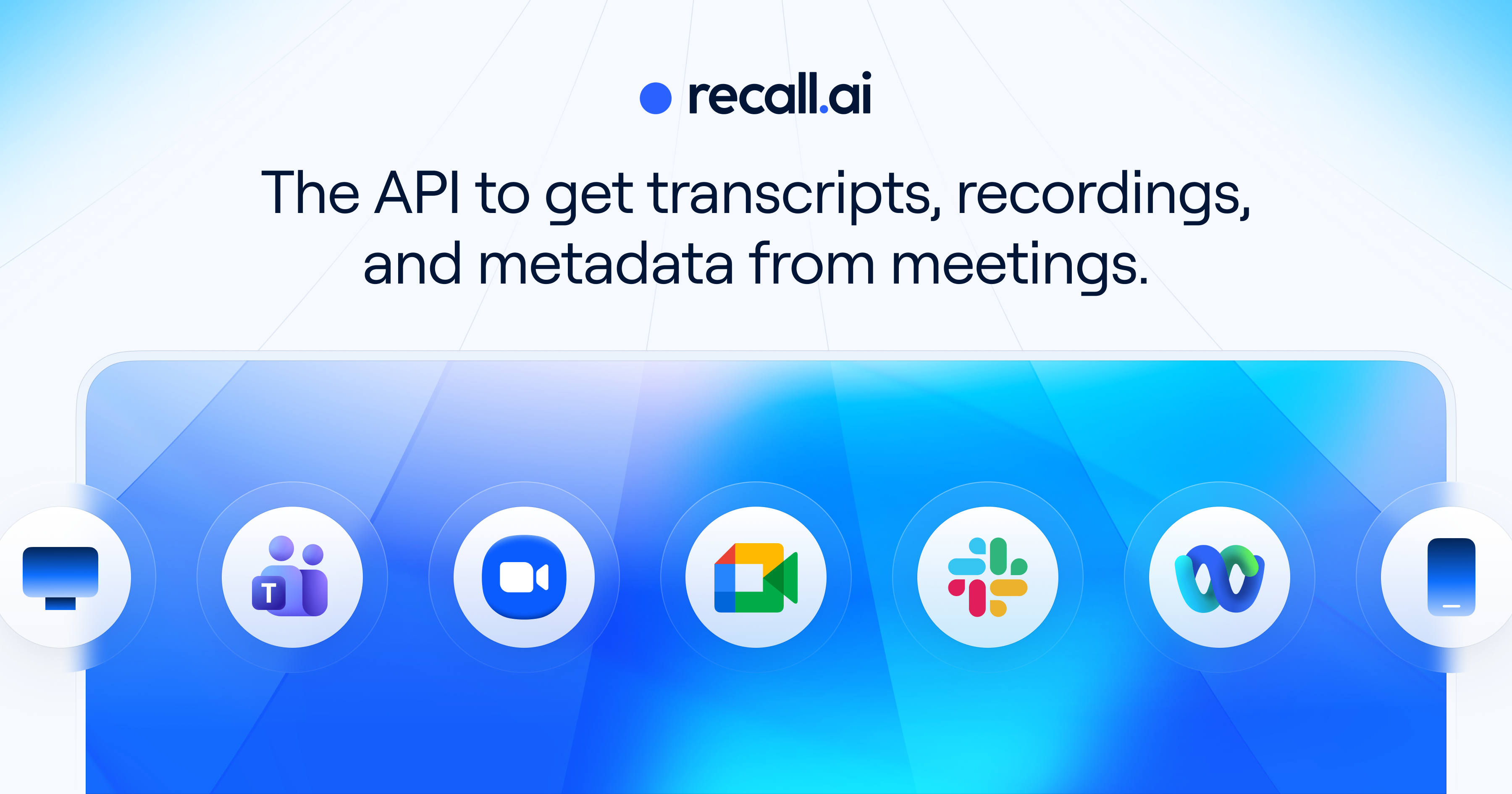
Recall.ai logo and the meeting platforms it captures: Teams, Zoom, Google Meet, Slack and Webex

THE PORTRAIT: A logo, a promise, and a row of icons. Recall.ai's own marketing image says the quiet part out loud - it is not any one of these meeting apps, it is the thing that quietly sits behind all of them at once.

Share this dossier LinkedIn Twitter / X Facebook Instagram
BY THE YESPRESS DESK · BUSINESS & TECHNOLOGY FILED FROM SAN FRANCISCO, CALIF.

There is a certain kind of company that decides the most interesting place to stand in a gold rush is behind the counter of the shovel store, and Recall.ai is one of them. It does not make the AI notetaker that summarizes your Tuesday standup. It makes the boring, load-bearing infrastructure that the notetaker needs in order to exist at all - the part where a bot has to actually join your Zoom call, sit there politely, and come back with a clean recording, a transcript, and a list of who said what.

This turns out to be a genuinely annoying engineering problem, which is the entire business model. Building a recording bot for Zoom is one project. Building one for Microsoft Teams is a different project. Webex is a third. Google Meet is a fourth. Slack Huddles is a fifth. In-person meetings, where there is no meeting platform to hook into at all, are their own special nightmare. Recall.ai's pitch is that you make one API call, they handle all of that, and the year of engineering you were about to spend becomes a few days of integration.

Every single conversation in the world is going to be recorded and become fundamental data.
- DAVID GU, CO-FOUNDER & CEO
The Business

Selling shovels to the notetaker rush

Here is the thing about conversation data. For a few years now, every company building an AI product has arrived at the same realization: the useful context about a business does not live in documents, it lives in meetings. Sales calls, customer interviews, standups, board meetings. Recall.ai likes to describe this as the world's largest untapped dataset for AI, which is the sort of line a company says when it has correctly noticed that a lot of software now wants to eat that data.

But to eat the data you first have to capture it, and capturing it is unglamorous. You have to keep up with Zoom shipping a UI change on a Thursday. You have to handle a Teams call where someone joins from a phone. You have to not fall over when thousands of bots are all recording at once. Recall.ai's customers - companies like Sybill, and reportedly names such as HubSpot, Calendly, ClickUp, Instacart and Apollo.io - would rather pay by the recording hour than staff a team to babysit this forever.

So they pay by the recording hour. As of the company's 2026 pricing, that is roughly fifty cents an hour to record, fifteen cents an hour if you also want the built-in transcript, and a nickel per media-hour to keep the file around longer than a week. There is no mandatory monthly toll; the calendar API is free. It is usage-based infrastructure pricing, the same shape as an AWS bill, which is fitting for a company whose most famous blog post is about an AWS bill.

That post - "How WebSockets cost us $1M on our AWS bill" - is worth dwelling on, because it tells you what kind of company this is. Recall.ai's bots move an enormous amount of video, up to about 150 megabytes per second at the tail. Their engineers discovered that shuttling all that video over loopback WebSockets was quietly burning CPU on frame-splitting and masking. So they replaced it with a custom lock-free shared-memory ring buffer written in Rust, cut the cores per bot in half, and saved on the order of a million dollars a year. Then they wrote it all up in public. The bug postmortem, it turns out, is also the recruiting pitch.
6
Meeting Platforms
+ In-Person
150 MB/s
Peak Video Per Bot
99.9%
Uptime SLA
$0.50
Per Recording Hour
What You Can Build

The product line

FLAGSHIP · 2022

Meeting Bot API

Send a recording bot into Zoom, Google Meet, Teams, Webex, GoTo and Slack Huddles. Get back recordings, transcripts, chat, participant metadata and speaker diarization.

2024

Desktop Recording SDK

Record natively on the device - including in-person conversations - without a visible bot ever joining the call.

2024

Output Media API

Stream an AI agent into a live call. It can speak, and render video or slides in real time. The recorder starts talking back.

2025

Mobile Recording SDK

Capture phone calls and in-person meetings from a mobile device - extending capture past the laptop.

2023

Calendar Integration

Enrich every recording with calendar and participant context. Included free on plans.

2023

Transcription

Built-in transcription, or route audio straight to Deepgram, AssemblyAI or Speechmatics if you prefer.

The Founders

Two Waterloo dropouts and a well-timed pivot

Recall.ai's origin is a small lesson in the value of not being precious about your first idea. CEO David Gu and his co-founder started out at the University of Waterloo - Gu dropped out at 19, about eighteen months into a software engineering degree - and their first company was a consumer app called Perfect Recall that helped researchers and product managers record calls. It went through Y Combinator's W20 batch. It was fine.

Then the LLM boom arrived in 2022 and 2023, and suddenly every AI startup on earth needed exactly the thing Perfect Recall had built for itself: reliable meeting capture. So the founders did the unsentimental thing and turned their internal plumbing into the product. They were, usefully, their own first customer - they rebuilt the old app on top of the new API, which meant they felt every bug their future customers would feel.

The grind that followed is the part founders tell each other about: reportedly sixteen-hour days, seven days a week, for years, and roughly $2 million in revenue reached on pure outbound sales before hiring a single salesperson. It is not advice so much as a data point about how much distribution one determined team can manufacture by hand.

Gu, fittingly for a man who sells meeting recording, is said to record and review his own pitch meetings to get better at them. There is something pleasingly recursive about that - the founder of the recording company using the recording company's core insight on himself. The insight being: the tape is where the useful feedback actually is.

Follow The Money

The cap table

RoundAmountDateNotable Investors
Seed~$2.7MDec 2022Y Combinator, Cathexis Ventures, Pioneer Fund, Rebel Fund, angels
Series A$10MMay 2024Ridge Ventures (lead), Industry Ventures, Y Combinator, Hack VC
Series B$38MSep 2025Bessemer (lead), HubSpot Ventures, Salesforce Ventures, Ridge, YC

The Series B cap table is the interesting one, because it is not just money, it is signaling. When HubSpot Ventures and Salesforce Ventures both write checks into the company that captures meeting data, they are telling you something about where they think that data belongs - inside the CRM. Bessemer led the round at a reported valuation of around $250 million, with a supporting cast of angels including Paul Graham, Docker's Solomon Hykes, Michael Seibel and Intercom's Eoghan McCabe. The reported ARR trajectory - very roughly $8 million at the end of 2024 to something like $26 million a year later - is the kind of slope that explains the price.

The Record

How it happened

2020

Y Combinator roots

The founding team goes through YC (W20) with an earlier consumer call-recording app, Perfect Recall.

2022

The pivot to an API

As LLMs create demand for conversation data, the team turns its internal recording infrastructure into the Recall.ai API and raises a ~$2.7M seed.

2024

$10M Series A

Ridge Ventures leads as the platform crosses hundreds of enterprise customers with strong year-over-year growth.

2024

The $1M WebSocket post

An engineering deep-dive on cutting AWS costs goes viral and cements the company's reputation for systems depth.

2025

$38M Series B

Bessemer leads at a reported ~$250M valuation, with HubSpot Ventures and Salesforce Ventures joining.

2026

New form factors, lower pricing

Recall.ai cuts usage pricing and expands capture into desktop, mobile and in-person meetings.

The Read

Why any of this is interesting

The tidy version of the Recall.ai story is that infrastructure companies win by being the thing everyone builds on and nobody wants to build themselves. That is true here, but the more specific reason it works is that meeting capture sits at the exact intersection of two things enterprises hate: it is technically fiddly, and it is a compliance minefield. Recording someone talking implicates consent laws, healthcare rules, and data-residency requirements. So Recall.ai went and got SOC 2 Type 2, ISO 27001 and HIPAA, and offers zero-data-retention modes and a 99.9% SLA - which sounds like the world's most boring feature list and is, in fact, exactly what lets a five-person AI startup sell into a hospital.

The forward-looking bet is Output Media, where the company stops merely observing meetings and starts participating in them - streaming AI agents that talk and show slides inside a live call. If the first act was "capture the conversation," the second act is "put something in the conversation." Whether that becomes as large as the recording business is an open question. But it is the natural move for a company that already sits inside every call, and it is the kind of expansion that turns a useful API into a platform.

Marginalia

Six things worth knowing

Watch & Listen

Interviews & demos

Questions

Frequently asked

What does Recall.ai actually do?

It provides a single API and SDKs for capturing meetings - across Zoom, Google Meet, Microsoft Teams, Webex, Slack Huddles and in-person calls - returning recordings, transcripts and participant metadata so developers don't have to build that infrastructure themselves.

Who uses Recall.ai?

Mostly B2B companies building AI notetakers, sales and revenue-intelligence tools, and meeting analytics. Reported users include HubSpot, Calendly, ClickUp, Instacart, Apollo.io and Sybill, among 3,000+ companies on the platform.

How does Recall.ai make money?

Usage-based pricing charged by the recording hour - roughly $0.50 per hour to record, $0.15 per hour for built-in transcription, plus storage fees - with volume-discounted Launch and Enterprise tiers.

How much funding has Recall.ai raised?

About $50.7M total across a ~$2.7M seed (2022), a $10M Series A led by Ridge Ventures (2024), and a $38M Series B led by Bessemer Venture Partners at a reported ~$250M valuation (2025).

Who founded Recall.ai?

David Gu (CEO) and his co-founder, both University of Waterloo dropouts. The company is based in San Francisco and is Y Combinator-backed.

The Directory

Find Recall.ai

aideveloper-toolssaasenterprisemeeting-apiconversation-datatranscriptiony-combinator