The first reggaeton critic in Rauw Alejandro's life was his mother. He was 10, newly supplied with music and street vocabulary by his young uncles, when he tried one of the genre's earthier words at home. María Nelly Ruiz removed the headphones with maternal efficiency. The music had arrived in the house; permission had not.
Two decades later, the same son would be discussing the moment in a yellow silk shirt, having built a career out of balancing the explicit and the romantic. His mother, a backing vocalist who raised him among his grandmother and sister in Villa Carolina, had taught him to buy flowers and chocolates and to mind the electricity bill. His father, guitarist Raúl Ocasio, gave him another line into music. Between them sat a boy who liked talent shows, Michael Jackson, Elvis Presley and Rihanna, but whose serious plan involved a ball rather than a microphone.
That plan matters because the abandoned parts of a life sometimes keep doing useful work. Rauw played football from six until 20. He went to Orlando hoping to be noticed by scouts. The opening did not come. Music did, first through songs uploaded to SoundCloud in 2014, then through a mixtape with an almost suspiciously apt name: Punto de Equilibrio, the point of balance.
An athlete without a field
The switch was not as complete as it looks on paper. Football had already taught him repetition, spatial awareness and the small social miracle of people moving together without colliding. He later described his creative team in sporting terms: a side understands itself by training together. Watch his live work and the analogy stops being cute. Choreography is not garnish. It controls tension, breath and the exact instant a beat becomes visible.
He entered Puerto Rico's crowded urbano scene with a practical distinction: he could dance. He also had a melodic instinct shaped by R&B. Early collaborations widened the circle. Duars Entertainment signed him in 2017. Sony Music Latin put him in its Los Próximos development project in 2018. “Toda,” recorded with Alex Rose and later expanded into a remix, gave the young catalog momentum. “Fantasías,” with Farruko, found a durable audience and later shared the 2021 Latin Grammy for Best Urban Fusion/Performance.
“You can have great talent, but without discipline, nothing happens.”Rauw Alejandro on the work beneath the instinct
Discipline is a plain word, which may be why it is useful. Rauw's version involves listening for the part of his voice a genre can reveal. He initially explored trap, Afro sounds and dancehall while trying not to disappear into reggaeton's traffic. Then “Mírame,” made with Nio García and Lenny Tavárez, brought him back toward the dembow. In the studio he heard what his melody could do against the rhythm. He did not accept the genre as a fence. He treated it as a floor.
Every album gets its own weather
Afrodisíaco, his 2020 debut album, introduced a singer comfortable with polish but unwilling to stay in a single lane. A year later, Vice Versa brought disco, funk and bright pop surfaces into the room. Its single “Todo de Ti” reached No. 2 on Spotify's global songs chart. Rauw calls that album his treasure and a lesson in taking a risk. He is equally firm that he will not make it again.
This is the governing rule: a hit is evidence, not an instruction. Saturno and its companion Playa Saturno traveled into a chrome-plated future of electronic textures and extraterrestrial imagery. Then he turned the telescope around. The next record would face the past.
Rauw does not merely pick a sound. He constructs a climate around it. There is a character, a wardrobe, a visual language and eventually a stage. He keeps close watch over the mix, the live show and the details in between. Delegation has not always come naturally. The team has grown stronger, but the captain still checks the grass.
A borrowed title, returned with interest
For Cosa Nuestra, he went to New York and studied the Puerto Rican migration that helped shape the city's salsa, jazz and hip-hop. He followed family memory too. His father was born and raised in Brooklyn before moving to Puerto Rico. The project offered a route through public history and private inheritance.
The key appeared on an old sleeve. Willie Colón and Héctor Lavoe had called their 1969 album Cosa Nuestra. Rauw knew the songs, but the image and phrase made the concept click: Nuyorican cool, theatrical danger, wide tailoring and a playful Italian-mafia pose. It suited someone who had been hunting for excuses to wear a tie since childhood. “Young spirit with an old soul” is his own summary. The clothes were expressive punctuation.
The record's history lesson happened in the rhythm section. Salsa and merengue met reggaeton. Güiro, maracas, conga and Puerto Rican cuatro sat beside digital sound. A Frankie Ruiz sample could share an album with Pharrell Williams, Bad Bunny and Feid. Pharrell encouraged him to sing the hook of “Committed” in English; Rauw kept his verse in Spanish. The bargain is typical: accept the unfamiliar, retain a hand on the wheel.
“I keep the island at the forefront of everything that I do.”Rauw Alejandro on Puerto Rico as his creative compass
Cosa Nuestra reached No. 1 on Billboard's Latin Albums chart and No. 6 on the Billboard 200. Fifteen of its tracks entered Spotify's Global Top 200. Those numbers describe distribution. The more revealing measure came when the songs reached the stage.
The arena becomes a theatre
Before the 2025 tour, Rauw spent weeks inside a hangar outside Miami. A production of roughly 115 people was learning a show framed as the story of a Puerto Rican migrant in New York. Two vintage cars waited nearby. Dancers rehearsed; Rauw watched. He had wanted to hear these songs behind him with a large live band, a depth he had not previously explored.
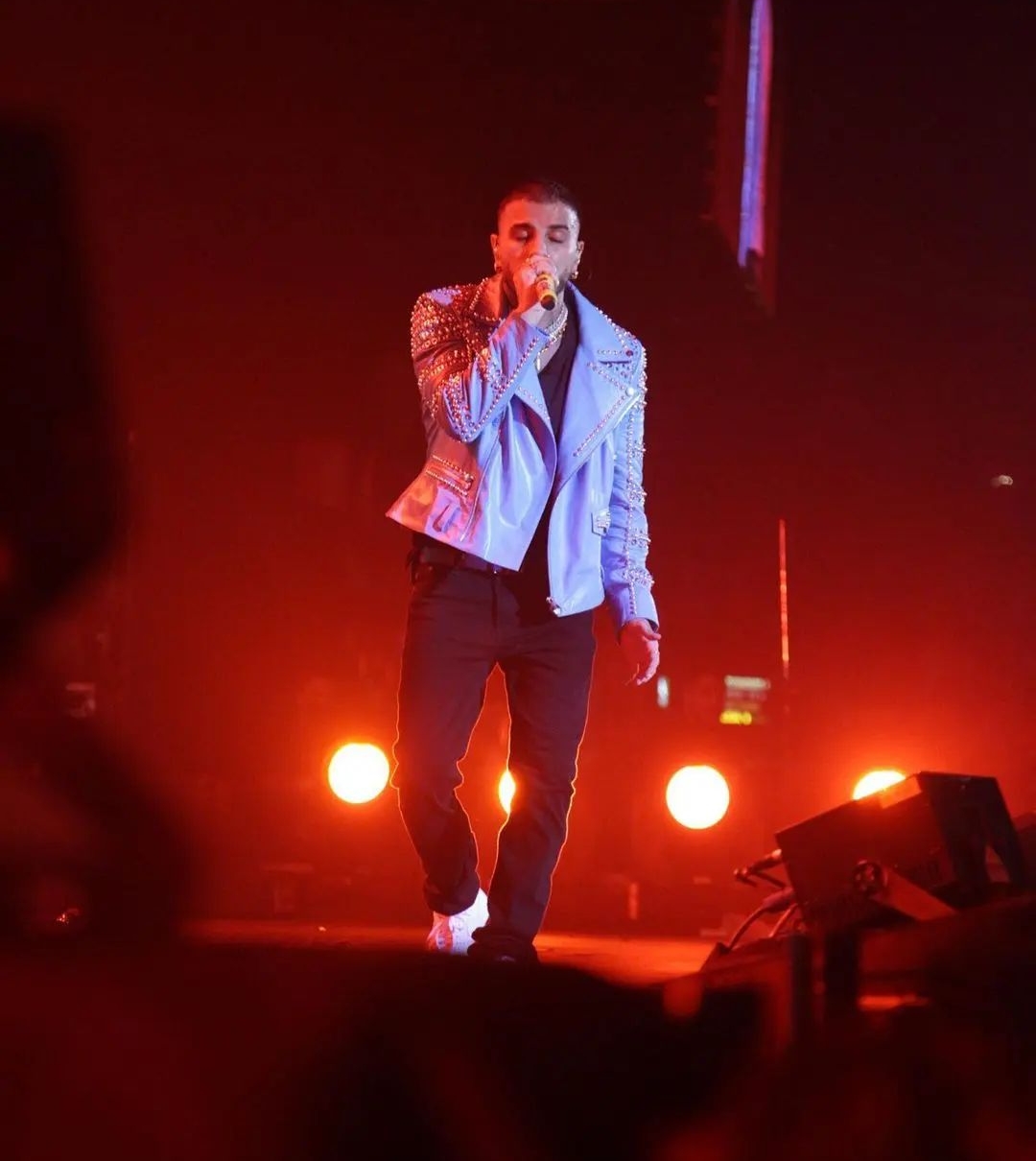
The finished production unfolded in four acts. In Barcelona, a seven-piece band worked at the edges of the stage before rising into view. Bars, tables and a car turned the open floor into scenes. A narrator carried the plot. The set moved through merengue, pop, romantic reggaeton and salsa, with choreography doing the stitching. Rauw sang, danced and acted. Broadway was less an ornament than a method for making a catalog feel like one evening rather than a shuffled playlist.
The Rauw method: look at the last project, list what it did not attempt, then build the next project around the gap. The process combines instinct with study and, by his own cheerful admission, a little marketing common sense.
The 2025 sequel Cosa Nuestra: Capítulo 0 moved further into Caribbean memory. Bomba, plena, salsa and bachata entered the 14-track prequel. “Carita Linda” reached No. 1 on both Latin Airplay and Latin Pop Airplay. “Buenos Términos” later received two 2026 Latin Grammy nominations. The old material had not trapped him in reverence. It gave him more tools.
Raúl keeps a little room for himself
There is Raúl Ocasio, the person, and Rauw Alejandro, the figure who walks into public wearing an album's idea. He has spoken plainly about the difference. The character can absorb projection; the person increasingly values privacy. Both, he says, matter to him.
That separation makes sense for an artist whose public work consumes so much surface area. He composes and sings, but also directs the creative language around the music and produces short films. An idea might arrive in a phone recording or on a scrap of paper while he travels. From there it acquires collaborators, color, movement and architecture. By release day, the song has somewhere to live.
Still, the compass returns to Puerto Rico. He has said he wants to retire on the island and that people there can count on him to speak about its future. His official site carries a Pa'Ma'Ra Project link, extending the public identity beyond releases and merchandise. The global machinery keeps moving, but home remains the reference point.
Legacy is a future-tense word
In 2026, “Dando Vueltas” brought his two old languages together: football and music. Created around the World Cup, the song turns the pitch into a gathering place and the circle into a rhythm. In September he added “Macacoa 2000” to Grand Theft Auto VI: The Album. Then, during a three-act Red Bull Chapters performance at Forest Hills Stadium in New York, he and producer Tainy revealed the title of his next album: Legacy.
The word could sound premature at 33, but Rauw has been thinking in eras for years. A legacy is not only what remains after the work stops. It is the trail connecting apparently opposite rooms: the SoundCloud upload and the arena band, the silver planet and the conga, the football drill and the dance break, the mother's warning and the son's carefully judged lyric.
He has said he may leave the spotlight young, though not music itself. That distinction feels true to his architecture. The bright public character can exit a room while Raúl keeps creating somewhere quieter. For now, another door has a name above it. The suit is pressed. The feet, as ever, know what to do.