The optical-networking PhD running one of enterprise software's most-watched companies - calmly, on data, with the volume turned down.
Three days into the job at Nutanix, his former employer sued him. He kept showing up to standups. A year later the case quietly evaporated.
December 2020. The world was indoors. Rajiv Ramaswami had just been named President and CEO of Nutanix, the San Jose-based hyperconverged infrastructure company that had spent the better part of a decade trying to convince enterprise IT that the data center could behave more like a cloud. Before the welcome flowers wilted, VMware - the company he had just left as Chief Operating Officer of Products and Cloud Services - filed suit. The allegation: a conflict of interest, given how much he knew.
It made for great headlines. It also made for a slightly surreal first quarter. Ramaswami responded the way an engineer responds to an alarm in production - he looked at the data, listened to counsel, and went back to the work in front of him. Twelve months later VMware dropped the case. By then Nutanix was a different company, and Ramaswami was already deep into the work of making it more so.
If you have heard his name, it is probably attached to that lawsuit. If you have not, that is fine, too. He runs Nutanix the way he ran optical networking groups at Cisco and Broadcom and the networking-and-security business at VMware: by gathering the inputs, asking better questions than anyone else in the room, and refusing to be the loudest voice at the table.
Nutanix sells what the industry calls hyperconverged infrastructure. The product story is more interesting than the category name suggests. Compute, storage and virtualization rolled into a single software stack that runs on commodity hardware, runs in the major public clouds, and lets a Fortune 500 CIO move workloads between them without learning a new operating model. The pitch to enterprise IT is straightforward: stop buying three things from three vendors and gluing them together. Buy one thing that behaves like a cloud, and run it wherever you want.
For most of Nutanix's life, that pitch competed head-on with VMware. Then Broadcom bought VMware, the pricing got dramatically less friendly, and a lot of enterprise customers started looking for alternatives. Ramaswami's Nutanix has been one of the largest beneficiaries. He will not say it that bluntly in earnings calls. He does not have to.
The current product agenda is broader than HCI. Nutanix has expanded into unified storage, database services, Kubernetes platforms, and most recently an AI offering aimed at the enterprises that want to run inference workloads without sending their data to a hyperscaler. The thread connecting all of it is the same thread that has run through Ramaswami's career - infrastructure that hides its own complexity well enough that the people running it can think about something more useful.
He spends a lot of time on the road. Computer Weekly captured him in the middle of a customer tour describing his approach to those meetings, which sounded less like a sales playbook and more like an anthropology project. Listen. Ask. Find out what is actually broken before deciding what to sell. It is not a coincidence that Nutanix's net retention rate has stayed embarrassingly high for a company in a category that was supposed to be commoditized years ago.
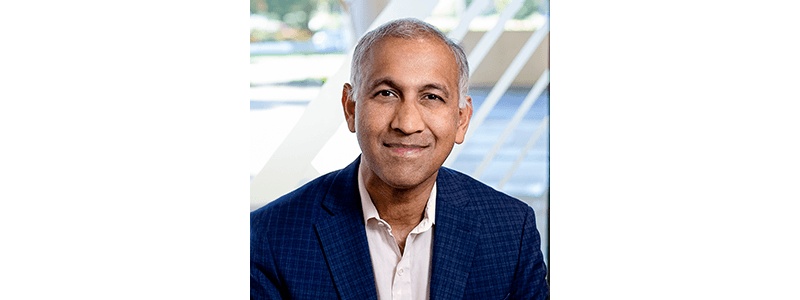
B.Tech in Electrical Engineering at the Indian Institute of Technology, Madras. The classic launch pad for a generation of engineers who would later remake American infrastructure software.
Master's and PhD in EECS at UC Berkeley. Both degrees in four years, while moonlighting at IBM Research Labs.
Leadership roles at IBM, Nortel and Tellabs - the optical-networking decade. He files patents at a clip most academics envy.
General Manager at Cisco. Runs multibillion-dollar lines in switching, data center, storage and optical networking. Learns to operate businesses, not just engineer them.
Joins Broadcom as EVP and GM, Infrastructure and Networking. Helps cement the company's grip on data-center, enterprise and carrier silicon.
Crosses from silicon to software. At VMware he runs the Networking and Security unit, then becomes COO of Products and Cloud Services.
Named President and CEO of Nutanix. VMware sues. He gets to work anyway.
VMware drops the lawsuit. Nutanix's stock has been the more interesting chart in the meantime.
Joins the board of directors of Marvell Technology, returning to the semiconductor world that trained him.
He took the IBM Research job while still a master's student. Most graduate students delay industry. He brought industry into graduate school.
Most are in optical networking - the unglamorous physics of pushing light through glass faster than the last engineer who tried.
He co-authored a widely cited textbook on optical networks. Engineers who have never met him have read his work on a final exam.
The IEEE Fellow grade is reserved for engineers whose work has materially shaped a field. It is rare for an active CEO to hold it.
No swagger, no stage moves. He runs customer meetings as conversations and earnings calls as briefings. The signal is in what does not get said.
Joining the Marvell board in 2025 closed a loop - the same semiconductor stack he helped scale at Broadcom now sits under the workloads Nutanix is selling.
Your success is not based on your technical knowledge.
Business acumen is about how you rally people. You don't want to be seen as the smartest person in the room.
Learn to gather all the data you can, because the more data you have, the better your decision quality is going to be.
A mentor should provide unbiased personal and business-related advice.
Ask people who have worked for Ramaswami what makes him different and the same word keeps surfacing: data. Not data the way a marketer uses it, but data the way an engineer uses it - as the input to a decision, not the decoration on top of one.
He has said as much publicly. Decision quality, in his framing, is a function of input quality. The job of a leader is to assemble inputs that the meeting cannot. Then ask the room a sharper question than the one on the agenda.
That style would not work everywhere. It works at Nutanix because the company is run by people who already think this way. The engineering culture inside Nutanix predates Ramaswami's tenure. What he added was a layer of operational discipline that the company had not always shown - tighter cost control, sharper portfolio choices, a sales motion built around outcome conversations rather than feature lists, and a willingness to pass on deals that would have been booked, marginally, by his predecessor.
The market noticed. Nutanix moved from cash-burn into durable free cash flow during his first two years. Analyst meetings stopped opening with questions about survival and started opening with questions about share gain. The CEO who took the job in the middle of a pandemic, and then in the middle of a lawsuit, has spent the years since making both stories feel like ancient history.
Got hired by IBM Research while he was still a master's student. The internship ended; the relationship did not. He stayed in the IBM orbit for years.
Frames customer meetings as discussions. Refuses to call them pitches. CIOs apparently respond by saying things they would not say to a salesperson.
Reads the numbers before the deck. Asks for the model before the recommendation. Engineering school is hard to shake.
Believes a mentor's only job is unbiased advice. Bias is what the rest of your network is for.
San Jose, by way of Madras, Berkeley, and roughly every major town that ever hosted a Cisco campus.
Sat through three days as Nutanix CEO before getting sued. Has been calm about almost everything since.
Tends to follow new portfolio bets - storage, databases, Kubernetes, AI - with quiet, careful expansions instead of splashy launches.
The phrase “data quality” appears in nearly every interview he gives. It is not a tic. It is the operating system.