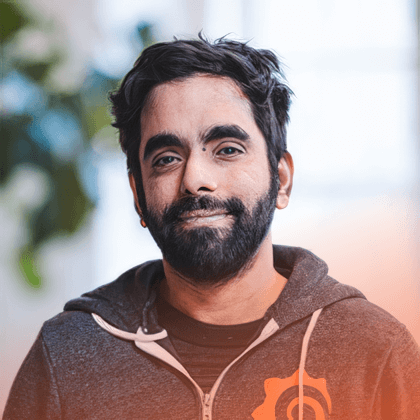
The dashboard guy
Raj Dutt runs Grafana Labs, which is a company most software engineers know but almost no civilians can name. That is fine with him. Grafana is the tool an engineer opens at 3am when a Kubernetes cluster starts smoking, and the point of the tool is not to be memorable at 3pm. The company crossed four hundred million dollars in annual recurring revenue in September 2025, added Ontario Teachers' Pension Plan as an investor in the same announcement, and hit twenty-five million users of its open source project. Grafana Labs also ranked thirteenth on the Forbes Cloud 100 that year and was named a Leader in the Gartner Magic Quadrant for Observability Platforms. If you rank observability companies by lines drawn on a chart, Grafana Labs draws a lot of them.
The company sells software that is famously free. This is the trick. Grafana is open source. So is Loki (logs), Mimir (metrics at scale), Tempo (traces), Pyroscope (profiles) and a lengthening list of other tools whose names read like a graduate seminar in complexity. Dutt's job is to run a business built on top of code that anyone can download without paying him. He has been doing this since 2014.
He co-founded the company, then called Raintank, with Torkel Ödegaard, a Swedish developer who had released Grafana as a hobby project earlier that year, and Anthony Woods, an Australian. The three men met in New York, which is where Dutt was already living and running things, having grown up in the North American software industry the way software people grow up in it: by starting a company as an undergraduate and never really stopping.
In 1999, while at Rensselaer Polytechnic Institute, Dutt founded Voxel, an infrastructure hosting company. He ran it for thirteen years, grew it past a thousand customers and sold it to Internap in 2012 for roughly thirty million dollars, then spent two years at Internap as SVP of Technology. The Voxel chapter is not a footnote. Dutt has said, more than once, that the biggest mistake of his first startup was not taking sales and go-to-market seriously enough - he almost laughed, he said, at the idea of building an enterprise sales team. Grafana Labs has an enterprise sales team.
That sentence is the whole thesis. Enterprise software companies design for the person signing the contract. Grafana designs for the person on-call. The person on-call downloads the free thing, uses it, brings it to work, tells their boss, and the boss eventually signs the contract. Dutt's version of go-to-market is essentially: assume your practitioner is smart, let them try everything, and then, when they need help, be the ones who wrote it. This has held up for eleven years.
The strategic name for it, inside the company, is the "big tent." Dutt uses this phrase in interviews the way founders usually use terms of art like "moat" or "platform." The big tent means: use whichever database you want. Grafana will graph it. Bring your own logs backend, your own tracing backend, your own metrics store; Grafana will not force you to consolidate. This is the least defensible strategy in software, because you are, in some literal sense, allowing your customers to leave. It is also, somehow, the most defensible strategy in software, because you are, in some literal sense, allowing your customers to arrive.
Grafana OSS has been downloaded more times than anyone at the company can plausibly count. The team page reports twenty-five million users. Most of them will never pay Grafana Labs a dollar. Some will. The ones who do run Grafana Cloud, which is the hosted version, or Grafana Enterprise, which is the licensed version, and both of those are what pay for the four hundred million dollars in ARR.
Dutt did not invent the open source commercial model - Red Hat did, roughly, and Elastic and Confluent and MongoDB have all had their turn - but he has been unusually candid about its trade-offs. When Grafana Labs relicensed its core products in 2021, he wrote a Q&A explaining why. The post is not a defense; it is a receipt. Companies that survive licensing changes tend to be the ones that show their work, and Dutt has consistently shown his.
Grafana's founding trio spread across three continents. This was in 2014, well before remote work became a corporate posture. Ödegaard was in Sweden. Woods was in Australia. Dutt was in New York. They ran the company on video calls and time-zone math, because there was no alternative that would let them keep the founders they wanted. Grafana Labs still operates as a distributed company today.
The name change was one of Dutt's better decisions. Raintank was the company. Grafana was the product. Everyone on the internet said "Grafana" when they meant "the thing with the dashboards," and in 2017 the company took the hint. The ego move would have been to spend years teaching people what Raintank was. Instead they let the community name the company. It is a small thing that reveals a larger disposition: run the business the internet has, not the business you think it should have.
In September 2025, at ObservabilityCON, Dutt was on stage explaining the same thing he has been explaining since 2014, which is that observability is not monitoring, that logs and metrics and traces are not enough on their own, and that any observability strategy that requires you to migrate all your data into one vendor is not really a strategy, it's a lock-in. What is different in 2025 is the acknowledgement that AI has scrambled the picture. When machines write more of the code, the code produces more surprises. Dutt's line on the AI observability boom is that the demand curve has bent upward because engineers now have to reason about code they did not write. Grafana Cloud, he has said, has grown accordingly.
Dutt is, by the standards of tech CEOs, understated. He does not have a widely-quoted personal manifesto. He has a self-description on the company team page - "observability nerd, licensed pilot" - which is the whole biography compressed into four words. He is working on a motorglider rating. Motorgliders are the aircraft you fly when you want to soar but also want an engine in case the thermals stop cooperating. There is probably a metaphor for open source commercial companies in there, but Dutt has not made it.
The most instructive thing about him, arguably, is that he is a second-act founder who used the lessons of his first act without being trapped by them. Voxel was a hosting company in the pre-cloud era; it was successful, but it was not a category-definer. Grafana Labs is a category-definer. Dutt has said, in several places, that the difference is partly about picking a wave big enough to matter and partly about being humble enough to build the boring machinery - sales, support, enterprise contracts - that lets you actually ride it.
The company he runs today has around 1,800 employees, roughly four hundred million in ARR, and a customer list that includes what the industry calls "logo customers" - Bloomberg, PayPal, eBay, and enough banks to make the finance section of the observability pitch write itself. The private-market valuation, based on secondary tender activity, has been reported in the six-billion-dollar range. Dutt still calls himself a nerd. The evidence supports this.
The climb
Reference points reconstructed from company blog posts, press releases and press coverage (SaaStr, Forbes, Grafana Labs press). Interior years are illustrative markers, not audited figures.
A working career
Quotes on the record
"We don't build technology for the buyer. We build technology for the practitioner."
"Open source is going to win in observability."
"Allow our customers to own their observability journey - make their own choices, choose their own vendors, choose their own technologies."
"This investment reflects the strong confidence our investors have in our vision for open, AI-powered observability."
Things people notice
Two-continent startup was too easy
Dutt built Grafana Labs across three continents in 2014, before anyone called it "distributed by default."
Let the internet name your company
Users kept calling Raintank "the Grafana company." In 2017 the company took the hint and made it official.
Second-act humility
Dutt has publicly said his first startup underinvested in sales. His second one has a proper enterprise motion.
The four-word bio
"Observability nerd, licensed pilot." That's what the company team page says. That's it. That's the bio.
Big tent, by choice
Grafana's interoperability isn't a concession. It's the plan. Any database, any backend, drawn on the same canvas.
The AI observability tailwind
More AI-written code means more surprises in production. That has been quietly good for Grafana Cloud.
Fun facts
Licensed pilot; working on a motorglider rating.
X handle is @nopzor - a relic of the old internet handle era.
Grafana's three co-founders worked from New York, Sweden and Australia at founding.
Voxel, his first company, grew past 1,000 customers before Internap acquired it in 2012.
Studied both Computer Science and Management at Rensselaer - the sales lesson may have been in the second half of the degree.
The company was Raintank for three years before quietly becoming Grafana Labs.
Quick answers
Who is Raj Dutt?
Co-founder and CEO of Grafana Labs, the company behind the open source Grafana observability platform.
What did he do before Grafana?
Founded Voxel, a hosting company, in 1999. Sold it to Internap in 2012 and served as SVP of Technology for two years before starting Grafana Labs.
Who are his co-founders?
Torkel Ödegaard, the Swedish developer who created the original Grafana open source project, and Anthony Woods, an Australian engineer. The three founded the company as Raintank in 2014.
Where did he go to college?
Rensselaer Polytechnic Institute, B.S. in Computer Science and Management, 2002.
How big is Grafana Labs today?
Over $400M in ARR, more than 7,000 customers, and 25M+ users of the open source project as of September 2025.