The cruel joke in vulnerability management is that success can look exactly like failure. Install a better scanner and it finds more flaws. Add more cloud accounts and the asset inventory swells. Plug in another threat feed and yesterday's manageable queue becomes today's five-alarm spreadsheet. Qualys has built a large, unusually profitable business around that mess. Its original product found the holes. Its current ambition is to decide which holes matter, prove they are dangerous, send the fix to the right team and measure whether the danger actually went away.
That sounds like a neat workflow. Inside a multinational enterprise, it is closer to air-traffic control. Laptops wander off-network. Containers live for minutes. A known vulnerability can be catastrophic on an internet-facing payroll server and mostly irrelevant on an isolated test box. Security sees severity; IT sees uptime; finance sees cost. Qualys's pitch is that all three can work from one continuously updated asset inventory and one shared measure of risk.
The first betSecurity software, minus the software project
Qualys was founded in 1999 by Philippe Langlois and Gilles Samoun, when enterprise security software usually arrived as a box, a license and an installation headache. The company launched a web-hosted vulnerability service in 2000. Customers could assess networks without building and maintaining the scanning infrastructure themselves. In 2001, Qualys raised a $20 million second round from Trident Capital and ABS Ventures, while Bessemer Venture Partners and VeriSign were among its original backers. Philippe Courtot arrived as chairman and chief executive and spent two decades turning the hosted scanner into a public company.
What did that first model cost? Public pricing from the era is scarce, and Qualys still sells most enterprise subscriptions by quote. The better documented number is the capital required to make the model credible: about $34 million in disclosed private funding before the company went public, followed by roughly $87.5 million in net IPO proceeds in 2012. Customers traded the capital expense and maintenance of on-premises software for renewable subscriptions. Qualys traded lumpy licenses for recurring revenue and responsibility for the platform.
The first thing to fail was not scanning. It was the old rhythm of periodic scanning followed by giant reports. Networks stopped having clear edges. Cloud instances, remote laptops, containers and mobile devices made quarterly snapshots stale on arrival. Qualys responded in 2015 with a lightweight Cloud Agent that could live on an endpoint and continuously feed the platform. One sensor could then support multiple jobs: inventory, vulnerability assessment, policy checks, endpoint telemetry and patching.
The product nowDiscover, rank, prove, repair
VMDR - Vulnerability Management, Detection and Response - remains the center of gravity. It discovers known and unknown assets, checks them for vulnerabilities and misconfigurations, adds threat intelligence and business context, then links important findings to patches, configuration changes or IT tickets. CyberSecurity Asset Management handles the inventory. TotalCloud covers cloud posture, workloads, identities, data and containers. TotalAppSec looks at web applications and APIs. Policy Audit and File Integrity Monitoring serve compliance teams. Multi-Vector EDR watches endpoints. TruRisk Eliminate handles patches and other mitigation.
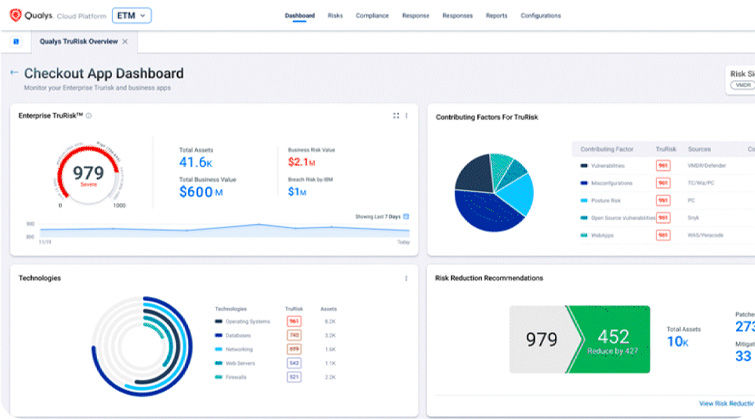
The connective tissue is TruRisk. Traditional CVSS scores describe technical severity, but not whether a vulnerable machine runs the checkout system, faces the public internet or has a working exploit circulating. Qualys blends severity with evidence of exploitation, threat intelligence, asset criticality and other context. The point is not another pretty number. It is a queue that a security leader can defend to an operations team and, eventually, a board.
Enterprise TruRisk Management, or ETM, stretches that logic beyond Qualys's own sensors. It ingests findings from other vendors, normalizes them around assets and risk, and presents what Qualys calls a Risk Operations Center. TruConfirm adds exploit validation. Agentic features help assemble queries and remediation steps. In 2026, TotalAI extended the platform toward discovering and governing AI models, services, MCP connections and agentic workloads. The company is trying to move one level up the stack: from being the scanner of record to being the place where pre-breach risk gets negotiated and reduced.
The customer engineA land-and-expand machine with an 83% gross margin
Qualys sells primarily annual SaaS subscriptions, generally invoiced upfront and recognized over the contract term. The unit can be an asset, an application, a cloud resource or pooled Qualys Units, depending on the product. The menu is modular; larger platform bundles offer multiple capabilities. That makes an exact public price hard to quote and an enterprise negotiation important. The cost grows with the estate and the apps switched on. For a small team that needs only scanning, the platform can be more machinery than medicine.
For Qualys, the model compounds. Of the $61.6 million increase in 2025 revenue, 76 percent came from customers that existed before the year began. That is the platform strategy expressed as accounting: begin with vulnerability management, then add inventory, patching, compliance, cloud or risk operations. Revenue reached $669.1 million in 2025, up 10 percent. In the fourth quarter, GAAP gross margin was 83 percent. By the second quarter of 2026, revenue was growing 11 percent year over year and management had lifted full-year guidance to $732 million to $738 million.
The audience is enterprise-shaped. Qualys reported more than 10,000 subscription customers in 130 countries at the end of 2025, including 74 percent of the Forbes Global 50. Public customer material names Capital One, Cisco, Humana, Cintas, Aflac, Avaya and Toyota Financial Services. The company says customers conduct more than 6 billion IP scans and audits a year, generating more than 2 trillion security events. Direct sales produced 51 percent of 2025 revenue; partners produced 49 percent. Integrations with ServiceNow, Jira and cloud providers matter because the last mile of security is usually somebody else's change window.
The fieldThe advantage is the common data - and the trap is the breadth
Tenable and Rapid7 are the closest alternatives in vulnerability management. Wiz and Orca Security made cloud-native security easier to buy. CrowdStrike, Palo Alto Networks and Microsoft overlap in endpoints and security operations. Tanium approaches the problem from endpoint management; ServiceNow from workflow. Qualys's difference is architectural and commercial: a shared cloud platform, a common asset model, many sensors, and a single lightweight agent reused across applications.
That can cut duplicate agents, infrastructure and swivel-chair work. It can also create dependency on Qualys's taxonomy, licensing and interface. A platform only consolidates if teams retire something else. Otherwise it becomes one more console with an ambitious name. Customers also have to keep asset ownership and business criticality current; a sophisticated score built on stale context is merely precise-looking noise.
Where the model bends
It works best across a large, mixed estate where security and IT agree on ownership, deploy sensors broadly and connect remediation to real workflows. It works poorly for a tiny homogeneous network, a buyer seeking one narrow capability, or an organization that cannot patch quickly for operational reasons. No ranking algorithm can manufacture a maintenance window.
The copyable playbookInventory first. Automate last.
The useful lesson in Qualys is not “buy a platform.” It is the order of operations. Start with an inventory that updates continuously. Attach a responsible owner and business purpose to each important asset. Combine technical severity with active exploitation and exposure. Send the resulting work into the ticketing and deployment systems people already use. Automate repetitive, reversible fixes. Then rescan and report the risk removed rather than the number of tickets opened.
Give every asset an owner, a business role and an agreed repair path before buying another threat feed.
Do not centralize every security function merely to reduce vendor count. Consolidate when shared telemetry improves a real workflow.
Track time to remove high-risk exposure and risk reduction by business unit, not the raw volume of findings.
If operations cannot act, improve ownership and change management before adding autonomous remediation.
Qualys itself changed its mind in stages. A hosted scanner became a continuous agent. Vulnerability management became VMDR. A suite of first-party apps became a risk layer that accepts third-party data. The company did not abandon the scanner; it kept moving the product closer to the decision and the fix. Its small acquisitions tell the same story: Spell Security added endpoint behavior technology, TotalCloud assets added cloud workflow, and Blue Hexagon added AI-driven network detection. These were components for the platform, not a roll-up of brands.
The company now has 2,625 employees, with 1,262 in research and development. Seventy percent of the workforce is based in India. Sumedh Thakar, an engineer who joined Qualys in 2003 and ran product before becoming chief executive in 2021, is a fitting leader for this phase: the strategy depends less on a dramatic new appliance than on making a sprawling system feel coherent.
The bet is sensible because the vulnerability backlog is not shrinking. But the outcome is not guaranteed. AI can help correlate, summarize and orchestrate; it cannot decide how much downtime a hospital, factory or bank can tolerate. Qualys wins when its score becomes a common language and its agent becomes quiet infrastructure. It loses when breadth turns into complexity. Somewhere between those poles is the unglamorous prize: fewer critical exposures, fixed before they become a headline.