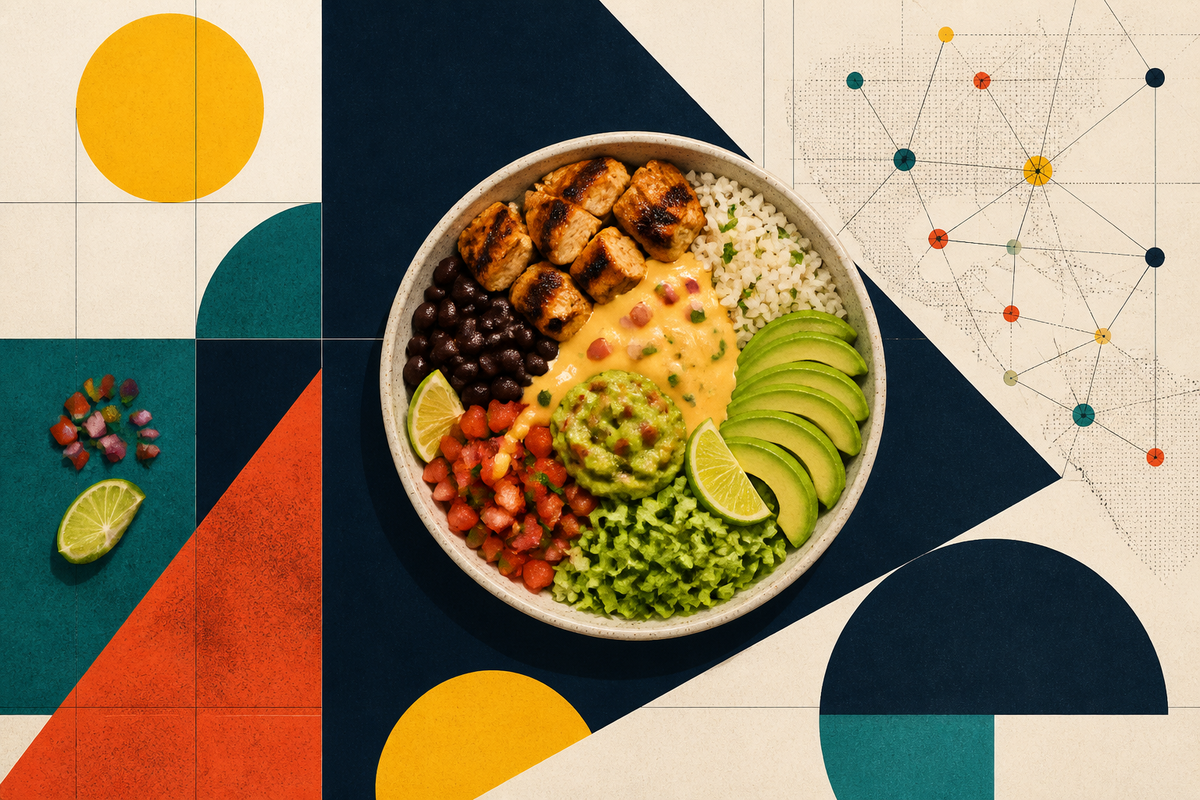
There is a specific moment in the fast-casual lunch ritual when optimism meets arithmetic. The tortilla has been warmed. The rice, beans and chicken are stacked. Then comes the spoonful that can turn a reasonably priced burrito into a tiny referendum on household budgeting: guacamole. At Qdoba, the answer is unusually painless. The first portion of guac - and its signature 3-cheese queso - comes on a qualifying create-your-own entrée without an extra charge.
The policy is not charity. Its cost lives somewhere in the menu architecture. But to a customer standing at the glass, it feels like the removal of a nuisance. In a category where every scoop can invite a decision, Qdoba has made the absent upcharge its most legible distinction. The promise is compact enough for an ad and practical enough to remember at noon.
That detail now sits inside a much larger proposition. Qdoba reported 865 restaurants in July, spread across 46 states as well as Canada, Puerto Rico, Japan and South Korea. The private company plans to approach 2,000 locations within eight years and open about 100 annually. More than 650 restaurant commitments are already in its pipeline. A brand founded in a 1,300-square-foot Denver storefront is preparing to test how far a simple counter-service idea can travel.
The invented name that stuck
Qdoba began in 1995 as Zuma Fresh Mexican Grill, opened by Anthony Miller and Robert Hauser at Sixth Avenue and Grant Street in Denver. Miller had worked in investment banking. Hauser trained at the Culinary Institute of America and worked at Le Cirque. Their division of labor was almost too tidy: one understood capital, the other recipes.
The first restaurant reportedly cost about $180,000 to open and produced more than $1.5 million in its first year. Its name was less durable. Zuma became Z-Teca in 1997 after a trademark dispute, then Qdoba Mexican Grill in 1999 after further naming friction. “Qdoba” was invented by an agency, a word with no inherited meaning and therefore plenty of room to accumulate one. In 2015, “Mexican Grill” became “Mexican Eats.”
Ownership changed more dramatically. Jack in the Box bought the 85-location chain in 2003 and spent 14 years expanding it beyond 700 restaurants and $820 million in systemwide sales. Apollo-managed funds acquired Qdoba for $305 million in 2018. Butterfly Equity, a private-equity firm focused on food, bought it in 2022 and folded it into Modern Restaurant Concepts. The current growth chapter belongs to that platform and to CEO John Cywinski, whose résumé includes running Applebee's and KFC.
“No microwaves. No freezers. No can openers.”Qdoba franchise materials
Customization without the little punishments
The product is familiar by design. Customers move along an assembly line and choose a vessel - bowl, burrito, taco, quesadilla, nachos or salad - then add rice, beans, protein, salsa and toppings. Proteins are flame-grilled. Produce is chopped and guacamole is made in restaurant. Qdoba describes its food as Mexican-inspired rather than making a broader claim to culinary authenticity.
This format solves two problems at once. For the diner, it compresses variety into a fast transaction. A family, an office or a group with different appetites can order from one line without eating the same meal. For the operator, the same ingredient system supports hundreds of combinations without requiring hundreds of recipes. Seasonal items such as 2026's Spicy Tequila Lime Steak and Churro Chips add novelty around that stable core.
Qdoba competes most visibly with Chipotle, another Mexican fast-casual chain born in Denver, and with Moe's Southwest Grill, Baja Fresh and Café Rio. It also competes at the edges with Taco Bell on convenience and price, and with bowl concepts such as Cava and Sweetgreen on customization. Scale belongs decisively to Chipotle. Qdoba's practical counterargument is a broader flavor palette, a franchise-heavy route to market and fewer surprises when premium toppings reach the register.
One counter, several businesses
Qdoba sells restaurant meals, but the corporation operates several related businesses through the same kitchen. There is walk-in dining and takeaway. Its website and apps handle pickup and delivery. QDOBA Rewards issues points and offers in exchange for repeat business and a clearer picture of customer behavior. Catering turns the line into a group-feeding machine, with hot bars, boxed meals and delivery for workplaces, schools and parties.
Then there is franchising, the engine expected to carry most new construction. More than 85 franchisees operated nearly 80 percent of Qdoba restaurants in July. The company wants that share to reach 85 percent, shifting more of the capital and day-to-day operating risk to local owners while collecting fees and royalties. Current published materials list a 5 percent royalty, a 4.5 percent marketing fee and a 1.25 percent local marketing requirement for traditional restaurants. The estimated investment spans roughly $545,500 to $1.294 million, excluding real property and liquor licensing.
The model favors experienced multi-unit operators. In July, Qdoba announced 30 planned restaurants in Atlanta with a former McDonald's operator and 20 in Nashville with a large Zaxby's operator. B Wild Investments affiliate 7 Star Eats, already a substantial franchisee, acquired 22 Pacific Northwest restaurants and raised its development commitment to 63 new units across Colorado, Utah, Washington, Nevada and New Mexico.
Qdoba can also bend the physical format. It has more than 100 nontraditional locations in airports, universities and military bases, where built-in traffic reduces the need to create a destination. Company materials describe footprints ranging from about 500 to 2,000 square feet, plus drive-thru options and conversions of existing restaurants. The menu's modularity is mirrored in the real estate.
Growth needs plumbing
Development agreements make expansive headlines, but a commitment is not an open restaurant. The less glamorous work is site approval, construction, training, staffing, supply, equipment and getting an online order into the correct bag during the dinner rush. Qdoba's ambition depends on making those systems boringly repeatable across different owners and building types.
Capital is part of that plumbing. In May, Qdoba closed a $435 million whole-business securitization made up of $360 million in senior notes and a $75 million variable-funding note. The company said the proceeds would refinance existing debt at a lower cost and improve liquidity for remodels, digital make-lines and technology. The transaction followed a $527 million Butterfly continuation fund raised in 2025.
The chain has evidence of customer pull. It says it has ranked among USA TODAY's 10Best fast-casual restaurants for seven consecutive years, including six years at number one, and that its loyalty program has earned repeated recognition. Its 2025 expansion announcement cited comparable sales growth of 6.1 percent in fiscal 2023 and 7.7 percent in fiscal 2024. Those numbers are useful to prospective operators because restaurant growth is easier to finance when existing stores are growing too.
Fresh food is a systems promise
The strongest parts of Qdoba's pitch create its hardest obligations. Fresh preparation requires labor, cold-chain discipline and food-safety controls in every restaurant. On August 11, Qdoba said it was cooperating with the FDA and CDC during an investigation into a multistate Salmonella Javiana outbreak. Out of caution, it removed fresh and pickled jalapeños from all U.S. restaurants while working with suppliers and distributors on their return. The episode is a reminder that a restaurant brand is also a supply network, and trust can move through it as quickly as an ingredient.
Consistency is equally unforgiving. A diner does not experience an 865-unit system; she experiences one scoop, one line and one crew on one day. The franchise model can accelerate openings, but it also multiplies the places where order accuracy, cleanliness and hospitality must match the promise. Qdoba's stated cultural pillars - hospitality, positivity and performance - become operational standards only when they survive a busy shift.
The company extends that idea of responsibility outside the counter. It says local restaurants host fundraisers and that partnerships with No Kid Hungry in the United States and Toonies for Tummies in Canada have helped provide more than five million meals to children. Its packaging changes include compostable bowls, recycled-paper bags, strawless lids and recyclable cutlery. These are incremental measures, not a solution to the environmental weight of a national restaurant system, but they describe where the company believes practical progress can happen.
Qdoba's cleverest product may be the feeling that the customer is still in charge.
Where the bowl goes next
Qdoba occupies an unusual position: large enough to be familiar, small enough to have blank territory, old enough to possess operational memory and newly aggressive enough to behave like a growth company. Its market opportunity is not to invent another lunch format. It is to make a known one more available, from Nashville suburbs to airport concourses, while maintaining a distinct reason to choose it.
That reason remains pleasingly tangible. Qdoba does not need a customer to understand securitization, unit economics or the difference between company and franchise capital. It asks her to notice what happens at the topping station. The guacamole lands. The queso follows. The price does not flinch. A national growth strategy, reduced to one quiet moment at the register.