The modern security alert arrives with impeccable manners. It announces a potential disaster, assigns itself a severity and leaves the difficult part to somebody else. Qasim Mithani has spent enough time around large software systems to be suspicious of that arrangement. His company, Depthfirst, is built around a more demanding idea: security software should understand the application, test whether a weakness can actually be exploited, decide what deserves attention and help write the repair.
It is an engineer's complaint turned into a company. The complaint is not that software lacks warnings. It is that warnings arrive without enough context. A suspicious line of code may be harmless in one system and catastrophic in another. A familiar dependency may contain a flaw that has slept undisturbed for years. The practical work begins after detection, in the untidy stretch between seeing a signal and shipping a safe fix.
Mithani's career has been a long apprenticeship in that stretch. Before he became a founder, he moved through finance, cloud computing and data infrastructure. Each stop placed him near systems whose reliability mattered, where the neat diagram on a whiteboard had to survive contact with customers, permissions, scale and all the peculiar ingenuity of the internet.
A systems education
At the University of Waterloo, Mithani completed a double-degree program in computer science and business with Wilfrid Laurier University. His listed specializations were AI, security and cryptography. He graduated in 2015 with distinction and appeared on Waterloo Mathematics' graduating Dean's Honours List. The pairing of code and commerce now looks almost suspiciously tidy for a future enterprise founder, though careers are kinder in retrospect than they are while being lived.
His first professional chapter was fixed-income trading at Ontario Teachers' Pension Plan. Then came Amazon Web Services, where he built developer and security products during the cloud platform's formative years. The work expanded from engineering into product leadership and general management. In 2018, he joined Databricks as an early leader. There, he led infrastructure and enterprise-platform work as the data company grew from promising technology into widely used machinery.
Infrastructure teaches a particular form of humility. The visible product may be a button, query or cheerful dashboard. Beneath it sit identity systems, networks, deployment machinery and a thicket of assumptions. Security failures flourish in the gaps between those layers. A tool that reads one file and ignores the architecture may be technically correct and practically useless.
“We've entered an era where software is written faster than it can be secured.”Qasim Mithani, January 2026
Building past the alert
Mithani co-founded Depthfirst in 2024 with Daniele Perito and Andrea Michi. Their backgrounds fit together with the satisfying click of a well-cut joint. Perito had co-founded Faire, worked on Cash App's founding team and researched security at UC Berkeley. Michi had led research engineering at Google DeepMind, working on reinforcement learning projects including Gemini and AlphaDev. Mithani brought the infrastructure and enterprise-platform view.
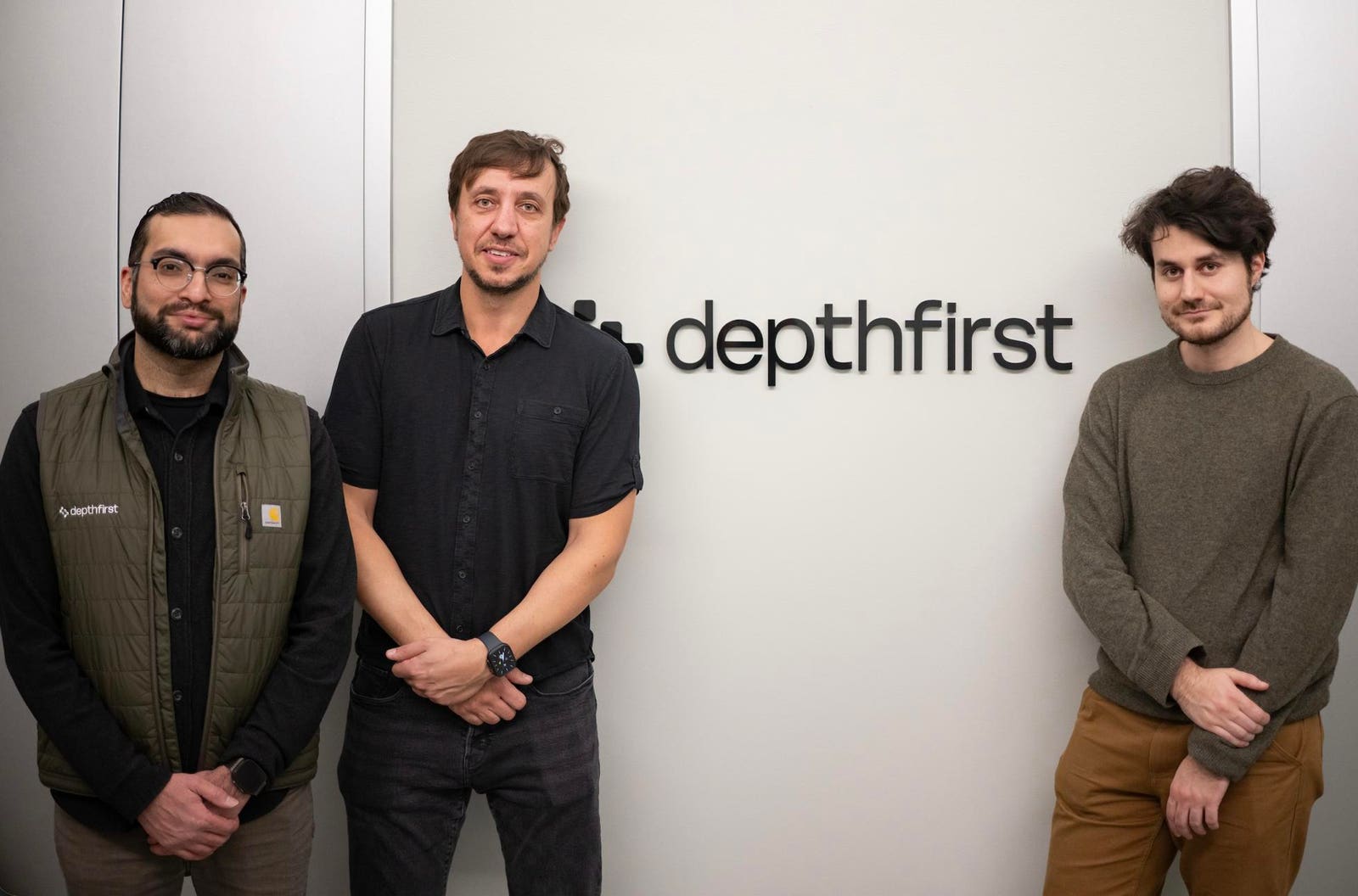
The company describes itself as an applied AI lab pursuing “General Security Intelligence.” Grand phrase, practical loop. Its agents build context about code, infrastructure and business logic. They search for vulnerabilities, attempt to validate them as an attacker would, prioritize the issues that survive that test and generate code changes for developers to review. The intended output is less “something may be wrong” and more “this can be exploited, here is why, and here is a proposed patch.”
That last step is the mischievous one. Security software has traditionally been rewarded for finding more. Engineering teams are rewarded for shipping. The incentives collide in a backlog, where an impressive collection of findings competes with product work. A ready-to-review pull request changes the shape of the conversation. It makes remediation part of the product rather than a chore dispatched elsewhere.
Depthfirst says its early system found more true-positive vulnerabilities than traditional static-analysis tools while sharply reducing false positives. Customers named publicly in 2026 included Lovable, Supabase, Moveworks and AngelList. The company also trained security-specific models, beginning with dfs-mini1 for smart-contract weaknesses, and later introduced dfs-large1 alongside its dfbench evaluation suite.
Capital at machine speed
The financing followed with unusual compression. In January 2026, Depthfirst announced a $40 million Series A led by Accel. Less than 90 days later, it announced an $80 million Series B led by Meritech Capital. The second round valued the company at a reported $580 million and brought total funding to $120 million.
Money is not evidence that a hard technical problem has been solved. It is evidence that investors are willing to finance the attempt. Depthfirst said it would use the new capital to expand AI research, train models for additional security domains and grow enterprise adoption. The ambition is to cover more of the work security teams perform while augmenting a scarce group of specialists, not pretending expertise has suddenly become abundant.
Mithani's public argument begins with acceleration. AI makes it easier to write software, so more code arrives faster. The same class of tools can help adversaries search for weaknesses and operate at scale. Defense cannot answer that shift with a prettier queue. It needs systems capable of forming hypotheses, testing them and acting while the information is still useful.
“AI has already changed how attackers work. Defense has to evolve just as fundamentally.”Qasim Mithani
The proof is in old code
The company's open-source research gives the thesis a concrete edge. Its team has reported and coordinated fixes for vulnerabilities in projects including Netty, Langfuse, Swetrix, Temporal and esbuild. In 2026, Depthfirst disclosed findings in FFmpeg and an NGINX rewrite-module vulnerability that had remained in the code for 18 years. Later work chained memory-corruption bugs in the Ruby JSON parser Oj into remote code execution affecting GitLab's default configuration. The flaws were reported privately and patched before public disclosure.
The age of that NGINX bug is useful because it punctures the comforting theory that heavily used code has already surrendered its secrets. Familiar software can become visual wallpaper. People stop seeing it. A patient agent does not get bored, but patience alone is insufficient. It must understand control flow, construct a plausible exploit, separate consequence from coincidence and produce evidence a maintainer can trust.
Depthfirst's Open Defense Initiative, announced in 2026, offered up to $5 million in company credits to critical open-source projects. The timing carried Mithani's familiar urgency: capable security models are improving, open-weight systems will follow, and widely shared code should be hardened before offensive capability becomes cheaper and easier to distribute.
A founder's useful obsession
There is a through-line from Mithani's Waterloo double degree to AWS, Databricks and Depthfirst. He keeps choosing places where technical machinery meets institutional consequence. Cloud services must work for developers. Data infrastructure must work for enterprises. Security agents must work for researchers, engineers and the people who approve the fix. Elegant technology that cannot cross those boundaries remains a demonstration.
His product language is telling. Depthfirst agents “go very deep,” he has said, trying to work out how an application functions and which vulnerabilities are most exploitable. Depth is not decoration here. It is the labor of collecting enough context to make a useful judgment. The company's name wears the idea plainly, like a programmer's private joke that escaped into the cap table.
The wager is still being tested. Specialized security models must keep pace with both frontier AI and ingenious human attackers. Automated patches must be safe enough for developers to trust. Benchmarks must reflect messy software rather than theatrical puzzles. Enterprise buyers must see fewer false positives and faster remediation in their own systems, not only in a polished demonstration.
That makes trust the quiet product behind the product. A model may discover a flaw, but an engineer still needs a clear explanation, a reproducible path and a patch that respects the rest of the system. Maintainers need coordinated disclosure rather than a public surprise. Executives need to know what changes their actual exposure. Mithani's operating challenge is to make one system credible to all three audiences. Speed wins attention. Evidence earns permission to act.
But the standard Mithani has chosen is refreshingly legible. A security product should be judged by the distance it closes between discovery and repair. It should know when a warning matters, show its work and help the person responsible finish. The alert has enjoyed a long reign as cybersecurity's favorite artifact. Qasim Mithani would like to replace it with something less glamorous and more valuable: a resolved problem.