The awkward moment comes before the client sees the proposal. A consulting firm has assembled a scope, chosen a team and calculated a price. Then someone from delivery questions the staffing. Someone from finance questions the margin. The spreadsheet is perfectly capable of adding numbers. Getting the organization to agree on what those numbers mean is another matter.
- Provus quotes services: scope, people, rates, approvals and proposals.
- Its customers include Thoughtworks, Trace3 and Prolifics.
- Enterprise serves complex deals; CPQ Express targets growing teams.
- AI can draft and compare quotes. People still review the promise.
Provus has built a business around that disagreement. Founded in 2021, the software company puts services estimation, pricing and quoting into a shared workflow. Sales can see the proposed deal. Delivery can examine the resources. Finance can inspect the economics. The result is intended to be a quote the company can live with after the celebration ends.
The number was never the whole problem
Services are peculiarly difficult to sell. A product has a catalog entry; a project has assumptions. Change the mix of senior and junior staff, extend the schedule or alter the deliverables, and the economics move. A discount can look harmless on the cover page while quietly consuming the room left for unexpected work.
Provus’s founding account describes estimates stored on individual hard drives, alternative scenarios passed through email, and too little historical information to choose sensibly between them. The founders had led sales and professional services teams and encountered those processes themselves. Their answer was services-specific CPQ: configure, price, quote, with the configuration reaching into the project plan.

Mahesh Baxi, Stawan Kadepurkar and Ganesh Ramachandran co-founded the company. Baxi was CEO when Provus announced its $12 million Series A in July 2022. Norwest led, joined by Accel, Storm Ventures and Firebolt Ventures. The money was allocated to product, engineering, sales and marketing. By its 2025 releases, Provus identified Kadepurkar as CEO.
What failed at Thoughtworks
A useful illustration comes from Thoughtworks. In Provus’s April 2026 recap of a webinar with former sales transformation leader John Gentry, the consultancy’s reputation-driven growth met contracting client budgets. Across 19 countries, sales practices differed. Its sophisticated Excel tools could calculate prices, yet the business lacked a consistent view of pricing trends.
“We discovered that we didn’t really know where we were with pricing.”
John Gentry · former Thoughtworks sales transformation leader
The change began with organizational plumbing: common sales stages, consistent CRM use, a forecasting rhythm and deal coaching to prevent late approval surprises. Provus brought services pricing into an enterprise system. The lesson is useful precisely because it is mundane. Shared definitions make the software’s view of the business more meaningful.
Prolifics arrived by another route. In its October 2023 adoption announcement, COO Anant Gupta said its homegrown system had served it well. The attraction of Provus was customizable quoting and a more connected Salesforce experience. Trace3’s March 2024 announcement likewise described a process involving several contributors and a desire to reduce turnaround time. Both cases put coordination near the center of the purchase.
A quote becomes a working model
The enterprise product, historically called Services Quoting Cloud, combines guided quoting, advanced pricing, scenario modeling, collaboration, approvals, document generation and reporting. Built on Salesforce, it occupies the space between the sales opportunity and the work that must be delivered. Its appeal is strongest when estimating a project requires several teams to negotiate the same constraints.
- 01 ScopeWhat will we deliver?
- 02 StaffingWho, for how long?
- 03 EconomicsAt what margin?
- 04 ReviewCan we promise it?
CPQ Express tackles a smaller version of the problem. Provus targets founder-led teams with 10–100 employees selling repeatable services. Users define a catalog, resource roles and rates, then describe a project in ordinary language. The assistant maps the request to that catalog; users review, adjust and export the quote. Pricing knowledge can become something a colleague uses without summoning the founder.
This is subscription software. Express advertises a 30-day trial; both Express and Enterprise direct buyers to sales for pricing. The buying decision therefore includes a conversation about the required setup and workflow. The practical cost also includes maintaining sensible service definitions and rates: a catalog is a business decision rendered as data.
The agent with the curious name
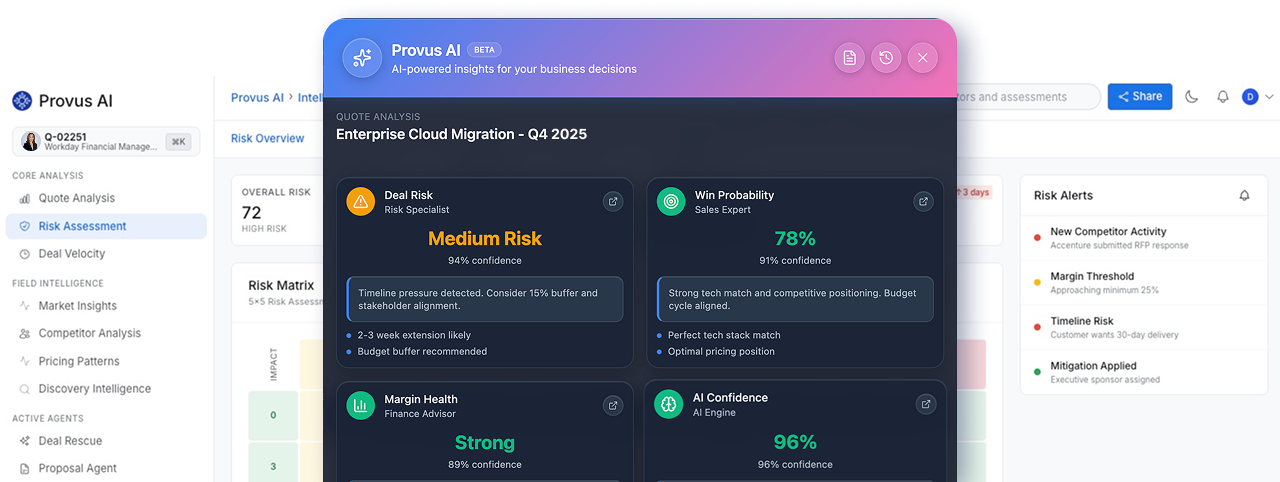
Provus introduced its agentic platform in October 2025 with named agents for optimizing quotes, predicting deals, responding to proposals and rescuing opportunities. Its June 2026 demonstration added a memorable character: Drewvus, an email agent that can turn a prospect’s message, RFP or discovery recording into a structured quote using account context.
The same demonstration showed value-pricing scenarios and quote optimization within budget or schedule constraints. Those are vendor demonstrations, rather than guarantees for every engagement. The significant detail is where the assistant works: inside the quote, with access to pricing and project information. The recap explicitly keeps the seller accountable and able to challenge the output.
There is a larger pricing question underneath the interface. In April 2026, Kadepurkar argued that AI-assisted delivery weakens the old connection between effort and revenue. If a team produces the same result with fewer hours, billing those hours rewards the customer while shrinking the seller’s invoice. Value pricing asks the firm to describe the outcome worth buying. Software can help compare structures; defining and defending that value still requires commercial judgment.
The promise has to reach delivery
In November 2025, Provus announced a Kantata partnership that carries approved work breakdowns, resource plans and budget constraints into project execution. Delivery data flows back into future estimates. That feedback matters: an estimate should eventually encounter the work it predicted. Otherwise, a company can repeat the same optimistic assumption with impressive consistency.
The company’s published values emphasize customer obsession, inclusion, accountability and execution. Those are aspirations, but accountability has a concrete expression in this product: somebody must own the quote. Collaboration is useful when it reveals disagreement early enough to change the plan, rather than collecting signatures after the assumptions have hardened.
Provus’s market includes alternatives such as ScopeStack, PSQuote, DealHub and PandaDoc, alongside spreadsheets and internal tools. Buyers should compare how each handles their particular scope, resource costs and approvals. The transferable habit is simple: test a quote against delivery capacity and margin before treating it as ready. With vague scope or unreliable rates, automation can merely distribute uncertainty faster. Provus’s proposition rests on making the underlying promise inspectable.