What It Does
The business of making work repeatable
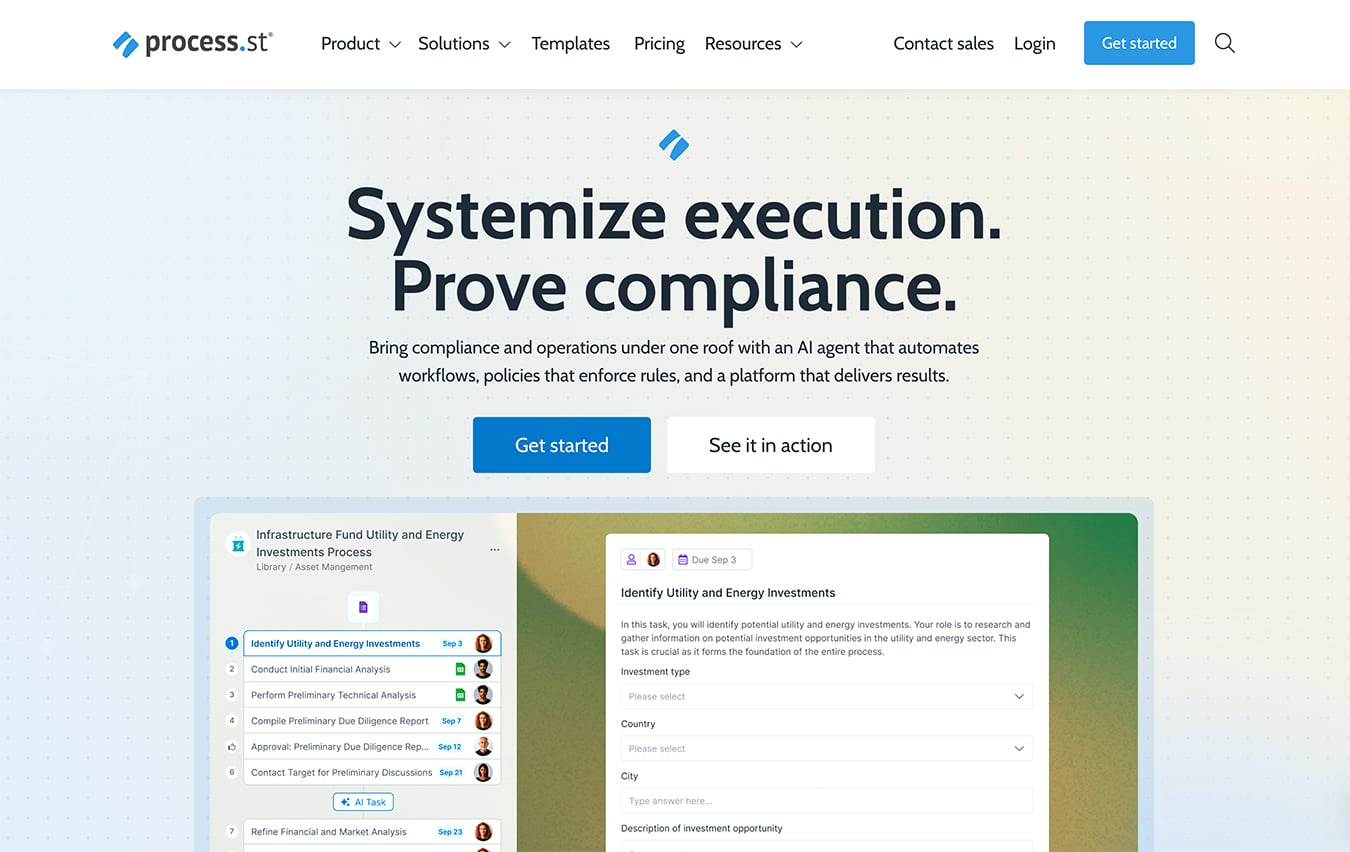
Process Street sells a deceptively simple idea: that the work a company does over and over should happen the same way every time, and that anyone should be able to run it without writing code. The San Francisco company builds a software-as-a-service platform where teams document a process once - onboarding a new hire, closing the books, screening a candidate, satisfying an auditor - and then run it as a structured, trackable workflow.
The building blocks are familiar to anyone who has ever kept a to-do list: checklists, forms, due dates, assignments. What Process Street adds is the machinery around them. Conditional logic routes a workflow differently depending on the answers entered. Approvals hold a step until the right person signs off. Analytics show which runs stalled and where. Integrations push data to Slack, Salesforce and thousands of other apps so information does not have to be retyped.
Over the past two years the company has moved up-market and renamed the mission. It now describes itself as a compliance operations platform, splitting the product into Docs for policy and document governance and Ops for the workflows that carry those policies out. Sitting on top is a layer of AI - including an agent named Cora that monitors execution in real time and flags risk before it becomes a finding.
The through-line has not changed since 2014. A written policy that sits in a shared drive is a hope. A policy that runs as a workflow, with a timestamped record of who did what, is proof. Process Street's whole pitch is the distance between those two things.
“A checklist feels too simple to be a company - until you try onboarding fifty employees the same way twice.”
The operational problem Process Street productized
Origin & Timeline
From a distributed agency's headache
Vinay Patankar, an Australian serial entrepreneur, and co-founder Cameron McKay were running a distributed marketing agency with contractors scattered around the world. Spreadsheets and project-management tools kept losing track of the same repetitive tasks. So they built a tool to document and run checklist-based processes. That tool became the company. Patankar had built three businesses before this one - the fourth stuck because processes never stop breaking.
2014
Founded in San Francisco
Patankar and McKay build Process Street to document and track checklist-based processes for their remote agency.
2016
Forms & structured data
The platform grows past plain checklists with form fields and richer workflow data capture.
2020
$12M Series A
Accel leads, with Salesforce Ventures and Atlassian. Forbes dubs it “GitHub for knowledge workers.”
2023
Process AI & Docs
A ChatGPT-powered process platform launches; document and policy governance is added.
2024
Cora, the AI compliance agent
Always-on oversight that monitors execution and flags compliance risk arrives.
2025
Compliance Operations Platform
The company repositions around Docs, Ops and AI agents for teams running audited, critical processes.
Customers & The Problems Solved
Who runs on it, and why
Process Street's customers span small businesses through large enterprises across technology, financial services, healthcare, real estate and property management, professional services and asset management. Publicly referenced names include Salesforce, Colliers, Drift, Cargill, DoorDash, Farmers Insurance and Hartford Healthcare - more than 3,000 organizations in all.
The problems are the unglamorous ones that quietly cost the most. Knowledge that lives in one person's head and leaves when they do. Onboarding that goes differently every time. Compliance controls that everyone swears they follow but no one can prove. Audits that turn into a scramble for evidence. Process Street's answer to each is the same: make the process a living, monitored artifact instead of a document nobody opens.
OnboardingSame setup, every time
Employee and client onboarding run as identical workflows, so nothing gets skipped and nobody reinvents the steps.
ComplianceAudit-ready by design
Docs governs policies for standards like ISO 9001 and SOC 2; audit trails capture who did what, when.
OperationsVisibility, not guesswork
Analytics and real-time monitoring show which runs stalled and where risk is building up.
How It's Different
Consistency, not just automation
Plenty of no-code tools promise automation. Process Street promises something quieter and harder: consistency. Where a wiki or a PDF is static documentation, Process Street turns the document into a workflow you actually run and track. Where general project tools manage one-off tasks, Process Street is built for the recurring ones. And where rip-and-replace BPM suites demand developers, it stays no-code so operations and compliance teams can build for themselves.
The old way
- Policy sits in a shared drive
- Onboarding differs by whoever runs it
- Audit evidence gathered in a panic
- Process lives in one person's head
- Spreadsheets track the untrackable
The Process Street way
- Policy runs as a live workflow
- Every run follows the same steps
- Audit trail captured automatically
- Process is documented and shared
- AI agent monitors execution
Expertise
A decade of watching processes break
Because the founders built the product to solve their own operational pain, the company carries a strong bias toward documentation, asynchronous work and repeatability - the habits of a team that has been fully remote since 2014, long before it was common. That expertise now shows up in how the company applies AI: not to replace the process, but to make sure you are running the one you already wrote.
“Cora, the AI compliance agent, provides always-on oversight across your controls, procedures, and workflows - monitoring execution in real time and flagging compliance risks.”
On Process Street's AI compliance agent
It is a telling design choice. The interesting bet is not that AI can generate a shiny new workflow, but that an agent can quietly enforce an existing one - oversight, not novelty. For a compliance buyer, that is the more valuable trick.