A reporter is writing about pantry snacks. The deadline is Friday. Somewhere, a founder has exactly the odd little bag of seaweed crisps the story needs, along with the photographs, ingredients, retail details, and origin story. In the old version of public relations, these two people may never meet. The founder sends email to 400 strangers. The reporter deletes 397 messages and then asks a group chat for help.
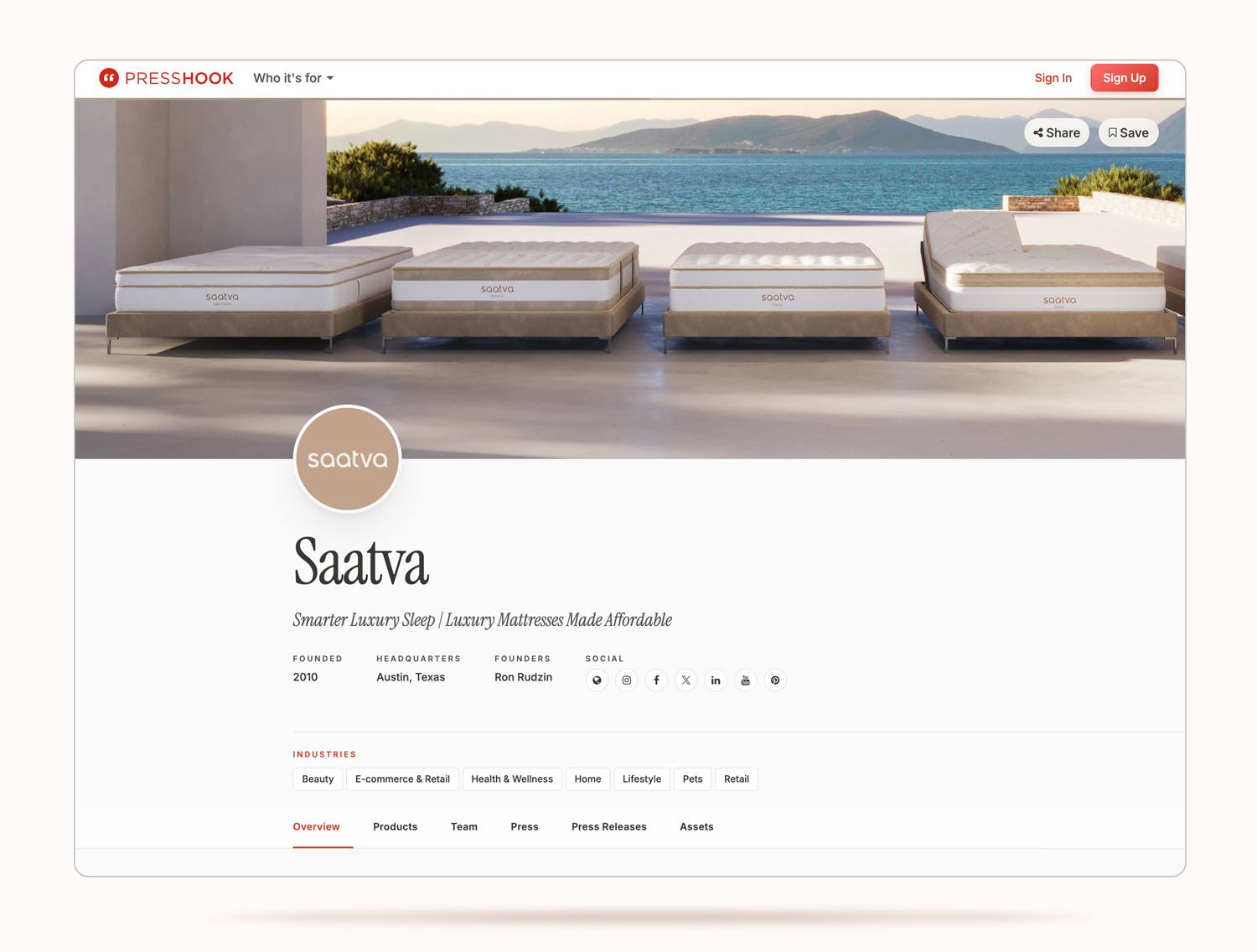
Press Hook is built around the suspicion that this is not an artful ritual. It is a bad database problem. The Atlanta company gives consumer brands a place to assemble a living press kit, answer requests, send samples, message writers, and watch coverage arrive. Journalists use the other side to look for products and sources without charge. The brand pays because it wants to be findable at the exact moment an editor has an appetite.
That reversal is the interesting part. Media databases have long helped publicists locate journalists. Press Hook also helps journalists locate brands. It is less a digital Rolodex than a small, searchable trade floor where the inventory is newsworthiness: a new product, an expert, a photograph, a founder with a useful story.
The failure came before the product
Michelle Songy learned the value of publicity while building Cake Technologies, a restaurant-payment startup she co-founded in London. Cake was bootstrapped. A full-service agency was expensive, so Songy tried the founder's classic alternative: do it yourself. The outreach took time and produced little worth keeping. Yet when coverage did appear, it helped with customers, investors, and credibility. The paradox lodged itself in her head. Press mattered most to the businesses least equipped to obtain it.
After Cake was sold to American Express in 2017, Songy worked there for two years. Then, on a 2019 trip to a remote homestay in Indonesia, a conversation with the owner sharpened the idea. The business had received most of its bookings from one article, but had neither the money nor the know-how to repeat the trick. Songy thought of Airbnb: a marketplace that made obscure supply legible to distant demand. Why was there no equivalent meeting place for small companies and the media?

Press Hook started in early 2020 with hospitality in mind. Then hospitality stopped. Lockdowns wiped out the first target market before the company could settle into it. The team moved toward food, home goods, beauty, and fashion - products that editors could still photograph, test, and put into service journalism. A summer beta helped more than 50 small businesses, and a private launch followed that fall.
“We remained agile, responding to real-time events, and expanded into new markets as lockdowns eased.”Michelle Songy, founder and CEO
What the subscription actually buys
A brand begins by building a structured profile: company story, founder details, products, talking points, logos, and high-resolution photography. It can watch live source requests, pitch directly, approve sample shipments, receive inbound questions, and track press. AI now helps draft the routine material - releases, pitches, media lists, and kits. A Shopify app, introduced in 2024, imports store products so a merchant does not have to retype its catalog.
The current offer is unusually specific about whom it wants. Consumer products are in. Pre-revenue companies, restaurants, law firms, political organizations, weapons companies, and brands seeking a one-time wire blast are out. Press Hook is not trying to be the universal communications department. Its sweet spot is a saleable object in beauty, food, wellness, home, fashion, parenting, pets, or the outdoors - preferably with enough traction to support a six-month campaign.
All four figures are reported by Press Hook. Impressions measure potential exposure, not readers who bought something.
The public comparison page lists Press Hook from $559 a month with a six-month minimum. It places a conventional agency at $8,000 to $20,000 a month and DIY software at up to $200. Those columns are not equivalent services. An agency supplies judgment and labor; DIY supplies tools; Press Hook supplies software, demand signals, and a network, with managed help available above the self-serve layer. Its own description is telling: roughly 95 percent self-serve.
Published monthly starting points
The black box gets a window
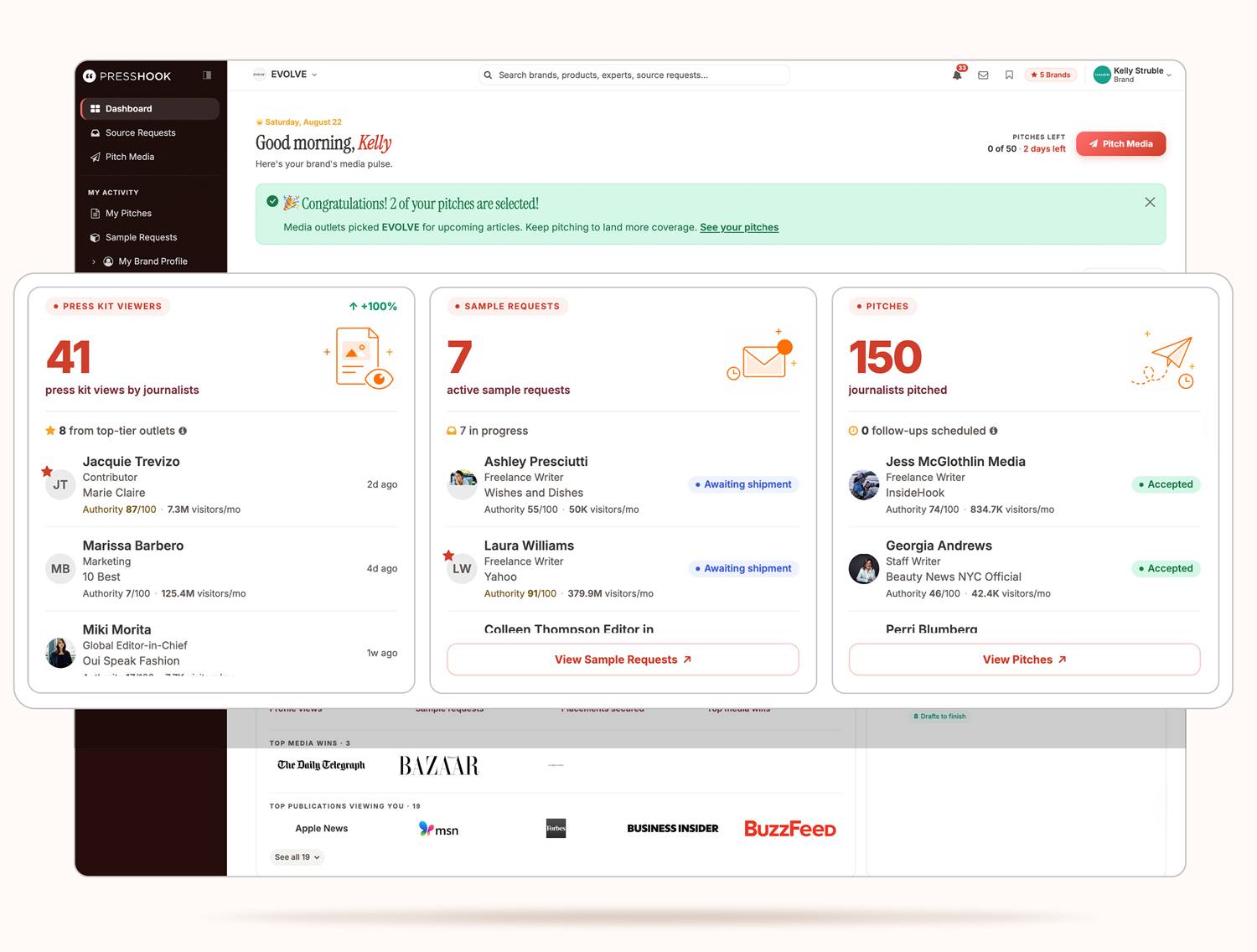
The cheapest feature may be visibility. Traditional PR often asks a client to trust activity it cannot observe, then wait for a monthly report. Press Hook exposes smaller signals: who viewed a kit, which sample went where, what request is live, and which relationship continues. A founder can see the work before seeing the headline. For agencies, the same machinery can hold several client kits under one account and widen a team's reporter network beyond the contacts any one publicist remembers.
The company raised a $1.5 million seed round in 2021 from Emergent Ventures, The Fund, and TnT Ventures. Songy had initially expected to bootstrap. Product-market fit changed her mind: capital could speed up the software and grow the network. By 2023, she reported $1.5 million in annual recurring revenue. In late 2024, she said total venture and debt financing had passed $3.5 million and the company had reached profitability that June.
The company pivots into products, helps 50-plus businesses in beta, and launches privately.
A $1.5 million seed round funds product and network expansion.
Press-kit, release, pitch, and media-list generators automate the blank page.
Merchants can import products; the founder reports profitability in June.
The part software cannot automate
Press Hook cannot make an uninteresting product interesting. It cannot force an editor to like a sample, guarantee a positive review, or fix a store that does not convert the attention it receives. The platform estimates 30 to 60 days to a first result, but earned media remains irregular. A six-month minimum can be sensible for editorial calendars and still be a poor purchase for a brand short on cash, imagery, inventory, or patience.
The network effect cuts both ways. The platform becomes more useful as more serious journalists and ready-to-ship brands participate. If requests drift away from a category, if brands answer everything indiscriminately, or if writers are buried beneath machine-made sameness, the old inbox problem simply moves into a nicer interface. Press Hook's AI can trim a pitch. It cannot supply the specific observation that makes the pitch human.
That is why the company’s best practical advice is almost stubbornly analog. Start before the season. Know the publication. Keep the pitch short enough for a phone. Tie it to a real event or cultural moment. Include sharp photography. Offer a sample with no strings attached. Have an affiliate program and a store ready before attention arrives. The machine removes friction; it does not remove taste.
The play worth copying
- Wait for proof. PR works better after a product converts and can stay in stock.
- Package the evidence. Put the story, facts, founder, retail links, and publishable images in one place.
- Follow demand. Respond to reporters who are already working on a relevant story.
- Respect the calendar. Holiday coverage begins while everyone else is still buying sunscreen.
- Measure relationships, not just impressions. One writer may return across several outlets and seasons.
Press Hook sits between three familiar choices: the giant enterprise media suite, the human agency, and the homemade spreadsheet. It is narrower than the first, less labor-intensive than the second, and far more organized than the third. The company’s bet is that consumer PR contains enough repeated work to productize, but enough human judgment to keep the marketplace valuable.
A bag of seaweed crisps will not become news merely because its founder filled out every field. But when a reporter needs one by Friday, being complete, visible, and ready to ship is no small advantage. In public relations, timing has always looked a little like luck. Press Hook is trying to give luck an inbox.
Go further
Explore the platform, its current brand catalog, and the company’s working notes on modern media relations.