A ticket gets you to the gate. Then the gate asks whether the ticket is really yours. Phil Scarfo has spent much of his working life in that small, awkward interval between possessing permission and proving you deserve to use it. At an amusement park, the interval can sour a perfectly good morning. At an ATM, it sits between a customer and their money. At an office, it stands between an employee and the start of work.
In 2013, speaking for fingerprint technology company Lumidigm, Scarfo described the amusement park problem in refreshingly unceremonious terms. Operators wanted to stop several people using one ticket. Customers wanted to get inside. An authentication system that made visitors struggle at the entrance risked spoiling the experience before it began. The roller coaster, one might reasonably feel, should supply the ordeal.
The example gives his career a human scale. Scarfo co-founded Imprivata with David Ting and served as an early chief executive. His other professional stops include Polaroid ID, NEC, Lumidigm and HID Global. Those names describe an industry. The person waiting at the gate explains the work.
The photograph came first
Before the arguments about fingerprints and digital credentials, there were identification documents. An August 1995 account of Texas’s move to electronically produced driver’s licenses listed Scarfo as a Polaroid contact. The old process involved film and a wait of 30 to 45 days for a license to arrive. The replacement system promised an electronically produced document mailed within a week.
Even the photograph had acquired a useful new courtesy: the operator could see it immediately and take another if the subject’s eyes were closed. This is a modest technological improvement until you consider how long someone might otherwise carry the evidence of an unfortunate blink.
By November 1998, Scarfo was identified as general manager of Polaroid ID Systems, discussing interest from government jurisdictions in identification technology. The work placed him where public administration met commercial imaging. A credential needed to be issued, recognized and used. A document could look convincing and still leave questions about the individual carrying it.
A company built around access
Imprivata grew from identity management technology that Scarfo and Ting had worked on inside Polaroid’s small-business incubator. Its founding belongs to the early 2000s: incorporation records point to 2001, while company histories also use 2002. Scarfo was a co-founder and early CEO; Ting was the founding technology leader.
The company shipped its OneSign enterprise single sign-on appliance in 2004. The proposition addressed a familiar irritation inside organizations: people needed access to several applications, while each application could bring another authentication demand. Single sign-on offered a way to simplify that procession.
That origin matters to Scarfo’s wider story. His career crossed the boundary between a physical credential and permission inside a computer system. A door and a software application can have quite different mechanisms, yet both eventually ask an organization to decide whether this person should proceed. The useful product has to turn that decision into something a user can actually complete.
Beyond the piece of plastic
In 2008, as HID Global’s vice president of identity management solutions, Scarfo discussed the company’s move into computer and network access. HID’s business had been associated with cards and readers. He described a broader role that included single sign-on and data encryption, with credentials serving both physical security and information technology.
The interesting commercial question was what the card enabled. Selling the object was only part of providing access. The permission had to travel through other systems, departments and applications. A badge that opened the front door could be part of a wider arrangement for reaching the tools inside.
By 2012, Scarfo was discussing the possibility of dispensing with the plastic altogether. Virtual credentials could be delivered electronically to a smartphone, used repeatedly or created for one use. He also pointed to the materials avoided when there was no physical card to manufacture or recycle. The credential was becoming less of an object and more of a service delivered when needed.
The demo ends. A customer arrives.
At Lumidigm, where Scarfo led worldwide sales and marketing, the practicality of fingerprint readers became a recurring subject. His 2011 article “Beyond the Door” opened with the gap between performance under laboratory conditions and performance in use. Demonstrating a reader in a controlled environment left a good deal still to establish.
His examples concerned the circumstances people brought with them. An environment might be wet, dry or dirty. One user would press confidently; another would barely touch the reader. A product installed for many people had to accommodate that variation. A security device could hardly insist on selecting its own customers.
Scarfo’s case for multispectral imaging rested on obtaining useful fingerprint information under those conditions. He described combining information gathered with different wavelengths of light. The business argument followed directly: a reader that required repeated attempts would struggle to deliver the convenience it advertised. Reliability belonged in the discussion before anyone started counting the benefits.
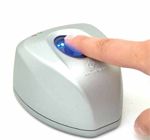
A small reader.
A very ordinary test.
There was also a technical contribution behind the executive biography. A 2010 application names Robert K. Rowe and Philip Scarfo as inventors of a method combining biometric sensing with other functionality. Originally assigned to Lumidigm, it proposed a multispectral system that could image biometric features and other material, including machine-readable information. One device could support several authentication tasks. The record is an application, listed as abandoned, rather than a granted patent.
A fingerprint needs an explanation
Making the reader work did not automatically make people comfortable with it. In a 2011 discussion of biometric templates, Scarfo addressed a persistent worry: the belief that systems necessarily stored a collection of fingerprint photographs. He explained the role of mathematical representations derived from selected features.
That distinction was part of the explanation he offered users, rather than a reason to wave away questions about privacy. A person encountering a scanner has to understand what the system is asking for. The organization deploying it also has to decide how the information will be handled.
In his 2014 writing, Scarfo examined why biometric technology could become familiar in practical settings while still provoking suspicion in public discussion. He pointed to banking and other everyday services where users could see a benefit. His commercial position was clear: acceptance depended partly on what people gained by taking part. Convenience needed to be visible to the person being authenticated.
“Cards, tokens, PINs and passwords are simply aliases for personal identity.”
Phil Scarfo, January 2016
The card and the person holding it
Scarfo’s banking articles made the distinction particularly sharp. A payment card could contain sophisticated technology and still be presented by someone other than its owner. The possession of a credential left an identity question unresolved. His argument for adding a fingerprint check concerned that remaining gap.
Writing about ATMs in 2015, he used Brazil’s adoption of card-plus-fingerprint authentication to illustrate the approach. The example brought the argument down to a transaction. A customer wanted access to an account; the bank wanted confidence about the customer. Extra security would be easier to accept if the interaction remained straightforward.
His January 2017 article, “Biometrics at the ATM,” returned to the balance between convenient transactions and protecting the identities used to conduct them. Banking gave the problem unusual clarity: the right account, the right person and a usable process all had to meet at one machine. None of those requirements disappeared because the card itself had become smarter.
A conceptual diagram of the checks Scarfo described in January 2016.
Letting people get on with it
The same concerns travelled beyond banking. In July 2013, Lumidigm announced its involvement in SMARTCORE biometric acquisition stations for visitors entering South Korea. Scarfo praised a design intended to combine government security requirements with convenience for travellers. The traveller’s fatigue was a practical consideration, not an inconvenience to the specification.
Another deployment involved Alfapass smart cards at Belgian ports. The system could check a cardholder’s fingerprint against the template on the card. Its enrollment process used two fingers, giving the user an alternative if the first presented a problem. Lost or withdrawn cards could be blocked across participating facilities. The arrangement brought together the credential, the individual and the organization’s changing permission to enter.
By March 2015, Scarfo was listed as HID Global’s vice president of global marketing for biometrics and scheduled to lead the opening connect:ID panel in Washington. Its title, “The Launchpad: Identity in a Brave New World,” supplied the expansive conference language. His published examples supplied something more tangible: a gate, a card, a reader and a person hoping the procedure would be over soon.
In 2013, he had also written that security systems must adapt as attempts to defeat them change. That argument leaves little room for a final victory speech. Equipment needs updating; authentication methods need reconsidering. The job continues after installation.
Read across these projects and a consistent professional concern emerges. Scarfo kept connecting the organization’s need for confidence with the individual’s desire to continue. The user should not have to become an expert in the machinery before being allowed through it. At the amusement park, after all, there is already somewhere more interesting to be.