The most valuable thing FusionAuth built for its community forum was the part that was never supposed to be the product. Gather, an API-first forum developed by the team behind the moderation tool CleanSpeak, needed a login system for testing. The forum flopped. The test harness survived. It became Passport, then FusionAuth - software for registration, login, single sign-on, multi-factor authentication, passkeys, user management, and the rest of the identity plumbing that every application needs and almost no application team enjoys rebuilding.
This is not the usual garage-to-unicorn fable. Founder Brian Pontarelli started Inversoft in 2007 with a Java profanity filter. A video-game customer helped turn it into CleanSpeak, and CleanSpeak revenue paid for later experiments. Gather arrived years after established forums and gave existing customers no compelling reason to endure a risky migration. By FusionAuth's own account, that was the first clear failure. It also supplied the clue: the team had needed a reliable authentication system to test Gather, and other developers had the same unglamorous need.
The useful accident inside the failed product
The product worked. The way it was sold did not.
The authentication system first went public as Passport in 2015. The name was hard to search and carried the residue of Microsoft's old Passport login. Worse, the team tried to imitate enterprise identity vendors: aim at large accounts, require a conversation, and sell through a long cycle. Ping Identity could afford that machinery. A small bootstrapped crew could not.
In September 2018, the team changed both the name and the invitation. Passport became FusionAuth. Developers could download a full Community edition, run it on their own infrastructure, and begin without asking a salesperson for permission. This was more than a rebrand. It moved discovery, evaluation, and much of implementation into the developer's normal workflow. The product could run on a laptop like a database, travel through CI/CD, land in a private cloud, or sit on an air-gapped server. FusionAuth also offered managed, dedicated cloud instances for teams that wanted the architecture without the pager.
“You should outsource authentication, but not your identity.”FusionAuth's operating idea
That sentence contains the company's market position. Auth0, Okta, Amazon Cognito, Microsoft Entra, and Firebase offer managed convenience. Keycloak offers open-source control with substantial operational responsibility. Homegrown auth offers maximum control and maximum opportunity to make a security mistake. FusionAuth occupies the middle: commercial software, a free self-hosted entry point, paid security features and support, plus managed hosting that remains single-tenant.
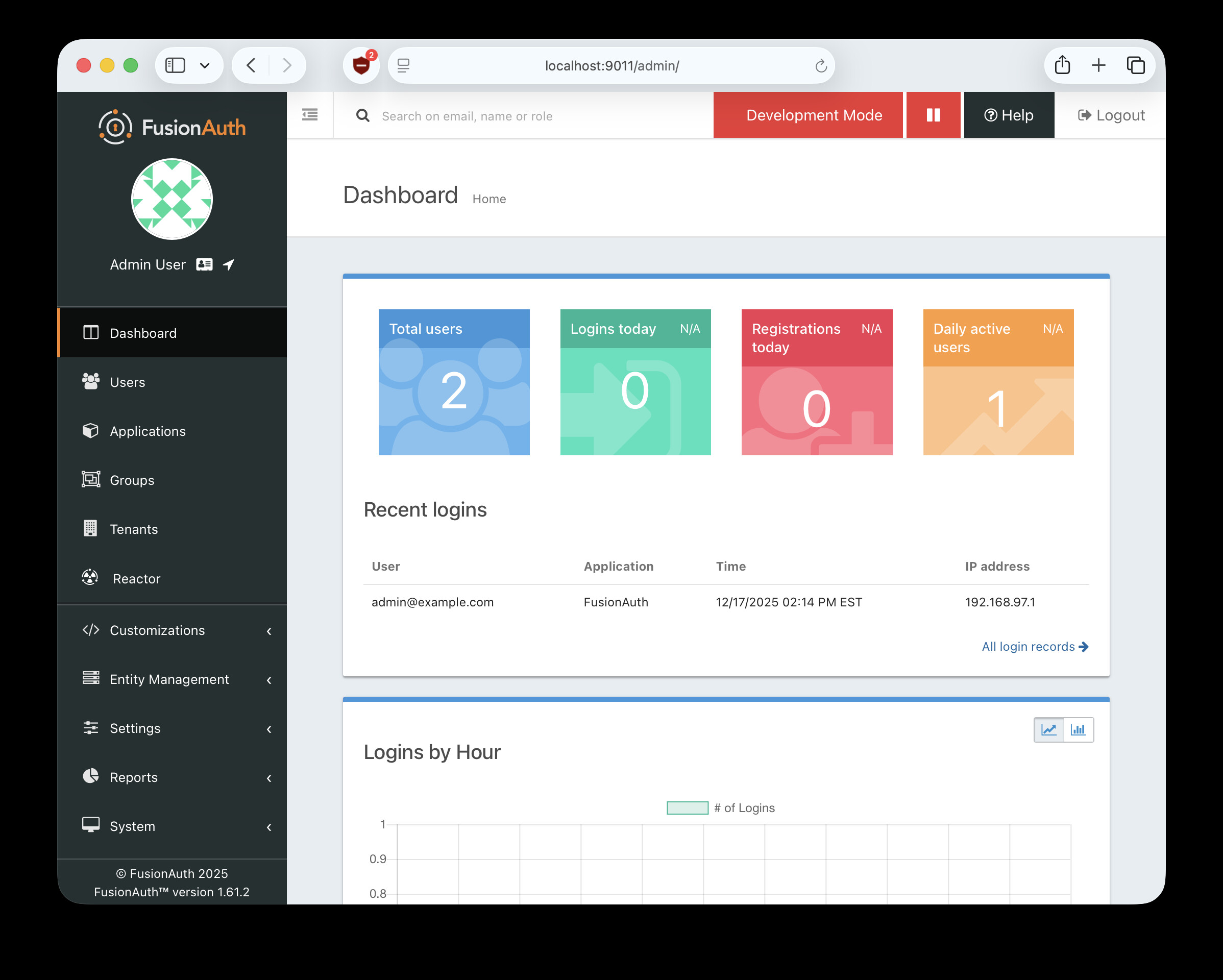
A login box is the visible inch of a deep system
A product team can use FusionAuth to register customers, customize login screens, connect social and enterprise identity providers, issue and validate tokens, manage roles, recover accounts, detect breached passwords, add passwordless login or passkeys, and challenge suspicious sessions with MFA. APIs, SDKs, quickstarts, webhooks, and Terraform support make it infrastructure rather than a design widget. The 2025 acquisition of Permify added a Google Zanzibar-inspired engine for fine-grained authorization - the logic that decides not merely who a user is, but which record, workspace, or action that user may access.
Its buyers range from startups escaping a homegrown user table to enterprises with data-residency, latency, or compliance constraints. Named customers and case studies include Bilt, WeRoad, Betty Blocks, UrbanSitter, DataStax, Waterford.org, ClearSpend, Zenni Optical, Clover, Oppenheimer, and STIHL. Betty Blocks used the platform across more than 10,000 applications. UrbanSitter reported cutting authentication development time by 90 percent. Unsupervised estimated that avoiding an internal build and upkeep saved $150,000. These are vendor-published case results, not a universal calculator, but they reveal the work customers are buying back.
Free software is the front door. Control, uptime, and help pay the rent.
FusionAuth's business model is legible. Community is free and unlimited for ordinary self-hosted use. Paid tiers add premium identity providers, breached-password detection, advanced MFA, custom OAuth scopes, threat detection, tenant management, service commitments, and engineer-led support. FusionAuth Cloud adds hosting. Commercial agreements also cover embedding, redistribution, resale, and customers that need negotiated governance terms.
Public starting prices shown for 1,000 monthly active users and annual billing as of September 2026. Infrastructure, scale, features, service levels, and contract terms can change the total.
The cost question has a second half. A free license does not make databases, patching, monitoring, failover, upgrades, and on-call labor disappear. Nor does migration become automatic: password hashes, social-account links, roles, redirects, email templates, and user consent all have to survive the move. FusionAuth publishes import scripts and migration guides, but the customer still owns the rehearsal. Teams with no appetite for identity operations may be happier with managed FusionAuth Cloud or a SaaS-only competitor. The self-hosted advantage matters most when control is a genuine requirement - regulated data, air-gapped deployment, customer-controlled infrastructure, local development, predictable tenancy, or a need to avoid a shared backend. It is less persuasive when a small team simply wants the shortest path to a hosted login and has no unusual deployment rules.
The bars are an editorial model, not benchmark data: more deployment control generally transfers more operational responsibility to the customer.
The capital decisionThey rejected growth-at-all-costs - then took $65 million to move faster
By 2023, FusionAuth said its free edition had passed 13 million downloads, paying customers exceeded 450, revenue had more than doubled each year, and the company was profitable. It ranked No. 1,597 on the Inc. 5000 after reporting 354 percent revenue growth over three years. Only then did it accept its first outside funding: a $65 million growth investment led by Updata Partners.
What changed their mind was not a sudden affection for venture theater. Bootstrapping had become a speed limit. Identity requirements were multiplying - passkeys, new OAuth work, machine identities, threat detection, regulation - while demand was outgrowing the team. The capital was earmarked for product development, go-to-market expansion, geographic reach, and a partner channel. Two Updata representatives joined the board. The sequence matters: customer evidence first, acceleration second.
The next transition arrived in 2025. Pontarelli moved from CEO to CTO and Brian Bell, previously CEO of Split and an executive at Ping Identity and Zuora, took the chief executive role. Pontarelli was blunt about the reason: building from zero and scaling toward nine-figure recurring revenue require different skills. Later that year FusionAuth earned ISO 27001 certification and bought Permify. In 2026 it introduced Intelligent MFA, which uses signals around a login attempt to decide when a stronger challenge is warranted. The platform is widening, even as its original wedge remains deployment choice.
What another builder can actually copy
- Audit failed products for infrastructure that solved a sharper problem than the product itself.
- Change distribution when the sales motion costs more than the company can support.
- Let technical users evaluate the real product in their own environment, not a decorative sandbox.
- Use a cash-generating product to fund exploration, but stop protecting the experiment when the market says no.
- Raise acceleration capital after a repeatable engine appears, with a named constraint the money will remove.
A company comfortable admitting it has fewer hands than ideas
FusionAuth's culture copy is refreshingly specific about constraints. “Our business has grown much faster than our company,” its careers page says. Features below the priority line are dropped rather than squeezed through at lower quality. The team emphasizes curiosity, technical depth, ownership, kindness, and being easy to work with. Benefits include unlimited PTO, 13 paid holidays, parental leave, and a 401(k) match; Built In named FusionAuth a 2026 Best Place to Work in Denver and Seattle.
There is some studied irreverence, too. Releases carry animal names - Flexible Fox, Proof Pangolin, Refined Reindeer, Intelligent Kamfa - while the website insists on “authsome” puns with the stamina of a dad who has found a receptive wedding table. The humor softens a severe category. A bad authentication decision can lock out customers, expose data, or turn a routine migration into a quarter-long excavation.
FusionAuth's most credible achievement is not that it made login exciting. It made the ownership decision explicit. Teams can buy the security layer without automatically handing over the place it runs, the way it is tested, or the shape of the customer experience. That bargain will not fit everyone. But it grew from a problem the founders felt themselves, inside a product the market rejected. The failed forum left one account behind. It belonged to a much larger company.