The invoices behaved themselves. That was the trouble. Three large employers had changed pharmacy benefit managers with a sensible aim: use a lower-cost Humira biosimilar. According to Pharmaceutical Strategies Group, a higher-cost version was dispensed instead. It was excluded from the formulary, earned no rebates, and cost five times as much on a net basis. Ordinary reporting did not expose the mismatch. Roughly $750,000 in expected savings slipped away.
- PSG advises the organizations paying for pharmacy benefits.
- Its Artemetrx software joins medical and pharmacy claims.
- Consultants help turn anomalies into contract, clinical and operational action.
PSG says its analytics identified the problem and its team helped recoup the savings. The revealing detail is what failed first: execution. A reasonable purchasing decision had become an unreasonable result. The episode offers a rather good introduction to a company whose work begins where the reassuring spreadsheet ends.
The invoices behaved. The drugs did not.
Pharmaceutical Strategies Group occupies the buyer’s side of the pharmacy benefits market. Employers, health plans, health systems and labor unions use its consultants to evaluate arrangements, negotiate terms and examine performance. The subject is narrow enough to sound dull and expensive enough to reward close attention. A benefit leader does not merely need a lower number in a proposal. They need a program that produces the intended result when someone fills a prescription.
PSG’s services connect several stages of that purchase: procurement, contracting, clinical optimization, audits and implementation support. The interesting question is how those stages inform one another. A contract defines an obligation. Claims show what occurred. A pharmacist interprets the treatment. An operations specialist helps determine what must change. Each sees a different piece of the same bill.
Relative net cost in PSG’s three-employer Humira case. The intended product is indexed to 1; this is not a market-wide price comparison.
Two benefits, one patient
A drug does not necessarily appear in the dataset marked “pharmacy.” Treatments paid through the medical benefit belong in the spending picture too. Reviewing only one side can leave a buyer with an incomplete account of medication use, cost and duplication. Artemetrx, PSG’s proprietary analytics platform, integrates the pharmacy and medical claims view.
The product family divides the work into useful jobs. Core supplies dashboards, reporting and clinical rules for finding potentially inappropriate utilization. Diagnostic assesses spending drivers and recommends changes, including lower-cost medications or sites of care. Extend supports custom reporting. Plus pairs analytics with clinical consulting. These are different ways of asking what a plan’s drug spending contains and what can reasonably be done about it.
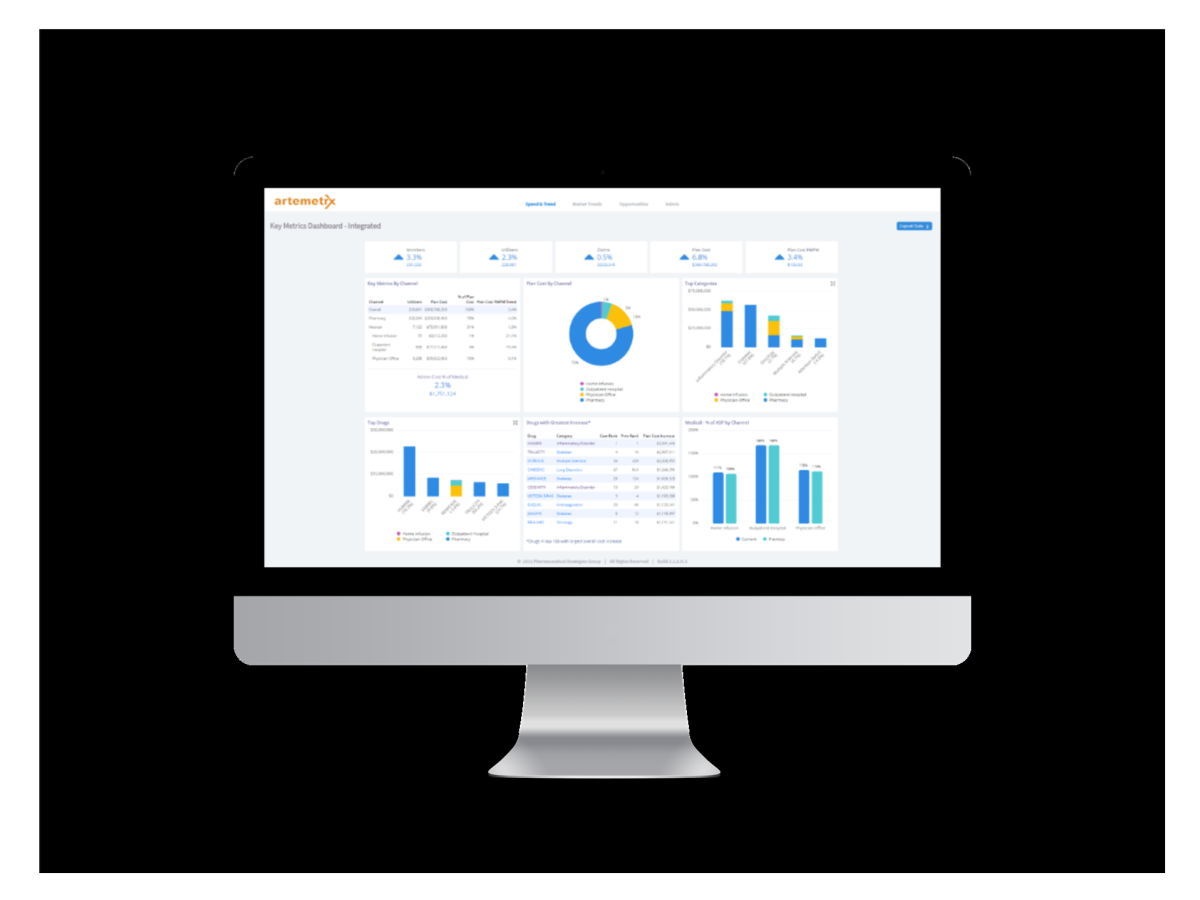
Core’s public page reports 1.5 billion pharmacy and medical claims and $3 billion in savings identified in 2025. “Identified” deserves its place in that sentence. An opportunity is not money already returned to a buyer. Turning a finding into a result may require a coverage decision, a vendor correction or a change in how care is delivered. The software supplies evidence; people still have work to do.
The consultant who stays after the signature
Much of PSG’s offering concerns the life of a contract after procurement. Pricing Monitor compares performance with pricing guarantees, accounting for details such as channel definitions, exclusions and fees. Rebate Monitor translates contractual terms into rules applied to claims, then compares expected rebates with the amounts paid. In practical terms, it gives a buyer another calculation to put beside the vendor’s calculation.
The distinction matters because an attractive headline term can coexist with exceptions that change its value. PSG’s audit menu extends beyond price to benefit design, clinical controls and implementation. A plan can ask whether the administrator implemented the intended rules, whether financial guarantees were met, or whether rebates were complete. Those questions require evidence more granular than an annual total.
- 01Define the contract obligation
- 02Compare it with paid claims
- 03Review the clinical implications
- 04Correct and monitor delivery
An editorial map of the work connecting PSG’s consulting, analytics and oversight services.
This is a B2B services and technology business: organizations buy expertise, analysis and support for their pharmacy programs. PSG also offers custom research and research sponsorship. Its alternative is not a single rival product. Milliman and Gallagher offer pharmacy benefit consulting; internal teams and PBM reporting can perform parts of the job. PSG’s proposition is to combine pharmacy specialization, its own analytics and ongoing operational help in one relationship.
A company with two beginnings
The founding date contains a small historical trap. PSG traces its roots to 1994, when Don Lea established AELRx. Dave Borden founded PSG in 2003, then acquired AELRx in 2004 and renamed it. The modern business inherited a history as well as a client-focused practice. A neat anniversary number conceals a more interesting sequence.
Ownership has changed too. Blue Wolf Capital invested in 2011. In October 2020, PSG’s 340B Link business was sold to Omnicell for $225 million. That price belongs to the divested business. EPIC Insurance Brokers & Consultants announced its acquisition of PSG in February 2021, placing the pharmacy practice within a broader benefits organization.

“Our values don’t change. They are enduring.”
Michael Lonergan · PSG’s 2024 anniversary interview
PSG describes a culture built around integrity, shared success, innovation, excellence and stewardship. Its careers materials advertise flexible remote work and development opportunities. Those are the company’s stated commitments. For a client, the practical test is whether the team can combine financial scrutiny with clinical judgment without losing sight of the member using the medication.
Unbundle the work, keep the responsibility
PSG’s Modular PBA service addresses a different purchasing question: must every pharmacy administration function come in the same package? A payer may select separate providers for components such as claims processing, networks, rebates or specialty pharmacy. PSG helps design the arrangement, assess vendors, negotiate and implement the pieces.
The appeal is control over individual functions. The cost in organizational effort is coordination. PSG’s own service description emphasizes project scope, return on investment, phased implementation and business continuity. Splitting a package does not make the interfaces disappear. Someone must keep the vendors, data and contractual responsibilities working together.
A buyer can copy the discipline without copying the entire structure. Start with the problem to solve. Specify the desired result and who owns it. Check that the data can demonstrate delivery. Where claims are incomplete, terms are ambiguous or nobody can act on a finding, the value of a sophisticated dashboard is constrained. Clinical review remains essential: a cheaper pathway has to make sense for the patient.
When the trial supplied the argument
Blue Cross and Blue Shield of Kansas City offers a concrete example of adoption. In its 2020 partnership announcement, Blue KC said an Artemetrx trial exposed significant savings opportunities that had been hidden in its data. That finding persuaded the insurer that its plan sponsors could benefit. The argument arrived as an analysis of its own information, rather than an abstract promise about analytics.
For a benefits buyer, that suggests a useful evaluation method: ask an advisor to demonstrate a specific discrepancy, explain its clinical and financial significance, and identify the action required. A colorful chart is pleasant. A finding someone can resolve is more persuasive.
The expensive question is changing
PSG’s research business keeps that scrutiny connected to the wider market. Its 2026 specialty report, sponsored by CenterWell Pharmacy, found 2025 specialty spending growth of 10.8% before rebates and 12.5% after rebates. Utilization was the dominant driver. More treatment use, rather than simply a higher price per claim, was shaping the result.
Its June 2026 benefit design report, sponsored by Transcarent, surveyed 237 benefits leaders. It found substantial interest in unbundled arrangements and continuing concern about GLP-1 affordability. GeneCQ, enhanced in 2025, addresses another planning problem by modeling gene therapy exposure. These developments widen the buyer’s task from reconciling yesterday’s bill to preparing for tomorrow’s treatments.
The lesson of PSG’s Humira case travels beyond pharmacy: verify the result at the level where the promise can fail. A purchasing strategy can be sound while its implementation quietly leaks money. The most useful advisor is the one who knows where to look, understands what the discrepancy means, and stays involved long enough to help fix it.
Keep following the claims
Explore PSG’s website, Artemetrx Core and demo requests, and the Humira transition case. Read the 2026 specialty report announcement and benefit design findings, or browse PSG’s insights and webinar recordings.
Follow PSG on LinkedIn and X. The EPIC acquisition announcement adds the ownership context.