A snack aisle is a peculiar place to find a former Marine jet aviator. It has no afterburners, no flight deck and no horizon. It does, however, have hostile terrain: rows of familiar brands, hard limits on shelf space, fickle appetites and a manufacturing process that can turn a promising recipe into expensive gravel. Peter Grant Barrick seems perfectly comfortable there.
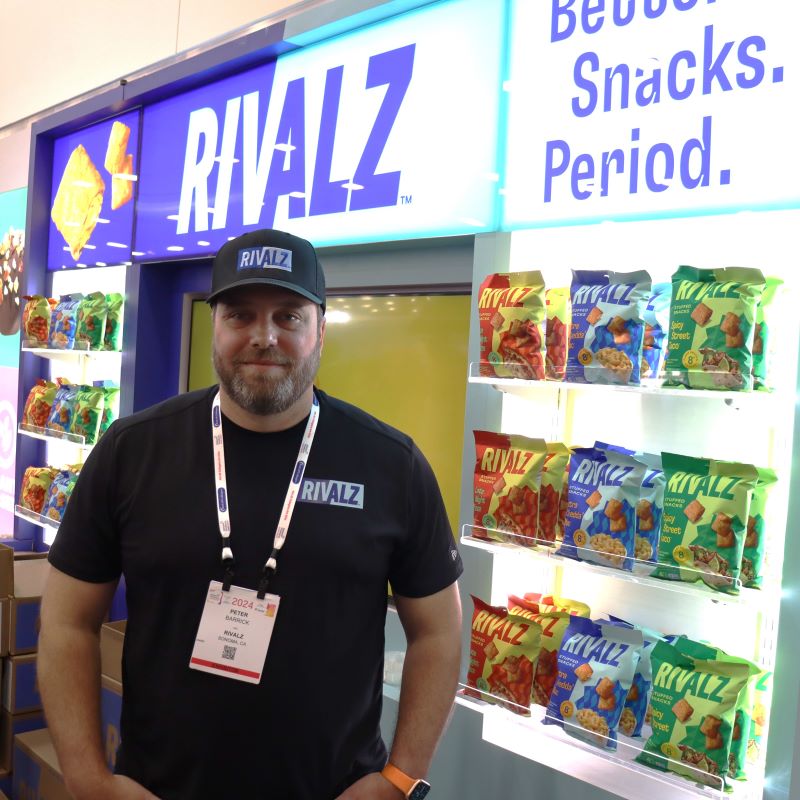
Barrick is the co-founder and CEO of Rivalz, a Sonoma company that makes crunchy, filled snacks and, more recently, puffs. The bags carry names such as Late Night Pizza, Extra Chedda' Mac and Spicy Street Taco. The ingredients include yellow pea flour. The technical core involves extrusion, the industrial ritual in which food is mixed, heated, pressurized and pushed through a shaped opening. One might reasonably wonder how any of this follows from a cockpit. Barrick's answer is hidden in the way he makes decisions.
He likes uncertain environments. More precisely, he likes giving uncertainty some furniture: an objective, a boundary, an owner and a deadline. He calls the arrangement a “decision box.” A department leader knows what belongs inside the box and has freedom to maneuver there. The boss supplies intent rather than a running commentary. It is military language with good office manners.
“In the Marine Corps and in the job I do now, being calm is king.”Peter Barrick
01 · The first cockpitA taste for consequential work
After undergraduate study at UC Davis, Barrick joined the Marine Corps around 2005. He entered the Navy-Marine Corps jet aviation program, flew combat missions in Afghanistan, then served on the ground as a forward air controller, directing aircraft in support of infantry. His assignments took him through parts of North Africa, East Africa and the Middle East. Near the end of an eight-year military career, he became a naval flight instructor.
His description of instruction is wonderfully free of brochure language: strap on two Pratt & Whitney J52 engines, sit beside a new student and do it again a few days later. The work taught him to decide before certainty arrived. Barrick says the military trains people to move with 70 percent of the information or less. Waiting for the remaining 30 can be its own bad decision.
One memory outlasted the deployments. In East Africa, he watched children improvise a Friday soccer match. Their ball was a tied plastic bag; rocks marked the field. Barrick has said that scene sharpened his interest in shelf-stable food that could travel without refrigeration. Years later, the commercial product and the larger purpose would meet inside the same piece of machinery.
02 · A second educationThe safe job, politely declined
Leaving the service left Barrick simultaneously prepared and unprepared. He knew logistics, planning, leadership and how to keep a team moving in disorder. Business translated those verbs into unfamiliar nouns. He returned to UC Davis for an MBA, graduating in 2016. Alongside his bachelor's and business degrees from Davis, he holds a Master of Arts from California State University, Sacramento.
The MBA gave him a bridge into food and finance. He worked with Wells Fargo bankers underwriting debt facilities for food-and-beverage companies in Sonoma and Napa counties. Balance sheets became another kind of instrument panel. He learned to identify what made a company durable, what made a lender nervous and how growth can consume cash long before it looks impressive.
Banking was respectable, useful and safe. Barrick missed consequence at closer range. He later wrote that he wanted to create value instead of chasing it. He helped start a private-equity firm, worked with emerging food brands and became director of operations at Sonoma Brands, the investment company founded by entrepreneur Jon Sebastiani. By 2020, he was discussing production scaling and supply chains with fellow UC Davis alumni. His résumé had acquired the three ingredients Rivalz would need: operational nerve, financial discipline and a network in food.
03 · The hard choicePea flour meets predictive analytics
Rivalz began with an unusually assembled founding group. Harold Schmitz and Ralph Jerome brought senior experience from Mars. Ilias Tagkopoulos brought artificial-intelligence research from UC Davis. Victor Friedberg and Miguel Reyna added investment and operating experience. Barrick became the chief executive, the person responsible for turning a table full of expertise into a company that could ship.
The early product decision revealed the group's temperament. A puff or chip would have been easier and cheaper. Rivalz chose a stuffed bite with a crisp vegetable-based shell and a soft center. Texture was the wager. People might read a label once; they encounter the crunch every time. The harder format gave the young brand something a nutritional claim alone could not: a recognizable eating experience.
Then came the machinery. Conventional food extrusion relies heavily on trial and error. Rivalz estimated more than 500,000 meaningful combinations among ingredients, dosing, heat, pressure, moisture and sensory targets. Its team built a proprietary dataset and used predictive analytics to narrow that field to 71 impactful experiments. The development cycle took about six months. Barrick says a conventional approach could have required at least 18 months and a much larger research team.
The experiments they did not have to run
This is the useful distinction in Barrick's account of AI. The model did not wander into a kitchen and invent dinner. Food experts framed the problem, an extrusion specialist understood the machine, and real-world trials supplied feedback. Predictive software reduced the search space. Human judgment still had to recognize a snack worth eating.
“You combine an AI platform with one of the best subject-matter experts in food, and that's where the magic happens.”Peter Barrick
04 · The operator's mapFour rules worth stealing
Give uncertainty a box
Define the objective, limits and owner. Let the person closest to the work choose the route.
Prefer a hard difference
The stuffed format created a sensory distinction precisely because it was inconvenient to manufacture.
Put software beside mastery
Predictive tools become useful when an expert knows which variables matter and which result is plausible.
Keep the mission portable
A company can sell brightly named snacks while developing the same process for more distant food systems.
The company launched commercially in May 2023. In February 2024, it announced a $6.1 million seed round. By that September, Barrick said Rivalz was headed toward nearly 2,000 stores by year-end, had secured vending distribution within the Los Angeles Unified School District and had grown Amazon sales 8.4 times over the previous year. Those figures captured a moment, not an arrival. Grocery rewards velocity and punishes sentimentality. Every new shelf is an audition.
Barrick's calm is therefore less a personality ornament than an economic tool. A nine-person company cannot afford the founder to become a weather system. Clear roles prevent every choice from climbing back to the CEO. Calm lets bad news remain information rather than theater. The objective is not serenity. It is throughput.
05 · Beyond the bagOne machine, two horizons
Rivalz's extrusion work eventually moved outside ordinary retail. In 2024, the company completed a proof-of-concept project applying cooker extrusion to humanitarian food formulations. In 2025, it announced a multi-phase collaboration with World Food Program USA, focused on process, scale and the use of equipment that could be deployed more broadly. The work returned Barrick to the shelf-stable question that had stayed with him since East Africa.
The connection is not sentimental. It is operational. Extrusion machinery already exists in many markets. Rivalz reported that a widely available single-screw system could offer a simpler, less capital-intensive route than more elaborate equipment for several tested formulations. Portability, cost and local manufacturing are business constraints before they become noble phrases.
Joins the Marine Corps
Jet aviation, forward air control and flight instruction follow.
Completes the UC Davis MBA
Business becomes the next language for leadership and logistics.
Runs operations at Sonoma Brands
Consumer products, supply chains and emerging brands come into focus.
Co-founds and launches Rivalz
A cross-disciplinary team brings the stuffed snack to market.
Broadens the platform
Humanitarian extrusion work, a $5 million Series A first close and a new puff line.
In June 2026, Rivalz announced a $5 million Series A first close and introduced its puff line. The move is mildly comic after the founders once rejected the easier puff in favor of the stuffed bite. But sequence matters. The difficult product established the platform and the brand's point of view. The simpler format can now extend them. Depth first, breadth later.
Barrick still describes entrepreneurship as forcing an idea into reality. Force is only half the story. His career suggests something quieter: a repeated effort to make complexity legible. A flight plan. A credit decision. A decision box. Seventy-one experiments. Each turns a foggy situation into a field small enough for responsible action.
He is also, for the record, a Manchester United supporter who likes golf, history and travel. These are reassuringly terrestrial hobbies for someone who spent years attached to jet engines. They also add a final note to the portrait. Risk may animate him, but the destination is not adrenaline. It is useful work, performed with capable people, in service of something that can leave the building.
The snack aisle remains crowded. Incumbents have distribution, recognition and more money than a Sonoma startup. Barrick has not mistaken a hard beginning for a guaranteed ending. He has simply chosen the sort of odds he understands: incomplete information, talented specialists, a clear objective and room to maneuver. Somewhere inside the extruder, under heat and pressure, a pea learns to crunch. The rest is operating.