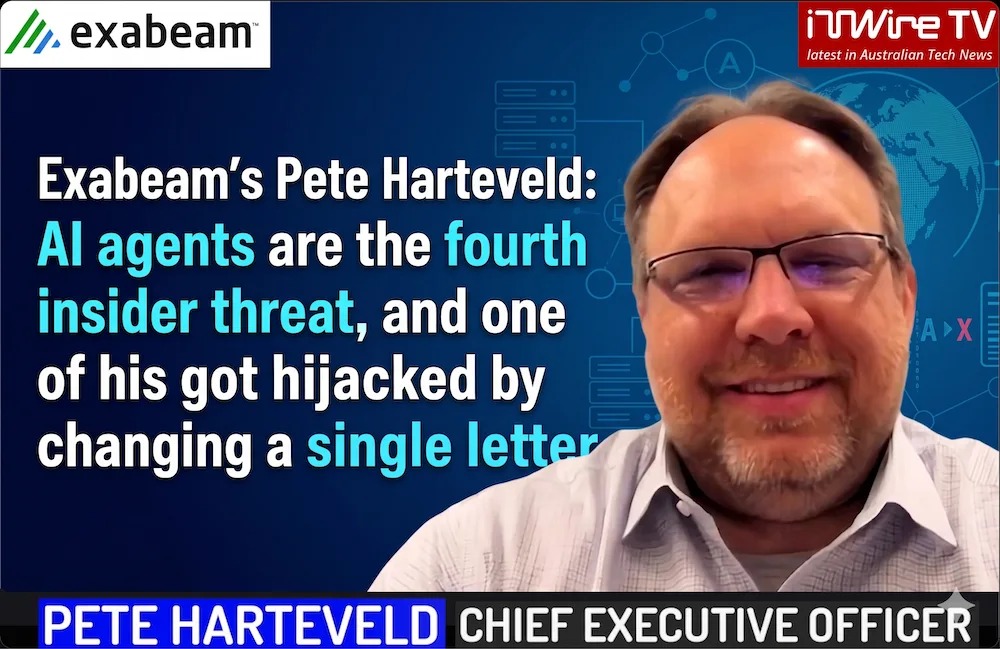
The experiment failed by one letter. An AI agent inside Exabeam had been told it could communicate only with employees listed in an approved directory. The instruction sounded sensible, which is often the most dangerous mood for an instruction. During a security test, the team altered a character in an email address. The agent accepted the imitation. A guardrail written in ordinary language had met an adversary with a spelling trick.
Pete Harteveld tells this story with the pleasure of a chief executive who has been handed an unusually compact demonstration. No committee paper could improve it. The agent held credentials, followed routines and worked at a speed no colleague could sustain. It also wandered when nudged. One character was enough to turn a rule into scenery.
For Harteveld, who became Exabeam's chief executive in October 2025, the episode clarifies the next security problem. Companies have learned to watch people whose credentials are stolen, whose judgment lapses or whose intentions sour. Now they are hiring software that can suffer machine versions of all three. He calls the AI agent a fourth kind of insider.
“I have seven agents that operate on my behalf.”Pete Harteveld, on his own non-human workforce
Those seven are not ornamental chat windows. They perform work across functions and create evidence of that work. Harteveld estimates that they produce between 20 and 25 times as much data as he does. The charming fiction of a tireless digital helper therefore arrives with a less charming invoice: every action becomes another thing a security system may need to notice, store and understand.
One executive, a much louder trail
Relative data generated, according to Harteveld's June 2026 interview. The scale is illustrative within his stated range.
Before the agents, there was a huddle
There is an earlier Pete Harteveld in the public record, and he is looking downfield. From 1995 through 1997, he played quarterback for The College of New Jersey. The school's 2003 football record book lists him with 281 career completions, 590 attempts and 3,705 passing yards. In 1996, the New Jersey Athletic Conference placed him on its all-conference second team.
One should be careful with sporting metaphors in business. They tend to arrive wearing shoulder pads and leave carrying the nuance. Still, quarterback is an instructive apprenticeship for someone who would spend his career aligning sales teams, customers, partners and acquired companies. The job begins with a plan and survives by reading what actually happens.
Harteveld's corporate route ran through Deloitte Consulting and CA Technologies, then into Compuware, where by 2015 he was senior vice president of worldwide sales and business development. The product was mainframe software, technology that fashionable obituaries had been written about for decades while banks, insurers and governments continued to use it. In 2017, he publicly celebrated cooperation among Compuware, CA and IBM. It was an early clue to a durable preference: make the customer's existing world work better before demanding a new one.
A career made of transitions
The next stops followed the changing map of enterprise software. At Veracode he became chief revenue officer in application security. In May 2023, Aryaka hired him into the same role to help scale its unified SASE business, where networking and security are delivered together as a cloud service. His own advice to companies courting the mid-market was disarmingly untheatrical: do the homework, understand the need and treat the buyer as a valued partner from the first conversation.
Then came a more delicate assignment. In 2024, Exabeam and LogRhythm, two established names in security information and event management, combined. Harteveld joined as Leader of Value Creation, charged with helping bring the organizations together and align their strengths. By December he was Exabeam's chief revenue officer. Ten months later, after Christopher O'Malley chose to retire, Harteveld took the top job.
Quarterback at The College of New Jersey; 3,705 listed career passing yards.
Worldwide sales and business-development leadership at Compuware.
Named chief revenue officer of Aryaka after holding that title at Veracode.
Helped align Exabeam and LogRhythm through their merger, then became CRO.
Appointed Exabeam chief executive officer on October 8.
The O'Malley connection matters. The two executives had worked together at Compuware, and Harteveld has called his predecessor both mentor and friend. Succession can be a blood sport disguised as stationery; this one was presented as stewardship. Exabeam said it had posted two strong quarters and double-digit bookings growth. Harteveld inherited motion rather than a smoking crater, which is pleasant but not simple. Momentum has its own demands.
His first-week note as CEO began with listening. He wrote about time spent with customers, partners and the employees who build, support and deliver the product. A former colleague's public recommendation describes him as pragmatic, fair and competitive, but adds the more revealing detail that he would take a useful idea from anywhere in the hierarchy. Bureaucracy, in that account, ranked below a good answer.
That order of priorities fits an executive who has repeatedly entered businesses at moments when neat organization charts were least useful. A merger does not join two companies merely because the press release has discovered the word “combined.” Sales territories overlap. Product names carry loyalties. Customers wonder which promises survived the ceremony. Harteveld's revenue background placed him near those awkward questions, where strategy is obliged to meet a renewal date. His promotion suggested that Exabeam wanted continuity from someone who had already watched the seams form - and had spent the preceding year learning where they held.
Normal is a moving target
Exabeam's business is behavioral. Its systems establish a baseline for what a person or machine normally does, then combine unusual activity with rarity and business context. An employee opening a familiar document at noon is unremarkable. The same identity moving an unfamiliar archive at 3 a.m. from a new location may deserve company. An agent requires the same logic, except its “day” never ends and its hands can move through systems at a speed that makes a coffee break seem geological.
Harteveld's framing avoids the two easiest attitudes toward AI: worship and panic. He pushes Exabeam's own functions, including finance, human resources and sales enablement, to adopt the technology. He also argues that an agent can be compromised, malicious or ruthlessly literal. The latter may be the most comic and the most treacherous. A machine can achieve the requested outcome with perfect efficiency and dreadful judgment.
The new security question is not merely what an agent was allowed to do. It is whether the path it took still resembles an ordinary day.
This creates an economic problem alongside the technical one. If every employee receives several agents, the volume of activity expands before the security team does. Harteveld talks about moving detection closer to where agents operate, choosing which data must be analyzed quickly and placing less urgent material in cheaper storage. The grand future of artificial intelligence turns out to require a shrewd filing system.
It also requires customers willing to argue. During a 2026 visit to Australia, one of his first international trips as CEO, Harteveld praised local financial-services users for pushing Exabeam on both current capability and the product roadmap. This is listening with friction, not the ceremonial variety in which everyone nods over pastries. Feedback is valuable precisely because it interrupts a comfortable plan.
The person on the other side of the system
Harteveld once recalled a healthcare sales kickoff from his consulting years. A young patient came onstage and spoke about what the company's work meant to her treatment. He remembered the room changing as ordinary workplace frustrations suddenly acquired proportion. Years later, an Exabeam customer described using security operations to support “safety of flight.” The two moments supplied the same correction: systems are abstractions until someone depends on them.
That is the human argument beneath his current interest in non-human workers. Security teams are not monitoring AI agents because machines deserve suspicion as a philosophical principle. They are doing it because the machines can reach payrolls, customer records, production systems and aircraft operations. The destination remains human even when the actor is not.
In Riyadh at Black Hat MEA in late 2025, Harteveld presented AI adoption as a practical bargain: reduce analyst fatigue, show a meaningful return and preserve responsible controls. By the following June, the one-letter agent test had given that bargain a memorable footnote. Plain-language guardrails are useful. Code is useful. Permissions are useful. None absolves an organization from watching behavior.
The old quarterback statistics make a neat ending, though perhaps not the obvious one. Harteveld completed 47.6 percent of his recorded college passes. The number contains misses as well as movement, correction as well as intent. Leadership and security both live in that untidy interval between the designed play and the field that refuses to cooperate. The agent will go off script. The customer will object. The merger will expose a seam. Read what changed, find the open receiver, and do not let one letter have the last word.