Consider a penny. At the gas station, it is the digit you squint at before turning into the forecourt. In a contract for a million gallons, it is $10,000. The unit has not changed. The consequences have. Somewhere between those two scales sits OPIS, a Dow Jones company whose business is helping people establish which price belongs in the calculation.
- OPIS supplies fuel benchmarks, market reporting and business software.
- Its customers buy, sell, price and audit energy commodities.
- The useful detail is local: product, terminal, payment terms and time.
The letters stand for Oil Price Information Service. Its customers include refiners, wholesalers, retailers, fleets, traders and public buyers. They face a problem a crude-oil headline cannot settle: what should this particular fuel cost here, under these particular terms? A useful answer must survive the scrutiny of someone on the other side of the transaction.
A penny with consequences
Follow the fuel. Spot markets concern physical cargoes and other bulk transactions. The wholesale rack is the terminal stage, where fuel is sold for onward distribution. Retail is the price motorists encounter. OPIS covers all three. Each is a different observation point, with its own commercial meaning; treating them as interchangeable makes for a very tidy, very misleading spreadsheet.
A fleet buyer can compare a supplier invoice with the agreed benchmark. A wholesaler can examine competing terminal offers. A retailer can monitor nearby pump prices. US Foods describes using OPIS rack data to review supplier agreements and reconcile invoices. This is the decidedly practical end of market intelligence: making sure the bill matches the deal.
Small difference.
Large delivery.
Difference across 1,000,000 gallons
Arithmetic only. Not an OPIS price or a promised saving.Fifty cities, thousands of calls
The company traces its roots to Oil Express, a petroleum newsletter launched in 1977. The OPIS newsletter followed in 1980. Co-founder Tom Kloza remembers gathering wholesale prices for roughly 50 American cities with Ben Brockwell. It took thousands of telephone calls. Their tools included pencils, paper and an early fax machine that needed six minutes to transmit a page.
There is something instructive about that machine. Even when transmission was painfully slow, the information was worth collecting. The commercial problem existed before a convenient interface did. OPIS subsequently added specialist spot reports, satellite delivery through PetroSAT in 1991, and a US retail pricing database in 1999. The delivery mechanism kept changing around a recurring purchasing decision.
Kloza recalls working with Bruce Levenson and Ed Peskowitz, the entrepreneurs behind Oil Express. He also points to oil-price decontrol in 1981 as an important opening for the service. His recollection offers a useful corrective to the neat founding myth: the market changed around the reporters. Their collection of local prices became more useful as the trading environment changed.
The clock inside the contract
By June 2025, the inconvenience was different. OPIS had useful pricing information spread across several rack tools. RackPro gathered it into an interactive platform. The launch announcement described a response to customers asking for faster access and simpler analysis. The bottleneck had shifted from transmitting a page to finding the right information across products.
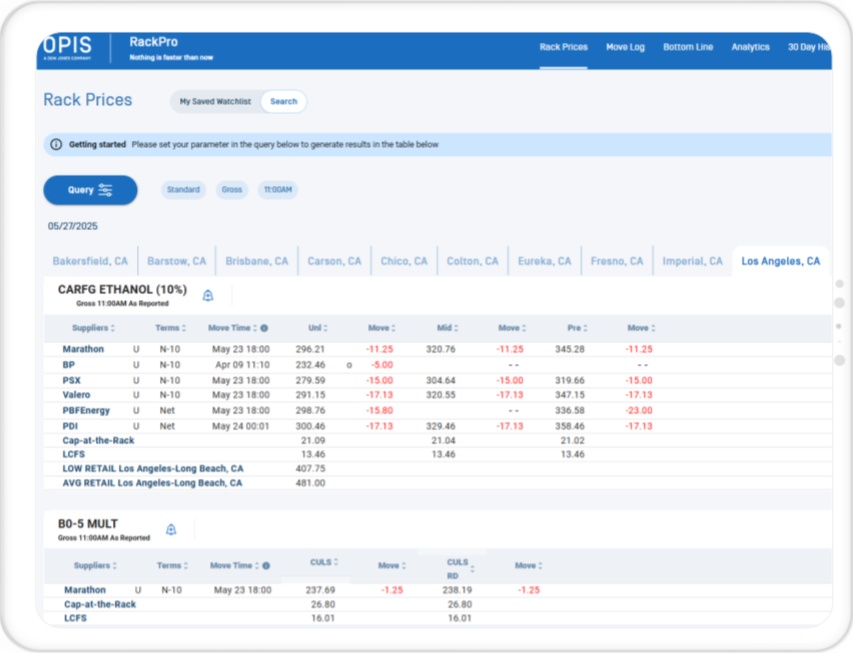
RackPro lets users filter supplier-posted prices, inspect historical moves and set alerts. Its benchmark views distinguish gross and net payment terms, branded and unbranded supply, and individual terminals. It also offers snapshots for 10:00 a.m., 4:59 p.m. and 11:59 p.m. Eastern. A timestamp can look like clerical trivia until a contract depends on it.
The Rack API carries pricing data into internal software, including accounting and invoice reconciliation systems. Reports and dashboards serve the person making a decision; feeds serve the system checking many decisions. OPIS sells subscriptions and data access around those needs, alongside software and industry events. Buyers choose the coverage and delivery their work requires.
For a prospective user, the sensible starting point is the actual decision: selecting a supply location, pricing a sale or checking a bill. Then identify the fuel grade, market, observation time and payment basis. That sequence follows the distinctions built into RackPro. Comparing two numbers becomes useful only after establishing that they describe comparable things. The interface can put them next to each other; the purchasing team still has to understand its own agreement.
A number both sides can use
OPIS competes in price reporting with businesses such as Argus Media and S&P Global Platts. Its case rests on the connection between detailed fuel coverage, established benchmarks and tools for everyday work. A buyer whose contract specifies an OPIS benchmark has a reason to use that exact reference. Another provider’s assessment may describe a different market or measurement window.
“It builds trust.”
Eric Ellis, owner, Ellis Oil Company
On using OPIS rack benchmarks with customers
This makes methodology part of the product. OPIS publishes assessment specifications and IOSCO price-reporting assurance reports. Its retail operation describes using multiple data sources and dedicated quality analysts to check incoming prices. The work includes deciding whether observations are comparable, identifying errors and explaining what a published number actually represents.
In February 2022, News Corp paid $1.15 billion in cash for OPIS and related assets, including coal, mining and metals information businesses. That was an acquisition price for a package of operations. It gives a concrete indication of the value placed on specialist information that can travel into contracts and purchasing systems.
The next market needs a number too
The same problem now appears in environmental commodities and hydrogen. In August 2026, OPIS and Nodal Exchange announced financially settled environmental contracts developed with IncubEx. That month, OPIS also launched Global Hydrogen Analysis with Hydrogen Calc, combining project information, production economics and supply-demand analysis. These markets need careful distinctions between technologies, locations and commercial terms.
Dow Jones brought OPIS and other specialists under the Dow Jones Energy identity in August 2026, while retaining their attribution on benchmarks. The lesson other businesses can copy is specific: solve a recurring information problem, then reduce the effort required to use the answer. The discipline matters. A benchmark must match the contract’s geography, specification and timing; it cannot guarantee available supply or an executable offer. Even a very useful number needs its instructions.