Consider two people looking at the same exchange rate. One sees an opportunity: perhaps the dollar will rise against the yen. The other sees an accounting problem: last month’s overseas sales must become a number in this month’s books. OANDA has spent three decades building a business around both of them.
That pairing explains more about the company than a screen full of flashing prices. OANDA supplies online trading, currency information and analytics. Its customers include individuals placing leveraged forex trades and businesses feeding exchange rates into financial systems. Behind the converter are execution engines, historical datasets and software connections.
- A broker for traders; an exchange-rate feed for finance teams.
- Trading costs depend on spreads, commissions and financing; business data uses subscriptions.
- FTMO completed its purchase in December 2025. OANDA’s Prop Trader transitioned in 2026.
01 /First, let people see the price
In 1996, computer-engineering professor Michael Stumm and econometric researcher Richard Olsen co-founded OANDA. Their backgrounds matter. Currency markets could be approached as a problem in information and computation, with software doing work previously reserved for specialist desks. OANDA made exchange-rate information freely available online. A person could arrive with a question about two currencies and leave with an answer.
The company’s fxTrade platform followed in 2001, allowing trades as small as one US dollar. That was a practical design decision. If software could process tiny transactions economically, participation no longer required a large ticket. Small trades could inhabit the same system as larger ones. The product widened access by changing the machinery underneath it.
The ambition required capital. Index Ventures led a $17 million Series A in 2005. A $100 million Series B followed in 2007, led by New Enterprise Associates with Legg Mason, Cascade Investment and T. Rowe Price. At the time, Stumm said the money strengthened OANDA’s ability to serve corporate and institutional customers. Expansion meant more than attracting another individual trader.
02 /Two customers. One moving number.
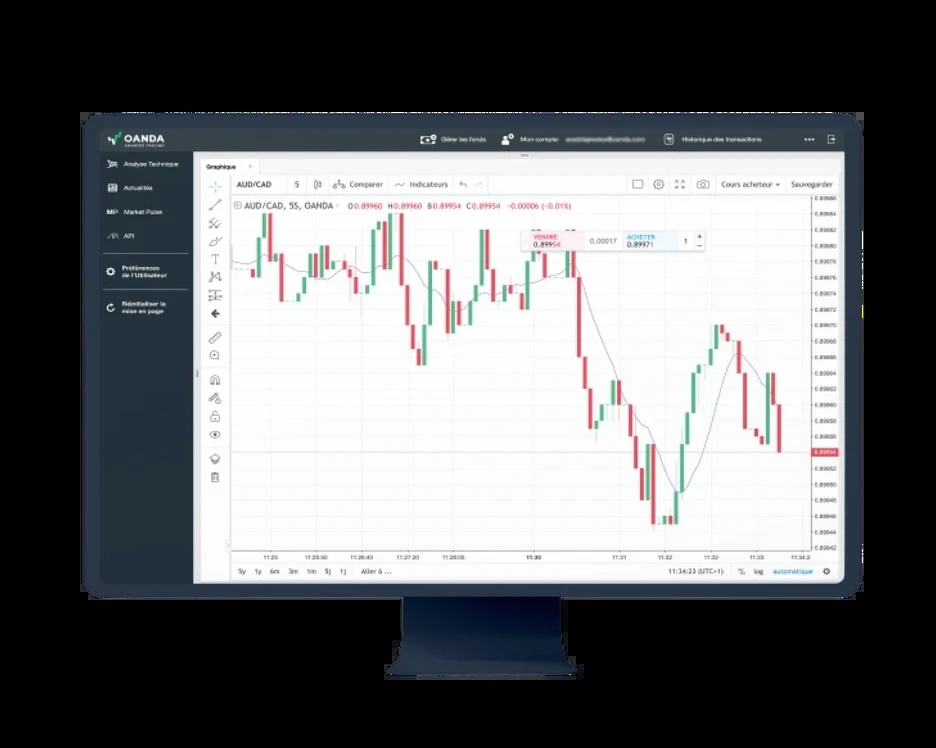
Today, the retail side offers OANDA’s web and mobile platforms alongside interfaces such as MetaTrader 4 and TradingView. A customer can study a chart, place an order and monitor a position. Developers with eligible accounts can use the v20 API to retrieve prices, manage orders and inspect account history. MarketPulse adds commentary on the events behind the price movements.
The finance department’s shopping list looks different. OANDA’s Exchange Rates API supplies data to accounting, treasury and other business systems, with integrations involving Oracle, Microsoft, SAP and Sage Intacct. Historical tools let users revisit earlier rates. Here the useful feature is repeatability: a finance team can automate retrieval instead of having someone copy a number from a website.
This is OANDA’s particular position in the market. Brokers such as IG, FOREX.com and Saxo are alternatives for traders; currency-data services such as XE compete for another part of the budget. OANDA participates in both conversations. That breadth makes comparisons more demanding. The right question is whether the particular product solves the particular job.
03 /The bill depends on the job
There is no single price for “using OANDA.” On its US forex offering, spread-only pricing includes the commission within the difference between buy and sell prices. A separate core-spread-plus-commission option is also advertised. Holding a position overnight can bring financing charges or credits, and other account charges depend on the applicable terms. A narrow advertised spread does not describe every cost.
For business data, the bill resembles a software subscription. At the time of research, the API’s Lite plan was listed at $450 per month or $4,850 annually, with 100,000 quotes per month. Higher tiers add capabilities. A seven-day trial gives a team room to test the feed before purchasing. The sensible experiment is concrete: connect a real workflow and check its dates, rate types and outputs.
The two products should never be confused. A reference rate used to translate revenue is not a promise that a trader can execute at that price. Nor does an automated feed decide a company’s accounting policy. OANDA can supply the number and the plumbing; the customer still has to choose the appropriate use.
04 /When the price outran the machinery
On January 15, 2015, the Swiss National Bank abandoned its exchange-rate floor against the euro. Liquidity disappeared and prices moved abruptly. The failure exposed across retail currency markets was a dangerous assumption: that a position could always be closed before losses consumed its collateral. Some customer accounts went below zero.
OANDA also lost money. In a subsequent account of the episode, its head of trading and quantitative analytics described how internal matching reduced the need to send trades into the disrupted external market. The company honored client trades and forgave negative balances. The episode made a technical distinction visible: the way a broker handles opposing orders matters when outside liquidity vanishes.
That history is useful context, not a guarantee about the next shock. Leveraged trading can produce rapid losses. Available instruments, protections and account terms depend on the local OANDA entity. In the US, crypto transactions take place through Paxos, which also provides custody; OANDA Corporation does not custody those assets. One brand can contain materially different arrangements.
“From the outset one of our most important goals was to democratize the forex market”RICHARD OLSEN / EUROMONEY, 2007
05 /The buyer brought a different ambition
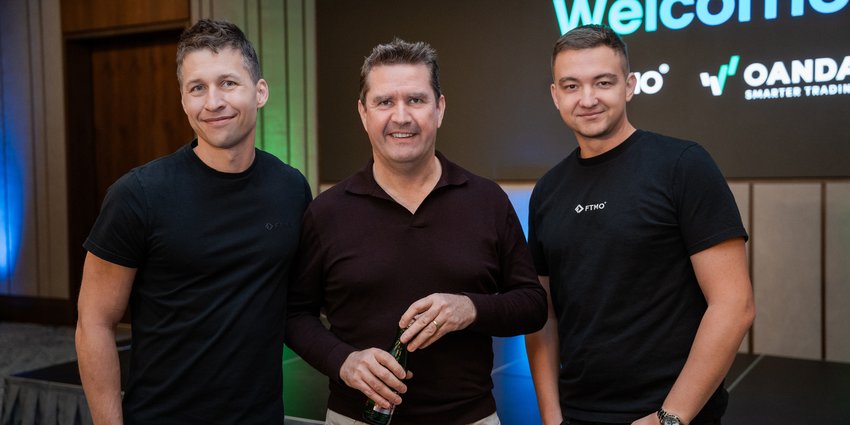
CVC acquired OANDA in 2018. On December 1, 2025, FTMO completed its purchase from CVC following approvals from five regulators. The price was undisclosed. FTMO said it intended to keep OANDA standalone while combining its own simulated prop-trading business with a group offering live brokerage. The attraction included OANDA’s licenses and experience operating across regulated markets.
Then the portfolio changed. In March 2026, OANDA announced that its Prop Trader business would transition into FTMO, freeing OANDA to refocus on brokerage. Clients were offered migration incentives or refunds where applicable. The dashboard became inactive on April 30. The acquisition supplied a clear reason to move that product to a specialist operation within the new parent.
06 /Make the number useful
The practical lesson: start with a recurring question, make the answer easy to obtain, then build around what people actually do next. OANDA’s currency information leads naturally to two tasks, trading and financial recordkeeping. Each demands its own product, pricing and controls.
The limits follow from the same logic. A finance team needing a particular benchmark must verify the dataset. A programmer needs an eligible account and supported API. A trader needs to understand costs, leverage and local rules. OANDA makes currency markets easier to access and currency information easier to use. Neither achievement removes the need for judgment.