Ten months is a long time to spend building something before a colleague tells you it is unusable. Nozomu Tsunoda had been developing an editor for legal contracts, with spelling corrections and a place to collect comments. His co-founder, Masataka Ogasawara, tried the beta. “This is unusable,” came the verdict. A lawyer might have appreciated a more elaborate opinion. This one was sufficient.
The problem was embarrassingly practical. Lawyers already worked in Microsoft Word. The new editor could neither match that familiar experience nor offer compatibility with it. Tsunoda later acknowledged that he should have spotted the difficulty sooner. The investment of time did not make the product useful. His partner’s refusal helped the company change direction.
Today, Tsunoda is co-founder and Group CEO of LegalOn Technologies. His career has carried him from corporate law into software, international expansion and, unexpectedly, writing manga. Yet the discarded editor remains a useful place to begin. It puts a specific decision ahead of the funding announcements: he accepted that the thing he had built needed to be replaced.
The first product review“This is unusable.”
Masataka Ogasawara, as recalled by Tsunoda
A lawyer looks up from the documents
Tsunoda graduated from Kyoto University’s Faculty of Law in 2010. He passed Japan’s old bar examination that year, placing first nationally in its written component. He registered as a lawyer in 2012 and joined Mori Hamada & Matsumoto in 2013. His work included mergers and acquisitions, disputes and corporate governance. He had learned the profession from inside its documents.
That training matters to the story. A contract review asks someone to read carefully, identify what could go wrong and express the consequences precisely. The task combines judgment with a substantial amount of repeated checking. Tsunoda had encountered both parts. His later business would depend on understanding where one ended and the other began.
He has recalled reviewing M&A documents until three or four in the morning, making mistakes and being corrected by senior lawyers. Then AlphaGo supplied an arresting example of what AI could do. If a machine could master Go, he wondered, could the same technological progress help with the painstaking document work in front of him? That question gave his dissatisfaction a direction.
Two ventures, one practical problem
In March 2017, Tsunoda and Ogasawara opened the law firm ZeLo. In April they established LegalForce, the company later renamed LegalOn Technologies. They wanted a business devoted to developing technology alongside their legal practice. The sequence is revealing: the professional problem came first, and the corporate vehicle followed.
Neither founder arrived with a ready-made engineering organization. In the first year, legal fees from ZeLo and personal borrowing helped pay staff. Product development, recruiting and fundraising all had to advance while money was being spent. The freedom to start a company came with a rather demanding list of invoices.
The initial product had to be abandoned. A narrower beta concentrated on automatic contract review and search; the formal LegalForce release followed in April 2019. Narrowing the assignment made the proposition easier to grasp. A legal department could examine the software against a task it already understood, rather than learn an entirely new way to write.
- Kyoto University law graduate; first in the old bar exam’s written component
- Joins Mori Hamada & Matsumoto
- March: ZeLo. April: LegalForce.
- Formal release of the contract review product
- LegalOn Cloud broadens the brief
Recruit the knowledge you do not have
Building that proposition required people who knew things the founders did not. Engineer Yuta Tokitake became an important early connection. Natural language processing research at Kyoto University, including work with Professor Shinsuke Mori, helped connect the company to technical expertise. Tsunoda has described the service’s development as the result of fortunate human connections.
The university relationship carried practical consequences beyond an academic affiliation. Kyoto University Innovation Capital invested in the seed round in 2018. Mori’s standing helped the young company talk to prospective AI recruits, and joint research provided a place to discuss how language-processing methods might solve concrete legal problems. For a lawyer hiring engineers, those introductions had real value.
The work also demanded legal expertise inside development. Lawyers prepared suggested language and worked with the product team, while ZeLo contributed practical knowledge and contract materials. Tsunoda’s original experience was useful because it could be translated into repeatable assistance. A model’s ability to process language still needed a clear account of what a legal professional wanted checked.
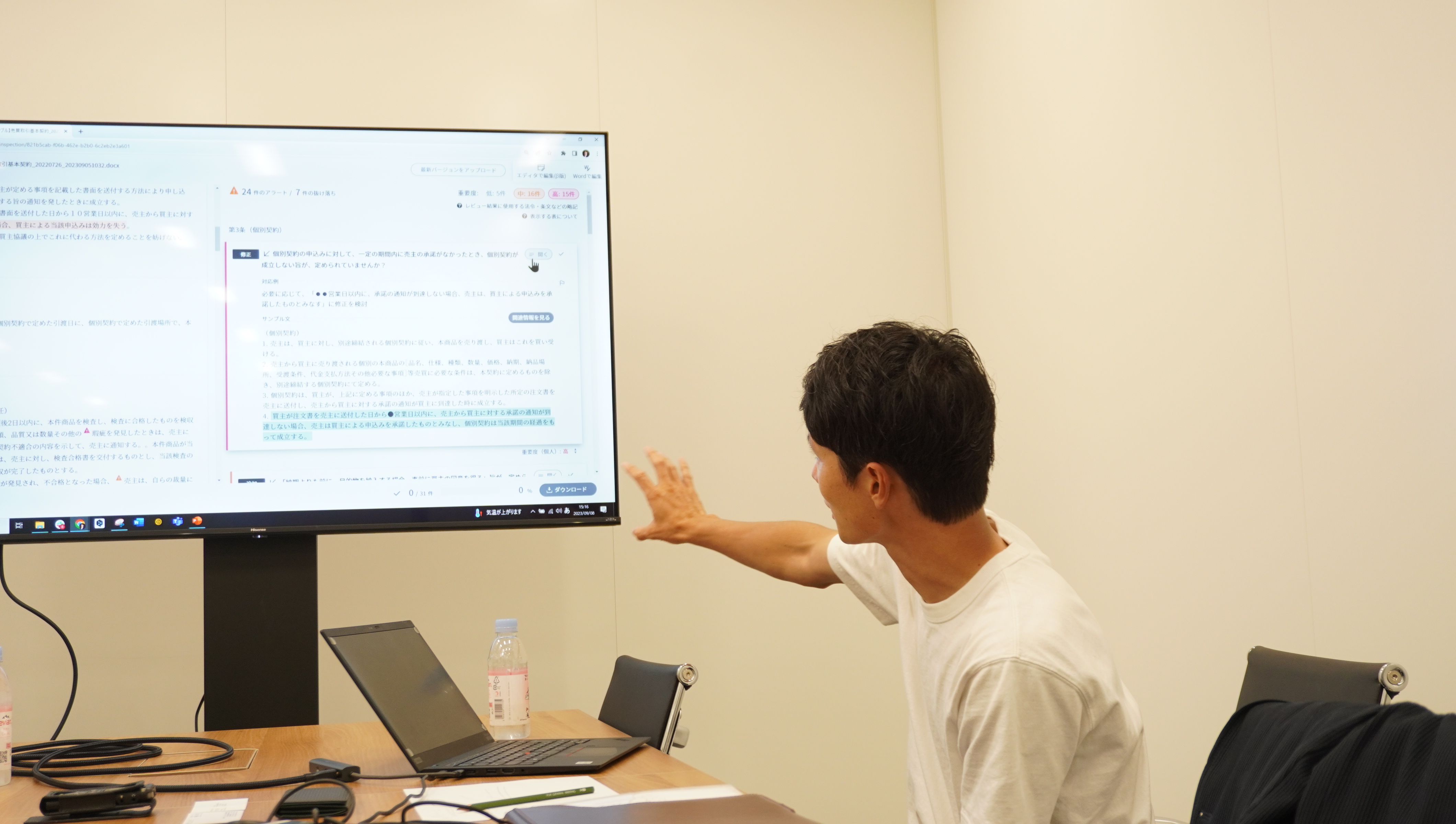
The sales pitch had a dress code
A useful product still needed an audience willing to try it. In a 2021 interview, Tsunoda described a distinction between the company’s internal culture and its outward presentation. Inside, the emphasis was on performance rather than formal clothes. Selling to conservative lawyers called for polished, articulate representatives. A T-shirt could apparently make an otherwise promising demonstration work rather harder.
The observation is funny because it is so specific. It also shows how closely he watched the customer. Familiarity, presentation and professional expectations formed part of the buying decision. An engineer could solve the technical problem while a sales team still had to make the proposed change feel credible to someone responsible for a contract.
He drew a similar connection between product development and legal practice: both require an independent view while remaining on the customer’s side. Listening involves more than transcribing requests. A client may describe a symptom, or ask for a familiar solution. The professional’s job includes working out what the underlying task requires. By January 2021, the company reported more than 700 customers.
“My goal was to find ways to use technology to support legal services.”
Nozomu Tsunoda, 2021
Success needed another rewrite
The editor was not the last occasion for reconsideration. By the end of 2022, Tsunoda felt the company’s growth slowing. He brought product leader Masahito Taniguchi into a two-day discussion with sales managers to identify the problems. Generative AI was emerging at the same time. An established product now faced a reason to rethink its own assumptions.
The subsequent planning went well beyond a new feature list. The team surveyed 3,000 respondents and interviewed between 30 and 40 companies. Taniguchi recalled a mind map large enough, if printed, to cover a six-tatami room. More than 200 product requirements documents followed. There are economical ways to decorate an office; this was a particularly laborious one.
The resulting platform, launched in 2024 as LegalOn Cloud, broadened the work beyond individual reviews. Tsunoda’s account of the effort includes uncertainty about whether it would succeed and respect for how explicitly the team had defined the work. The episode echoes the first pivot at a different scale: customer evidence had to earn its place ahead of attachment to the existing product.
Tokyo was the beginning of the map
The international chapter had already begun. In December 2022, LegalOn announced its expansion into the United States and appointed Daniel Lewis as US CEO. Lewis had founded Ravel Law and worked at LexisNexis. Tsunoda was bringing in another leader with experience suited to a part of the business that now needed building.
In July 2025, the company announced a $50 million Series E led by Growth Equity at Goldman Sachs Alternatives. Its former law firm, Mori Hamada, also participated. The employer Tsunoda had left had become an investor in the company he co-founded. The announcement put total funding at $200 million and described collaboration with OpenAI on legal AI.
The customer count moved from more than 7,000 in that July announcement to more than 9,000 in August 2026. These are company-reported milestones, rather than a measure of any individual’s contribution. They do show how far the assignment had travelled from the abandoned editor. Tsunoda’s current Group CEO role sits alongside Lewis’s Global CEO role, reflecting the wider organization the founders now have to run.
July 2025
August 2026
Company-reported milestones. Funding and customer counts describe the company, not personal wealth.

An AI executive picks up a pencil
Then there is the manga. Tsunoda is credited with the original story for Entrepreneur, a series set in Tokyo in 2027. Its university-student protagonist encounters a world of competing founders and AI partners modelled on the thinking of historical business figures. Tsunoda describes its themes as decision-making and a future in which people work with AI.
His account of learning to draw begins with copy paper and a pencil. Inspired by Hirohiko Araki’s book on manga technique, he tried character designs, discovered the difficulty of poses and bought roughly ¥100,000 worth of books. An iPad and CLIP STUDIO PAINT followed. The executive advocating advanced AI applications had first equipped himself like an unusually well-funded beginner.
He experimented with AI imagery too, but found the results generic and character consistency difficult. The detail gives his enthusiasm some texture. He was willing to test the tools and still describe where they disappointed him. Writing fiction also lets him return to the question behind his business in a different form: what happens when people make consequential decisions with a machine beside them?
There are fish beyond the spreadsheets
Tsunoda is from Tokushima Prefecture and enjoys fishing. During a Singapore business trip in his law-firm years, he used time off to travel by boat to Indonesia and fish there. He has also described annual holidays on Hachijojima, with the day’s catch becoming an evening barbecue. The itinerary has the pleasing virtue of supplying its own dinner.
Those recollections belong beside the corporate milestones because they preserve a person in a profile that could easily become a sequence of financing rounds. Boats, tackle and an island barbecue give the reader something more tangible. They also leave room for a pursuit whose outcome arrives on the end of a line, rather than in a quarterly presentation.
The next draft is already under way
By September 2026, Tsunoda was describing a broader ambition: AI-driven management across legal work, governance, sales, HR and other business functions. The group company On Technologies, established in October 2025, provides a vehicle for products beyond LegalOn’s legal focus. He presented the wider operating model as work still to be demonstrated, with his own organization serving as a testing ground.
He also acknowledged that serving thousands of companies had not given him absolute confidence in the product. It still needed improvement, and a changing environment could expose complacency. That is a useful admission from someone selling tools intended to make professional work more dependable. Experience had increased his confidence in handling problems, he said, while leaving plenty of problems to handle.
On October 11, 2026, he appeared on CLUB CEO to discuss law in the AI era with younger participants. The subject remains close to the one he encountered as an associate looking through documents late at night. The scale has changed; the need to decide what deserves human attention persists. Somewhere between the contract, the product plan and the manga page, Tsunoda keeps finding another draft to work on.
Follow the next draft
Profiles, conversations & further reading
- LegalOn Technologies
- Tsunoda at ZeLo
- X / @Tsunoda_LegalOn
- Wantedly
- Entrepreneur: the manga
- His manga-making journal
- The early product story
- The 2023 conversation
- On sales and customers, 2021
- Rethinking the product
- Fishing and the founding years
- His 2026 outlook
- AI-driven management, September 2026
- Series E announcement
- 9,000-customer milestone
- Listen: CLUB CEO, October 2026
- Watch: CIC LIVE on YouTube (Japanese)
- Watch: Legal 500 conversation