Nicholas Tommarello’s first reaction to equity crowdfunding was to think it sounded idiotic. In November 2011, his friend Nick Plante told him about legislation moving through Congress. Tommarello pictured a marketplace full of dubious investments, inexperienced buyers and founders trying to manage a crowd of shareholders. He could see the mess before he could see the business. Then the idea refused to leave him alone.
There was an awkward flaw in his objection: he wanted the thing to exist. He wanted to put small amounts into startups he cared about, to help someone attempt something difficult and own a little piece of the result. The founding account he later published preserves both impulses. It is an unusually useful beginning for a financial company: enthusiasm arriving only after suspicion had pulled up a chair.
That conflict gives the story its shape. Opening an investment market requires believing in people you have never met. Running that market requires considering what those people might get wrong. Tommarello had imagined both sides before he built Wefunder. The small check was attractive precisely because it was small. Someone could help a founder without pretending to be a venture capitalist. The question was how to make that ordinary act possible, and how much machinery would have to surround it.
A founder among founders
Before Wefunder, Tommarello had already been building things and gathering other builders around him. He worked at Urban Interactive and founded Startup Workaway. A biography describes the latter as ten-day work retreats with about twenty other founders in mansions. The setting sounds like a holiday; the presence of twenty startup founders suggests the conversation was unlikely to stay off work for long.
He had an MBA from Babson College, but the degree did not settle his view of how entrepreneurs learn. In 2012, he argued that coworking and accelerators were more useful for building a network than an MBA program. His own accelerator history includes Techstars Boston in 2010 and, later, Y Combinator’s Winter 2013 batch. The recurring unit in this career is a group of people trying to get something started.
Wefunder fits that history. A founder’s friends can be close enough to understand an ambition and still far from the networks that finance it. Tommarello knew that gap from the inside. His professional life supplied the people he wanted to back; securities rules supplied the reason he could not simply write the checks.
Congress was the quick part
By January 2012, the project had outrun the law. An early account of Wefunder’s development described Tommarello and Plante building a platform while legislation was still being debated. The site’s invitation-only beta was restricted to accredited investors. Tommarello was thinking about selectivity, too: feature a limited number of startups, with an experienced investor involved before the crowd followed.
He and friends went to Washington to help push the legislation forward. Barack Obama signed the JOBS Act in April 2012. For a software founder, a presidential signature might have looked rather like the green light at the end of a deployment process. It was closer to permission to begin waiting.
Tommarello later recalled expecting a launch about nine months away. The rules enabling Regulation Crowdfunding took another four years. In his 2021 conversation with Mercury, he described the next stretch, through further reform, as “a grueling eight-year wait.” A startup can change its product on Tuesday. The environment that decides whether the product may operate does not necessarily share that calendar.
He stayed involved in the details. A January 2014 submission to the SEC argued for crowdfunding rules that could attract quality startups. This was patient, technical work sitting behind the appealing public promise. A usable market would depend on the terms of participation as much as the existence of a website. There is little romance in a comment letter, but sometimes that is where a founder has to put the ambition.
- 2012JOBS Act signed
- 2013Y Combinator W13
- 2016Reg CF goes live
- 2021$5m annual raise limit
Milestones in the market Tommarello helped build.
The office before the opening
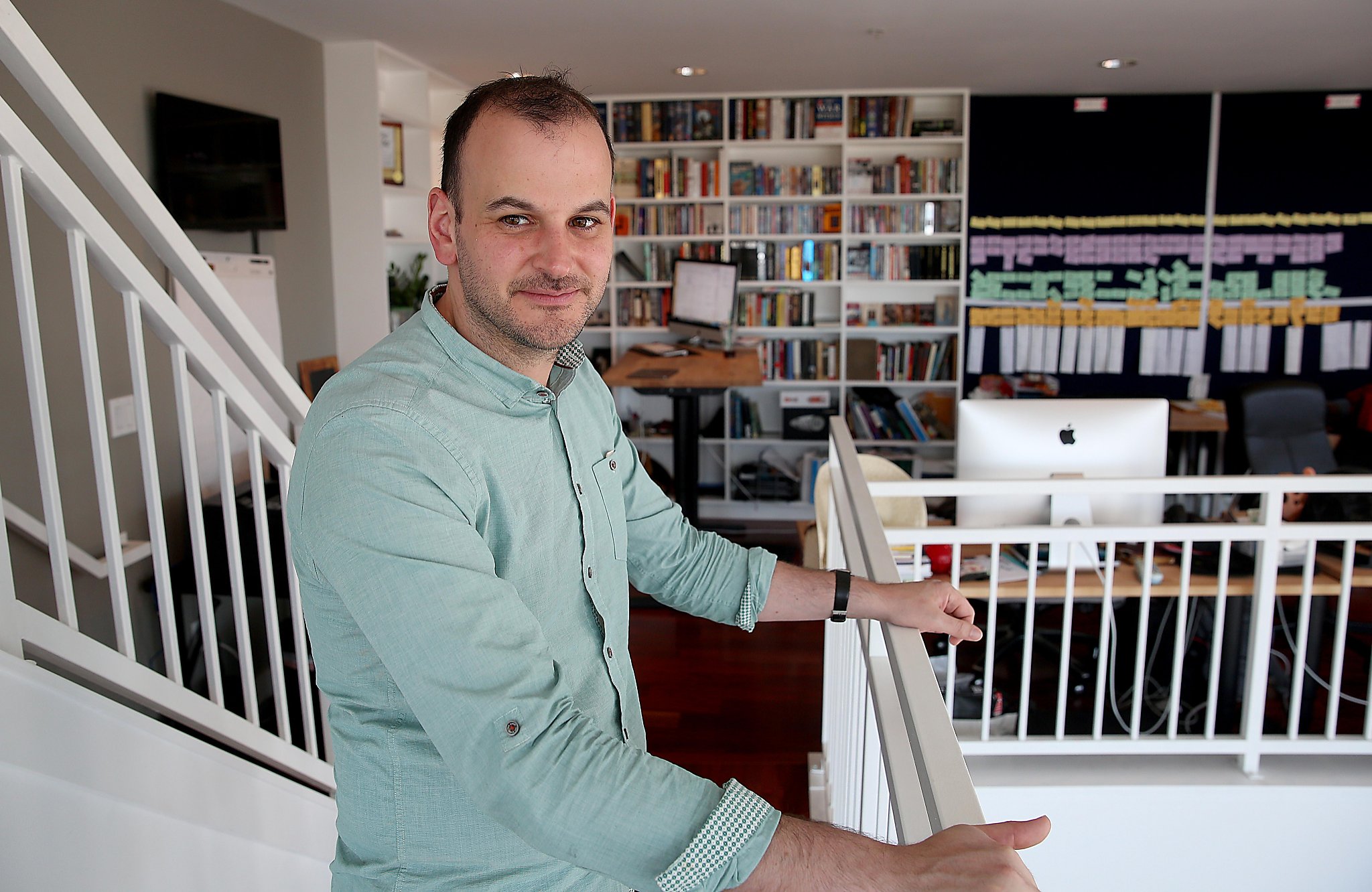
A photograph from May 12, 2016 catches Tommarello at his San Francisco home office, four days before the new rules went live. He rests a hand on a white railing. Behind him are books, computers and a board crowded with colored notes. The scene has the familiar tidiness of an office that has discovered sticky notes are cheaper than certainty.
Once the market opened, he resisted the idea that it should instantly become enormous. In July 2016, he reported about $3.5 million in Regulation Crowdfunding investments processed during Wefunder’s first two months. He expected awareness and comfort to build gradually. The early explanation of how the team found companies was pleasingly unglamorous: face-to-face meetings with founders. An online market still began with people meeting people.
Making room for the customers
The 2021 reforms changed the scale of what companies could attempt. The annual Regulation Crowdfunding fundraising limit rose from roughly $1 million to $5 million, and changes made it easier to pool crowd investors on the capitalization table. Tommarello’s argument was that companies with other funding options could now invite customers and supporters to invest alongside their established backers. The March 2021 change gave that argument more room.
The appeal is easy to recognize without dressing it up. Customers already spend money, attention and reputation on companies they like. Ownership adds another relationship. For the founder, inviting those people into a financing round means treating their attachment as something with economic weight. Tommarello’s work sits in that passage between liking a business and holding an investment in it. Those are different commitments, even when they begin with the same enthusiasm.
Annual company fundraising limit under Regulation Crowdfunding. A legal ceiling, not a return.
The first person to believe
In April 2025, Tommarello revisited his thoughts about XX, Wefunder’s program for very early founders that ran from 2018 to 2021. His original 2018 reflections put particular weight on the first money into a company. Experienced founders and operators could contribute judgment as well as capital. He wanted more businesses to exist because someone had helped their founders begin.
This is the part of the mission where the arithmetic becomes personal. A check can pay for work. It can also tell a founder that someone else thinks the work deserves doing. For Tommarello, the memory of that first believer can outlast the transaction. He was describing a relationship whose importance may survive the investment itself.
In his Smart Humans conversation, he connected that impulse to angels who had backed him early. Their help had shaped his own progress, and he wanted to pass it forward. He described his motivation as developing beyond investment access toward creating more angel investors. The ambition had become a question of multiplication: how many people might learn to offer the help he remembered receiving?
“Everyone remembers the first person who believes in them.”Nick Tommarello · reflections on XX
A small rebellion against the rulebook
After years working inside a regulated business, Tommarello turned his attention to how Wefunder itself makes decisions. His December 2024 essay Principles Over Rules argues that an organization can accumulate instructions until its people lose the room to exercise judgment. He remembers an eight-person startup sharing one table, where lessons traveled immediately. A larger team needs a deliberate way to share that understanding.
The companion essay offers a wonderfully particular solution. Employees would write short lessons; each role would have a collection organized around a few memorable principles. Someone would maintain it, and the team would periodically remove material. He called that pruning “The Culling.” Even an opponent of bureaucracy, it turns out, may enjoy inventing a departmental title.
The joke belongs to him. In his proposal for an intuition-building machine, Tommarello admits to creating bureaucratic jargon because he finds it amusing. Beneath the vocabulary is a practical demand: experience should become available to the next person who needs it. The system is supposed to improve judgment through concise examples and discussion, rather than leave every employee alone with a thick instruction manual.
His next essay takes the same concern into government. He describes a disagreement with FINRA about displaying the combined amount raised under different securities exemptions, explaining why he believed the fuller figure mattered to investors. It is his account of the dispute, and his argument for giving officials more discretion alongside more accountability. The founder who wanted a law changed had become the operator living inside its interpretation.
The business moves; the question remains
Tommarello remains Wefunder’s founder and CEO. His public activity includes a May 2026 update titled Investor Update: We Launched Syndicates, Funds, and SPVs. Wefunder’s current company presentation also describes an expanding venture-investing business for accredited investors. The platform that began with the small investor now serves several kinds of private-market participation.
That presentation reports more than $1 billion directed into companies through its Regulation Crowdfunding business. It also says its Regulation D business is its largest growth engine. These are company reports about the business, rather than measures of Tommarello’s personal wealth. They show an operator widening the company’s activities while continuing to describe community rounds as part of its core.
There is a useful tension here. Building a lasting company means following demand, and demand does not arrive neatly arranged around an origin story. His early question was who gets to participate. As Wefunder expands, that question becomes worth asking again, with each new product and each new category of investor.
His public biography lists climbing mountains among his interests. It is a tempting metaphor, but the office photograph tells this story better: a person beside a railing, with years of work visible behind him. The idea had been simple enough to fit inside a small check. Making it usable took a trip to Washington, a long wait and a willingness to keep dealing with the details. Somewhere in those details is another founder who gets to begin.
Keep the conversation going
Read Tommarello’s essays, visit Wefunder, or find him on LinkedIn, X, Facebook and Medium.
Further reading: Series Tea conversation · Wefunder’s early days · The first months of Reg CF.