On the eighth attempt, Narayana Aaditya Ganeshkumar got into Y Combinator. By then, he and his co-founder Nishant Joshi had accumulated plenty of practice at applying. The seventh attempt brought a top-10-percent email. Before that, he recalled, there had been silence. A startup application can be a remarkably efficient writing workshop: the tuition is disappointment, and the reader seldom leaves helpful notes.
The useful change, in his telling, was specificity. Skillsync had been a recruiting platform with an expansive proposition: it could help hire anyone. The founders narrowed their attention to open-source engineers in demanding fields, including flight control systems and computer vision. Suddenly, they had a clearer customer and a problem they could describe without opening every door in the building.
Today, Skillsync has moved to a different problem: finding and carrying forward the work inside AI conversations. The change makes an interesting question of its founder. How does someone travel from hiring engineers to moving chats between agents? Follow Aaditya's public work, and a recurring concern appears: the effort that produces a result often disappears behind the result itself. He wants people to be able to see it, understand it and use it again.
The people inside the system
Aaditya's education crossed two kinds of systems. He studied instrumentation and control engineering at the National Institute of Technology, Tiruchirappalli, from 2014 to 2018, then human resource management at XLRI Jamshedpur from 2018 to 2020. His career included consulting at Deloitte and product work at Juspay. Machines, organizations and the people trying to operate both were all within reach.
In 2021, he and Dhrumeel Dutia created the Ideal Gas newsletter. Its premise was refreshingly recognizable to anyone who has ever received an instruction to be more proactive: workplaces supply hours of practice, but their rules can remain fuzzy. The newsletter addressed culture, organizational design, change and psychology, promising practical help with questions people might hesitate to ask aloud.
The name supplied some levity. The subject supplied the friction. An organization can have a chart, a handbook and an enthusiastic induction presentation while leaving a newcomer to discover the actual rules by trial and error. Ideal Gas tried to make those rules discussable. It put the mechanics of working together on the page, rather than leaving them in the category of things everyone supposedly already understands.
That is an early expression of a concern that would recur in his products. Work contains knowledge that its official records capture poorly. A job title tells you something about a person. So does watching how they solve a problem. The second description takes more attention, and can be much harder to file.
At the checkout, small things count
His payments writing brought that attention to a different setting. In April 2023, Aaditya wrote about payment orchestration: the difficulty of coordinating an expanding choice of payment methods and processors. More options create decisions about routing, conversion, cost and control. A business accepting money online needs those options to cooperate, which is considerably less glamorous than announcing that they exist.
In July, he examined checkout experiences that had made him abandon purchases. He organized the exercise around the presentation of payment methods, user inputs, copywriting and navigation. The title, “Why I won't pay on your website,” was admirably free of diplomatic padding. The article looked at the moments when a customer's intention encounters an interface and quietly gives up.
Both pieces attend to the gap between having a capability and making it usable. Accepting a payment is an achievement; helping someone finish paying is another concern entirely. It is a useful distinction for a product founder. A feature can look complete from the side of the person building it while remaining troublesome from the side of the person who has to use it.
During his work around Hyperswitch, Juspay's open-source payments project, Aaditya also collaborated with Joshi on an essay called “The Inverse Conway Maneuver.” Published in the project's GitHub wiki in June 2023, it examined the relationship between architecture and communication. Its opening example concerned the layout of Britain's parliamentary chamber, an unexpectedly literal way into a discussion about software teams.
The essay considered how structures shape the conversations people have, and how patterns of communication shape the systems they build. Read alongside Ideal Gas, it shows Aaditya returning to organizations as designed environments. The room, the reporting line and the software boundary all influence who can hear whom. Even very clever people have to work through the arrangements around them.
“Software is a team sport.”
Narayana Aaditya Ganeshkumar
A repository is full of people
Skillsync's earlier product approached engineering through the evidence people leave while doing it. Its Product Hunt launch described reading pull requests, reviews and comments to build a living map of skills. Contributions could reveal domain expertise and successful patterns that a team might otherwise overlook. Aaditya's interest extended beyond counting commits to the way contributors approached their work.
When Product Hunt founder Ryan Hoover asked how the product distinguished good, average and great engineers, Aaditya resisted assigning people a proficiency score. He described contributors with different inclinations: some enjoy urgent fixes, others research or creative work. The aim was to understand those differences and help people work with their strengths. A leaderboard would have been easier to explain. He chose a more complicated conversation.
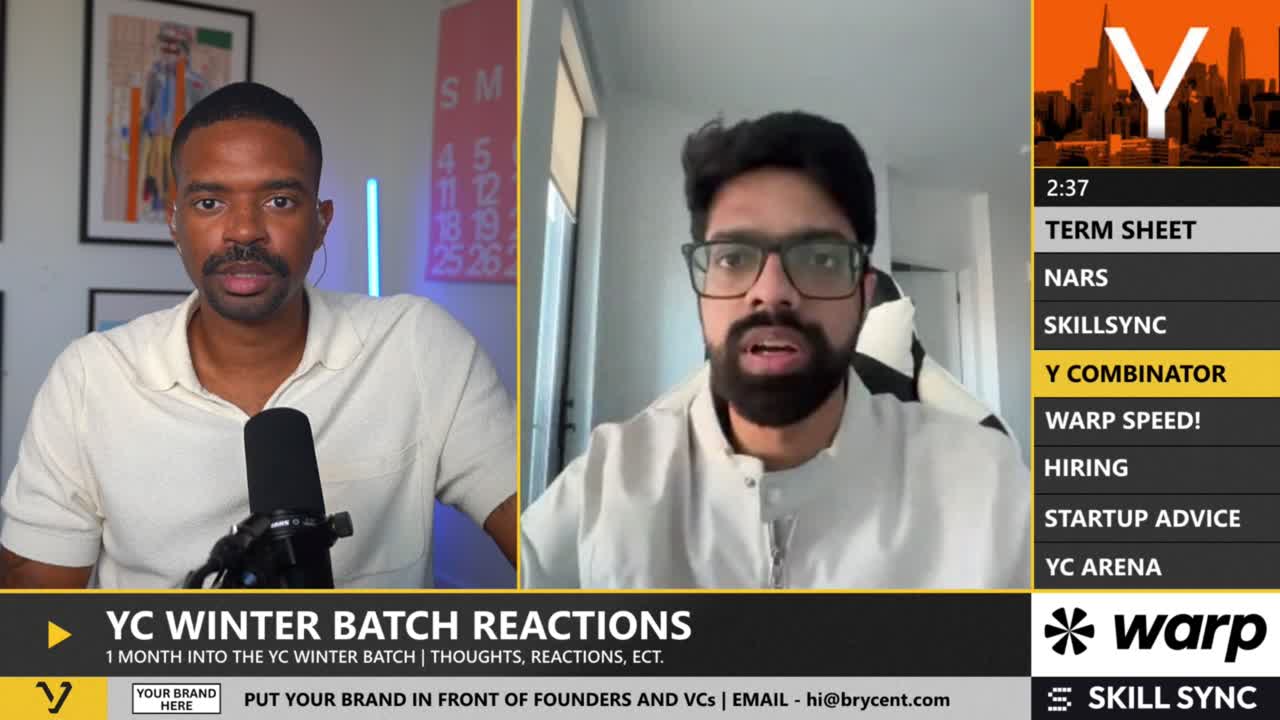
That emphasis also appeared in his interview with Bryce Johnson. Aaditya criticized hiring processes that fail to understand someone's actual work. He described the peculiar circuit of AI-written résumés and biographies being processed by AI screening and interviews. Automation can make a process move faster without improving the human understanding at its center. His concern was what happened to the person whose abilities the process was meant to discover.
In another part of the conversation, he compared engineers publishing work with creators making content around their interests. An engineer's specialized project could become something to be consulted on or hired for. The interesting possibility was the freedom to pursue a niche and still become legible to someone who needed precisely that capability. Fame was a poor substitute for fit.
Experiments with the invisible part
In May 2025, Aaditya shared Prompt Inspector, a prototype inspired by browser developer tools. The team had been using language models to analyze GitHub repositories, and their prompts were becoming longer and harder to understand. Which instruction had affected which part of the answer? Changing random lines and hoping was an unsatisfying debugging method, however traditional that method might be.
The prototype placed a prompt beside its output and let someone select output to highlight a possible prompt influence. Aaditya was explicit that this version used another language-model check to make the mapping, with more rigorous attribution approaches under exploration. That qualification matters. A helpful view into a process still needs an honest account of what it can establish.
In September 2025, he wrote about GitHub Aura, an app for turning coding activity into shareable session summaries. He compared sharing programming sessions with runners sharing workouts. Languages, commits and time spent could appear in a visual record. Here was a lighter version of the same concern: hours of effort produce traces that other people might appreciate, if somebody gives those traces a form they can read.
These experiments did different jobs. One tried to inspect how instructions influenced an answer; the other tried to give coding effort a shareable shape. Together they add texture to the founder behind Skillsync. He has repeatedly built around the activity surrounding an output, where explanations, recognition and useful knowledge are liable to fall through the cracks.
Two founders in the same session
By June 2026, Aaditya was writing about a more immediate kind of collaboration. In “The jazzification of building software,” he used a band as his model: players respond to one another while the music is happening. Software teams, he argued, often separate after planning and discover one another's decisions later, through tickets and pull requests. The interaction arrives after the opportunity to shape the idea together.
He grounded the argument in his work with Joshi. When faced with something difficult, they would enter the same session and work through it live. Joshi could take an approach Aaditya had not considered; seeing it develop could show Aaditya that an entire flow could be removed. The observation is personal and specific: being present changed what they were able to build.
He called their proposed shared-session experience Campfire. The name suited his account of people gathering around a piece of work, seeing an approach take shape and joining before it hardened into a handoff. His aspiration was for small, opinionated teams to develop their own way of building together. Taste, in this account, needs a place to be exercised with other people.
The conversation goes with you
Skillsync's current product gives AI conversations a place to accumulate and a way to travel. Its desktop app is presented as local-first, with sessions searchable across tools and transferable between agents such as Claude Code, Cursor and Codex. The founders describe their aim as preserving the conversation and tool history alongside the work. Their open-source Rust engine, txcript, handles translation between session formats.
That makes the company's present task easy to picture. Someone changes tools and wants the discussion to come along. A teammate revisits a decision and wants its explanation. The ambition is that changing an agent, or returning to an old project, should require less reconstruction of what has already been figured out. The company's claim is a product promise, with implementation available for inspection in its engine.
Aaditya's path gives that promise a human setting. He has written about unclear workplace rules, examined obstructive checkouts, asked how engineering contribution becomes visible, and described the pleasure of building beside his co-founder. Those subjects place people at the points where systems fail to communicate. His current bet is that a conversation can remain useful after the window closes. Anyone who has ever said “we already worked this out” will understand the appeal.