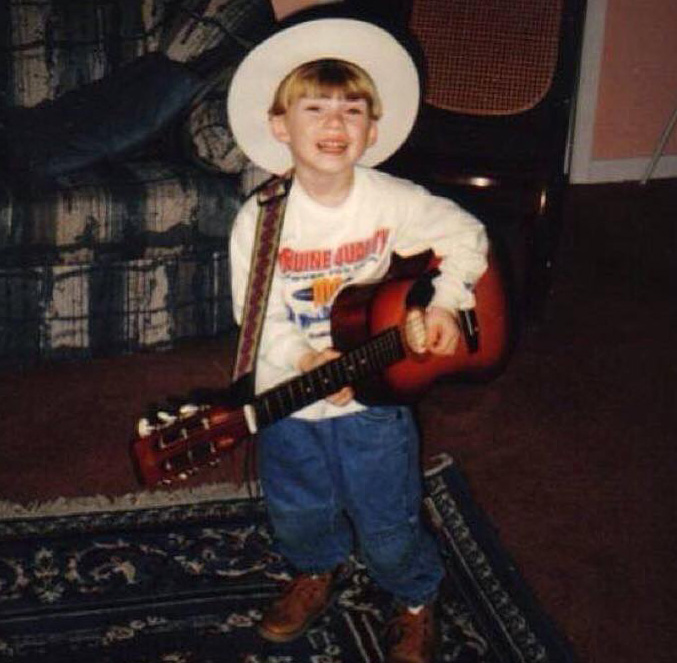
The child in the photograph is wearing a white cowboy hat and holding a sunburst guitar that appears to have been built for somebody twice his size. His grin suggests the proportions are perfectly sensible. Long before Morgan Wallen became a country singer with a stadium-sized audience, he was a boy in East Tennessee whose days moved between music and sport. He sang at his father’s church from age three, working out three-part harmonies with his younger sisters. At five he asked for a violin. At seven came piano. Then baseball grew louder.
Baseball supplied the schedule and the obsession. Wallen played for thirteen years and became a shortstop and pitcher at Gibbs High School near Knoxville. Music did not disappear; it waited at home in his parents’ record collections and in the muscle memory of church harmony. His father liked classic rock. His mother listened to country and contemporary Christian music. Wallen absorbed all three, then added the hip-hop that mattered to a teenager coming of age in the 2000s. The mixture would eventually become his commercial dialect: country at the root, other genres drifting through the branches.
The second plan began on a bedroom wall
When baseball ceased to be his future, Wallen did not step smoothly into a waiting music career. He had a blank space where the plan used to be. Songwriting filled it. He bought guitar chord charts at Walmart, taped them to his bedroom wall and taught himself to play. At eighteen he wrote his first song. What began as a way to put feelings somewhere soon acquired the discipline of the sport he had left behind: repetition, adjustment, another attempt.
His mother supplied the next interruption. She signed her twenty-year-old son up for season six of The Voice in 2014. Wallen sang Howie Day’s “Collide,” joined Usher’s team, moved to Adam Levine’s and left during the playoffs. The show did not hand him a career. It did something more practical: it put him in rooms with musicians, revealed how much he did not yet know and gave him a public starting point from which to change.
Sings in church at three and learns family harmonies.
Music returns to the foreground; guitar and songwriting follow.
The Voice introduces his rasp to a national television audience.
A move to Nashville and a deal with Big Loud turn possibility into work.
Nashville offered a less glamorous education. Wallen moved there in 2015, signed with Big Loud and entered the writing-room economy, where a useful line has to survive several opinions before lunch. His early collaborators included Craig Wiseman, Rodney Clawson and the Warren Brothers. Producer Joey Moi helped frame Wallen’s sanded rasp with drums and textures that could sit on country radio while sounding natural in a streaming playlist. The accent stayed conspicuously East Tennessee. That was not a flaw to correct. It was the address on the envelope.
The voice itself carries two useful opposites. It can sound worn even when the melody is bright, and tender even when the lyric is behaving badly. That tension gives Wallen’s memorable recordings their aftertaste. He is rarely singing from the clean side of a decision. The songs tend to arrive after the call, after the last round, after pride has made an expensive purchase. Country music has always kept a chair for regret; Wallen drags it close to the microphone. His phrasing also owes something to music beyond country. Consonants land like percussion, verses clip forward and choruses open wide. A listener does not need to study the arrangement to feel the gears shifting. The technique hides inside the drawl.
“I lived country music more than I listened to it, if that makes sense.”Morgan Wallen, on growing up in East Tennessee
A local voice discovers enormous rooms
If I Know Me, released in 2018, established the pattern. “Up Down,” with Florida Georgia Line, gave him a radio foothold; “Whiskey Glasses” turned regret into a chorus roomy enough for a bar full of strangers. The record climbed slowly, reaching No. 1 on the country album chart long after release. Wallen was learning that a song’s opening weekend mattered less than whether people returned on an ordinary Tuesday.
That lesson became the architecture of Dangerous: The Double Album in 2021. Thirty tracks allowed several versions of Wallen to occupy the same house: the rowdy host, the wounded ex, the small-town nostalgist and the singer testing pop and R&B edges. The album spent its first ten weeks atop the Billboard 200 and later won ACM Album of the Year. Its scale looked extravagant until listeners treated the track list as an invitation rather than a burden.
The public record also contains conduct that cannot be filed under chart trivia. In 2021, a video showed Wallen using a racist slur. Radio networks pulled his songs and his label suspended him; Wallen apologized and said he was wrong. In 2024, after throwing a chair from a Nashville rooftop, he pleaded guilty to two misdemeanor counts of reckless endangerment. These episodes sit beside the success, not outside it. Popularity can measure attention. It cannot perform accountability on anyone’s behalf.
The abundance is the strategy
One Thing at a Time arrived in 2023 with thirty-six songs, a title that displayed a fine sense of mischief. “Last Night” became Wallen’s first solo Hot 100 No. 1. The album led the Billboard 200 for sixteen consecutive weeks in 2023, returned for three more in 2024 and carried his concerts into stadiums. The One Night at a Time tour drew 3,107,695 people across eighty-seven shows, ten countries and three continents.
A stadium changes the physics of a country song. The private detail has to cross a football field; the pause before a chorus has to hold tens of thousands of people who already know what comes next. Wallen’s catalogue was prepared for that conversion. The verses offer enough specificity for headphones, while the hooks use short words and broad vowels made for collective noise. The shows also reveal how streaming scale becomes human scale. A number on a chart is abstract. A crowd finishing a lyric in another country is not. For an artist whose earliest performances happened in a small church, that distance is both geographical and oddly circular: another room full of people singing together, only now the ceiling is open.
Wallen’s records suit the streaming age because they behave like places rather than pronouncements. A long track list gives the casual listener many doors. The production moves easily between acoustic confession, arena country and clipped pop rhythm. Familiar songwriters recur, which keeps the language coherent even when the cast expands. He does not need every listener to love every song. He needs enough songs to become somebody’s particular one.
His collaborations widen that place without changing its center. Post Malone’s “I Had Some Help” put two drawling voices over a brisk pop-country engine and debuted at No. 1. “What I Want,” a duet with Tate McRae, did the same in 2025. On I’m the Problem, Wallen co-wrote twenty-two of thirty-seven tracks and worked within a much larger community of writers. The album opened with 493,000 equivalent units, and in a single week thirty-seven Wallen songs occupied the Hot 100. Six sat in the top ten. Big numbers often become wallpaper; here they describe a catalogue arriving as a crowd.
The long game returns to the ball field
One revealing thing Wallen said early in his career was not a prediction about stardom. Awards, he explained, were not what lit his fire. He wanted to stick around, to make music for as long as he wanted. Longevity is a plain ambition and an exacting one. It asks for songs after the novelty has gone, for a reason to return when the haircut changes and the first clever headline is spent.
His foundation makes that long view tangible. Created in 2021, the Morgan Wallen Foundation supports youth access to sports and music, the two structures that organized his own childhood. It has helped restore ball fields, supplied equipment and instruments, supported music programs and responded when communities faced crisis. A portion of every tour ticket goes to the work. The logic is unusually clean: return access to the kinds of rooms and fields that first gave you somewhere to practice.
In 2026, Wallen completed the twenty-three-stadium Still the Problem tour and released “Been By Now,” a standalone single first played live in Baltimore. The title carries a familiar Wallen tension: the clock says one thing, the person says another. At thirty-three, with four studio albums behind him, he occupies a peculiar position. He is an established institution whose preferred subject remains the unfinished self.
“I just want to be able to stick around as long as I want to, and to do this for as long as I want to.”Morgan Wallen, early in his recording career
The cowboy hat in the childhood photograph is funny because it looks like a costume borrowed from the future. The guitar does not. A guitar is only wood and wire until somebody keeps picking it up. Wallen’s story, in its clearest form, is about that repeated act: returning to the instrument, the writing room, the stage, the work of matching a regional voice to a very large audience. The stadium lights are brighter. The habit is the same.