The cable that launched Moon Audio was born from a familiar form of domestic optimism: an engineer building a home theater. Drew Baird had collected much of the equipment, but the interconnects bothered him. He wanted the sort of cable that cost roughly $1,000 and did not have the budget to match. So he bought Cardas connectors, used DH Labs wire and made his own. He built extras, listed them on eBay and watched them sell within days.
That was 2001. Moon Audio incorporated in 2003, and the Silver Dragon became its defining line. The name “Moon” was chosen because it was easy to pronounce and remember. “Dragon” was a wink at Baird's Dungeons & Dragons hobby. A branding agency might have produced six decks and a myth about lunar fidelity. Baird had a memory test and a pastime.
Today the Cary, North Carolina, company occupies a peculiar but useful position in high-end audio. It makes custom cables. It sells headphones, in-ear monitors, digital-to-analog converters, amplifiers, streamers and turntables from other manufacturers. It publishes reviews and connection guides. It runs an Audio Concierge and a growing video and podcast operation. Moon Audio is a workshop, a specialist shop and a media company folded into one compact business.
The first failure was already in the system
What failed first? Not a launch, a fundraise or a factory plan. It was the cable Baird already owned. In his telling, that weak link could not match the rest of his system, while the attractive replacements were too expensive. This matters because the product brief arrived before the company: improve the connection, use serious materials, and keep the price below the four-figure option that irritated him.
Baird was a structural engineer by trade and an equipment tinkerer by temperament. He made cables after work and on weekends. Early customers provided the important signal. They were not buying generic wire; they wanted unusual connectors, headphone modifications and builds tailored to the gear sitting on their desks. A Head-Fi founder later described Moon Audio as his first call for the odd custom job. The company's advantage took shape around “yes, that connector too.”
“We believe that substance always wins over hype.”Moon Audio's stated company value
The mind-changing moment was gradual, then decisive. Awards and orders accumulated. In 2010, Drew and his wife, Nichole Baird, committed full-time. He left his engineering job. She applied her advertising and marketing background to branding, customer service and sales. Moon Audio's own history does not frame this as one cinematic leap. It reads more like a pile of evidence that finally outweighed two steady careers.
Four dragons, no universal spell
Moon Audio does not market one cable as the answer to every system. It organizes its house line into four personalities. Silver Dragon uses UP-OCC silver and is positioned as clear and detailed. Black Dragon uses copper and promises warmth and body. Blue Dragon is the neutral, lower-cost entry. Bronze Dragon leans inviting and musical, with newer speaker and power models combining copper and graphene.
Flagship silver conductors for listeners seeking separation, air and tightly controlled bass.
Copper builds intended to add body to systems that sound forward or lean.
The accessible introduction, aimed at clarity without an intentional tonal tilt.
Copper and, in newer models, graphene for warmth paired with detail and dynamics.
The vocabulary is subjective, which is precisely why the segmentation is smart. Instead of asking a customer to accept “better,” Moon Audio asks what the current system sounds like and what the listener wants changed. Warm headphones may be paired with Silver; a thin system may point toward Black. It is product merchandising disguised as system diagnosis.
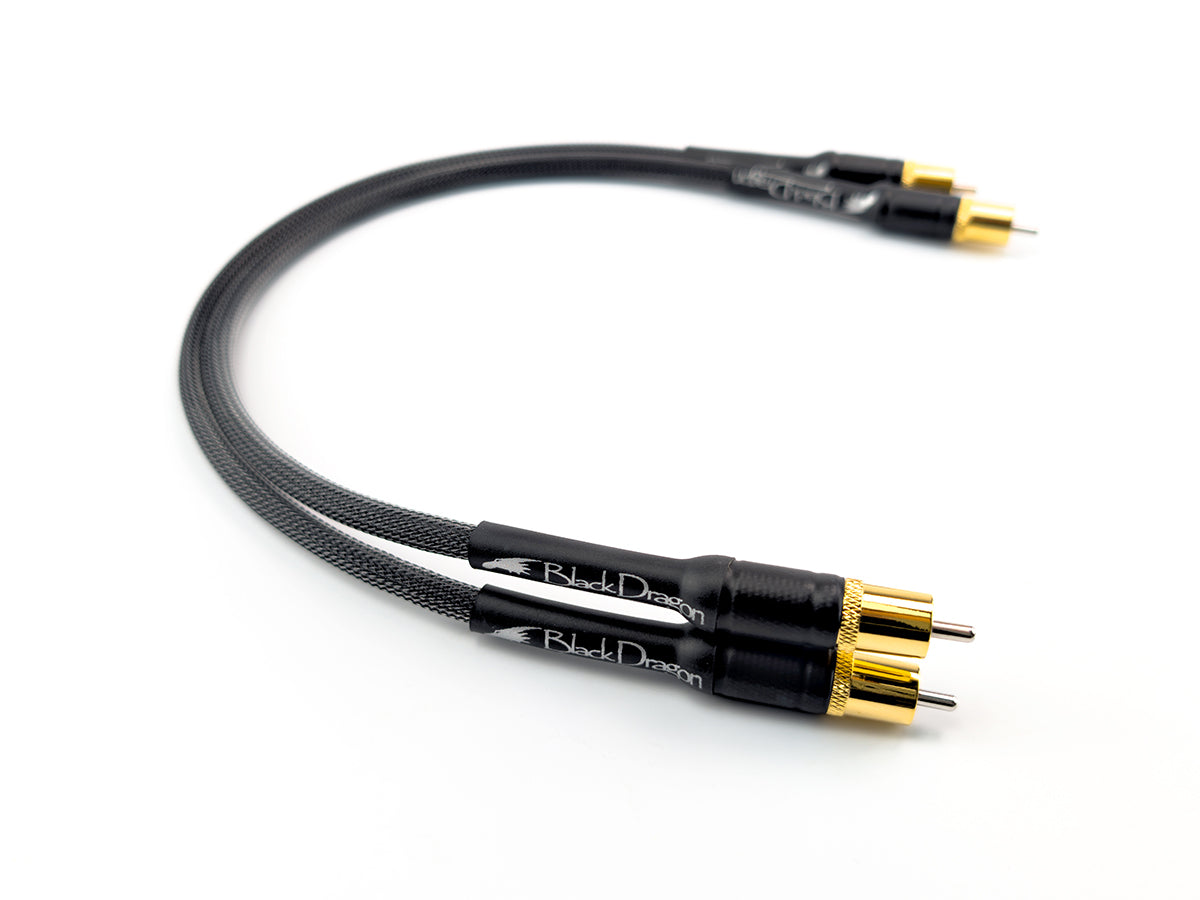
The objects are built to order in Cary. Many product pages require buyers to list the make, model and connection of their devices. Length, headphone connector, amplifier termination, premium hardware and rush assembly become options. The workflow is closer to ordering a suit than grabbing a USB cable at an airport kiosk.
What it costs, and what the price is doing
This is not bargain-bin hardware. Current examples show a Silver Dragon portable headphone cable at $235, a Silver Dragon USB cable at $315, a Black Dragon interconnect at $325 and a universal Silver Dragon headphone cable at $825. Premium, longer and device-specific configurations can move higher. A one-business-day rush build adds another fee.
Selected listed prices · August 2026
The cost buys more than conductor metal. It covers small-batch labor, many connector combinations, consultation and inventory knowledge. It also buys a story about refinement that the buyer must judge. In the audiophile cable market, audible differences are debated with unusual stamina. Moon Audio's claims about soundstage, tone and detail are the company's claims, not universal scientific agreement.
That tension is not a footnote to the business. It is the market. Enthusiasts may own revealing systems, trained ears and recordings they know intimately. Skeptics may see ordinary electrical requirements wrapped in luxurious language. Moon Audio has survived between them by being specific: conductor type, gauge, shielding, connector, compatible device and intended tonal direction are all on the page.
The store around the cable
The second half of the model is retail. Moon Audio carries specialist brands across the signal chain. A customer can arrive for a Focal headphone, add an amplifier or portable player, and leave with a Dragon cable terminated for the exact pair. The proprietary product earns differentiation; authorized retail expands the basket. Astell&Kern lists Moon Audio among its American dealers, while the store catalog spans dozens of names from Sennheiser and HiFiMAN to Chord Electronics and Meze.
The JH Audio relationship shows the professional edge. Moon Audio says it has made stock cables for JH Audio in-ear monitors as well as Dragon upgrades. Its client page connects those systems with monitor engineers and performers. The value in that setting is not decorative luxury. A touring rig needs secure fit, known terminations, repairability and someone willing to handle a weird request quickly.
Content completes the flywheel. Reviews bring shoppers searching for gear. Guides explain connections. Workshop videos make hand assembly visible. The Fidelity Exchange gives Drew access to mastering engineers, designers and industry operators, then turns those conversations into long-form education. By 2026, Moon Audio's YouTube channel showed roughly 36,000 subscribers - a substantial audience for a small private audio shop.
The culture follows the same logic. Team biographies do not stop at job titles; they list each person's preferred headphone, cable and source. That bit of retail theater is also useful routing. A customer interested in a Focal Stellia or a portable Sony player can see which employee lives near that taste. Engineers, cable builders, writers and video producers become named listeners rather than an anonymous support queue. For a founder-led company selling subjective improvements, personality is part of the warranty: the recommendation came from someone prepared to say what they use at home.
The part another niche business can copy
The transferable idea is not “sell silver cable.” It is to own the anxiety around a configurable purchase. Moon Audio asks for the customer's devices before accepting many orders. It explains the tradeoffs in the language enthusiasts use. It sells a proprietary component alongside every larger product the component touches. And it turns repeated support questions into searchable media.
A founder can copy the sequence: solve a problem in a hobby you already understand; sell the surplus before scaling; notice which custom requests recur; standardize those requests into named families; then publish enough practical guidance that the store becomes the reference desk. The method is especially effective where compatibility is messy, customer taste matters and a wrong purchase is expensive.
When the playbook will not work
- The underlying product is a commodity and customization adds no meaningful convenience.
- Customers cannot perceive, value or credibly test the promised improvement.
- The system is too modest, noisy or mismatched for the accessory to address its real bottleneck.
- Education becomes disguised promotion and the audience stops trusting the reviewer.
- Made-to-order complexity creates delays, errors or service costs that the margin cannot absorb.
Moon Audio is now old enough to expose the virtue of patience. It did not begin with venture funding, a mass-market gadget or a plan to “disrupt” listening. Publicly available information shows no institutional funding and the company does not disclose revenue. Its visible assets are more tactile: an 8,000-square-foot Cary operation, a compact team, a catalog of award-recognized cables, manufacturer relationships and an archive of explanations.
The company's deepest product may be certainty. The buyer knows which plug arrives, why the cable was recommended and who to call when an exotic headphone refuses to cooperate. That certainty is valuable in a hobby where one person's revelation is another person's expensive placebo. Moon Audio does not end the argument. It has built a durable business inside it.
Keep listening
Explore Moon Audio's workshop, catalog and conversations directly: