Michael Smith wanted an office with somewhere good to eat nearby. In 2011, the co-founder and chief executive of StreetEasy was shopping for more room, and the requirements were pleasingly particular: older buildings, open space, a neighborhood that still felt like New York. He was looking downtown. Union Square, he thought, had become too corporate. A company devoted to helping people choose a place to live had developed opinions about choosing a place to work.
“We care a lot about eating,” he said. It is a useful little window into a founder whose public story is usually compressed into an acquisition price. Smith helped build StreetEasy, then sold the business to Zillow for $50 million in cash in 2013. Before the deal, there were years of making a difficult city legible. There were also colleagues who needed desks, a room that suited them and, apparently, a respectable lunch.
An apartment conversation, with evidence
New York supplied StreetEasy with a subject that rarely needed introducing. People talked about apartments whether they were moving, staying put or simply enjoying someone else’s improbable rent. Smith recognized that appetite early. In February 2006, with the website still in beta, he described a city where real estate conversation was part of ordinary daily life. The opportunity was to give those conversations more useful information.
His professional background included Credit Suisse, where he had held responsibility for trading technology and telecommunications in North America. He came to residential search with experience of financial technology rather than a conventional brokerage career. That distinction helps explain the kind of company he went on to lead: a business organized around finding and examining information before a consumer contacted an agent.
Smith, Nataly Kogan and Douglas Chertok formed NMD Interactive in 2005; the name used their initials. Sebastian Delmont became the co-founder associated with its technology. Early accounts place StreetEasy’s first appearance around the turn of 2005 into 2006. By February, it was attracting roughly 2,000 visitors a day, Smith said, despite having done no marketing. He was already talking about deeper information on buildings and the process of buying in New York.
There is something revealing about that early priority. A property website could add another map, another location or another set of photographs. Smith was interested in making the existing listing more informative. For a buyer, the listing is an invitation to ask questions. The business depended on how many useful answers could sit beside it.
One address. Several better questions.
The city went up. The software had to follow.
An apartment building makes a peculiar database problem. A street address can contain many homes, each with its own asking price and transaction history. Knowing what happened upstairs may be more illuminating than knowing what happened several blocks away. New York’s density made the building itself a useful unit of investigation. A service that understood only the address would miss much of the story.
Delmont’s colleagues later credited him with developing a platform suited to those vertical buildings. That engineering belongs in Smith’s story because the company’s distinctiveness was collective. The CEO could choose the direction; the product still needed people who could make the city’s untidy particulars behave on a screen. Real estate has always been good at producing paperwork. Making that paperwork useful to a stranger is another occupation.
Sofia Song, who joined in 2007, became closely associated with StreetEasy’s research and communications. Her work helped put the company into the conversations of brokers, journalists and buyers. Smith was leading a business whose credibility required more than an attractive interface. Information had to withstand attention from people who knew the buildings and had money riding on the answer.
The features reflected the lives of its audience. Searches could account for subway access and school zoning. Shoppers could save their investigations and return to them. These are modest conveniences to describe, but an apartment decision is made of such particulars. A home can look wonderful until the morning journey begins. A useful product anticipates the less photogenic questions.
A business people could look things up in
StreetEasy’s early relationship with the brokerage industry was uneasy. It assembled listings and made information easier for the public to inspect, changing who could arrive at a conversation already informed. Yet the audience included professionals, too. Brokers could use the service to research properties and bring listings to potential customers. Over time, major firms began supplying data directly.
By 2011, StreetEasy was operating with a small staff and several sources of income: advertising, promoted listings and subscriptions. Its free browsing audience sat alongside users willing to pay for more information or professional tools. The arrangement gave Smith a practical task beyond publishing data: keep the service useful to the people searching while finding things that the professional side would buy.
That balance matters in any account of the founder. Transparency was a product promise, and the product needed revenue. StreetEasy could be valuable to a consumer because information was easy to access, and valuable to a broker because consumers were there. Those interests could overlap without becoming identical. Building the company meant keeping enough of both groups involved.
As the team grew, its office needs became less theoretical. StreetEasy eventually took a 7,500-square-foot space on Crosby Street in Soho. The earlier search had been an unusually candid expression of Smith’s tastes. The eventual move gave the company a room of its own in the sort of downtown setting he had wanted.
“We care a lot about eating.”
Michael Smith · on StreetEasy’s office search, 2011
The price of a local habit
On Sunday evening, August 18, 2013, Smith gathered StreetEasy employees in the company kitchen. Zillow was buying the business. The announcement became public the following day. The setting is wonderfully domestic for a transaction of that size: a company that helped people find homes heard about its own change of ownership in the kitchen.
Zillow agreed to pay $50 million in cash. StreetEasy had 34 employees and nearly 1.2 million monthly unique users. Those figures describe the company at the time of the deal, rather than some later version of the brand. The transaction closed on August 28. Smith had carried the business from its early New York operation into ownership by a national real estate company.
Cash paid by Zillow for StreetEasy
The strategic logic was geographical. Zillow had a broad national business; StreetEasy had developed a recognized service in a market where national reach had not supplied all the answers. Smith’s company brought a local audience and working relationships with New York brokerages. Its value was bound up with having become a familiar place to investigate unfamiliar apartments.
On August 19, Smith and Zillow chief executive Spencer Rascoff marked the occasion at Nasdaq’s opening bell. The celebration moved a business built around individual apartments onto the screens of Times Square. It was a public milestone for a team whose ordinary work involved much smaller details.
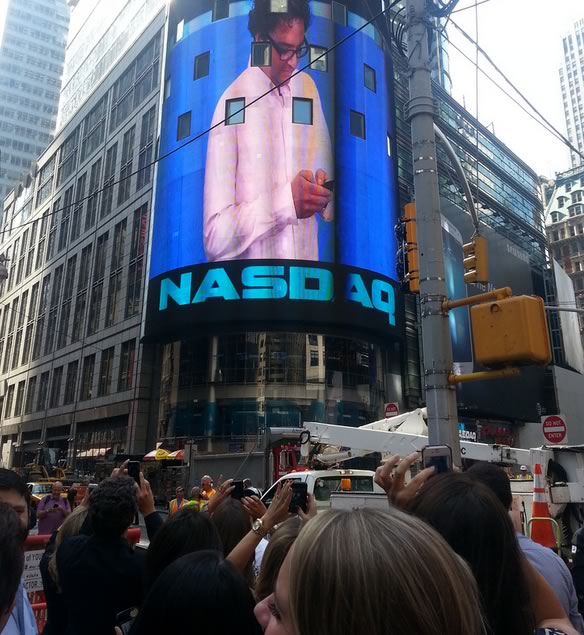
A second meeting in the kitchen
The celebration and the leadership transition arrived close together. In late September, employees assembled again, and Smith announced that he would cease being CEO and become chairman. Susan Daimler, general manager of Zillow New York, assumed operational leadership. The sale and the change in Smith’s job were separate events, even though they occupied the same short stretch of the company’s life.
More senior departures followed, including Song’s and, in early 2014, Delmont’s. The business kept its name while its leadership changed. For Smith, the company he had run was entering a period directed by other people. A sale can be a clear achievement and still leave a complicated next chapter. There is no need to invent his private reaction to recognize the scale of that change.
Smith’s chairmanship ran through 2014. His later work returned to a familiar category of human difficulty: deciding where to go. In 2015, he became CEO of String Discovery & Messaging, which he founded with Ari Horowitz, formerly chief executive of BlackBook Media. Apartments gave way to restaurants, hotels and other places people might want to experience.
After the apartment, somewhere to go
String combined discovery with messaging, recommendations and access to hospitality expertise. Smith argued for recommendations shaped by personal preferences and trusted connections. There is a recognizable continuity with StreetEasy: people do not merely need a larger pile of possibilities. They need a way to judge which ones fit the decision in front of them.
String was a project of Tribeca Heavy Industries, where Smith has been identified as managing partner. The firm describes its activities as building, consulting with and investing in businesses. The later venture extended the place-based interests visible in his StreetEasy years, though choosing dinner and choosing a home plainly carry different consequences.
His own property also brought him back into public real estate news. In December 2024, McDonald’s litigation alleged that his Tribeca penthouse expansion occupied roof space covered by the chain’s equipment rights. It sought roof restoration and at least $10 million. Smith had maintained that the renovation received board approval; he also raised a limitations defense in related litigation. These were contested claims, rather than findings that the expansion was unlawful.
The more enduring contribution of Smith’s StreetEasy years sits in an ordinary action: looking something up before deciding. A price beside a photograph is a starting point. A building, its history and the neighborhood around it give that price some company. Smith helped build a business around the extra questions. When it came to his own office, he had a few of those himself. Including where to eat.